Buying Guide
The best studio keyboard stands are not interchangeable. A narrow single-tier support solves a different problem from a three-tier rig or a tabletop workstation. Start by listing the instruments and accessories that must fit at the same time. Then compare the documented load rating, adjustment range, footprint, and protection features rather than choosing by frame style alone.
Choose the right configuration
A single-tier stand is appropriate when one keyboard is the main instrument and the surrounding studio already has desks, shelves, or accessory mounts. The GrowDaily Z-Style Keyboard Stand with Wheels is the clearest selected example, with height and width adjustment, wheels, straps, buckles, and padded contact areas. The GrowDaily model is designed for one keyboard, so it leaves less room for a second instrument or separate production surface.
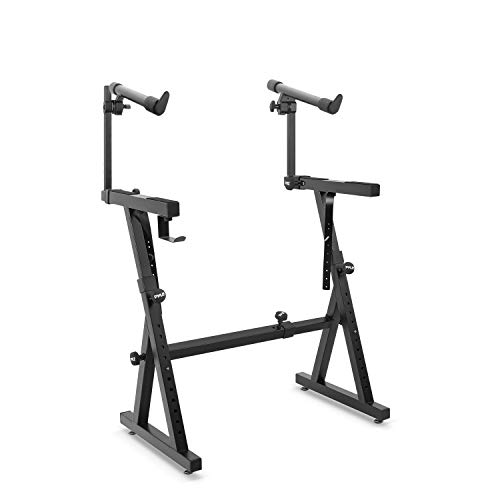
A dual-tier stand is useful when two instruments must remain available without occupying two separate floor positions. The STRICH Dual Piano Keyboard Stand emphasizes low listed weight and foldability, while the Fiada 2-Tier Double X Keyboard Stand uses a double-X structure with a raised upper tier and quick folding. The Pyle PKST2TZ Z-Style 2-Tier Stand adds a removable second tier, making its layout more configurable. Check the upper-tier capacity carefully: a secondary controller or compact keyboard may fit even when a heavier instrument does not.
Three-tier stands target larger rigs. The Gator Frameworks 3-Tier A-Frame Keyboard Stand and OnStage KS7903 Three-Tier Keyboard Stand both document support for three keyboards. Gator lists a 210-pound total capacity and broad arm adjustment. OnStage specifies the current price per tier and independent support-bar, height, and tilt adjustment. These stands can save floor space, but they need enough room above and around the instruments for comfortable access.
Match capacity to the actual rig
Treat a stated overall capacity and an individual platform capacity as different specifications. Pyle lists the current price overall and the current price for its platform, while STRICH lists the current price for the upper tier and the current price for the lower tier. Those distinctions matter when a heavier keyboard is placed above a lighter controller. A high total figure does not automatically mean every level has the same rating.
The Liquid Stands MS1111 Keyboard Workstation and GrowDaily Z-Style Keyboard Stand with Wheels each list a 250-pound capacity. The AxcessAbles Keyboard Stand with Steel Tabletop lists the current price, and the AxcessAbles Dual Keyboard Stand with Tabletops lists the current price. These figures are useful for comparison, but the listing data does not establish how a particular instrument distributes weight across the stand. Confirm the instrument’s dimensions and the manufacturer’s placement guidance before loading it.
The OnStage KS7903 has a different capacity format: the current price per tier for three tiers. That makes the individual instrument limit especially important. The Fiada listing does not provide a specific total load figure, so its rating should not be inferred from the metal construction or dual-tier format.
Prioritize adjustment range
Height adjustment affects whether the stand works for seated playing, standing production, or both. GrowDaily spans 22 to 37 inches, Liquid Stands MS1111 spans 26 to 36.5 inches, and the AxcessAbles Keyboard Stand with Steel Tabletop spans 26.25 to 37.5 inches. Fiada covers approximately 27 to 37 inches. Wider ranges provide more setup options, but the correct choice still depends on the keyboard’s own height and the user’s bench or chair.
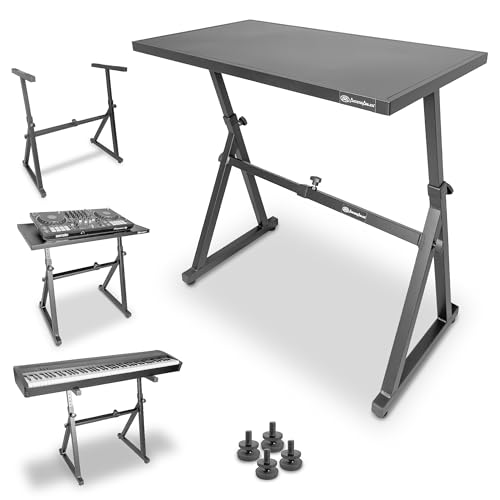
Width and depth are equally important. A stand may support a 54- or 88-key instrument while still requiring enough support surface for its chassis. Gator specifies adjustable width and arm depth, while Liquid Stands MS1098 Expandable DJ Table Stand expands its tabletop from 32 to 43 inches. For a workstation, compare the usable surface with the footprint of the mixer, controller, or computer equipment you plan to place there.
The Pyle PKST2TZ provides independent second-tier height, depth, and angle adjustment. OnStage allows independent support-bar, height, and tilt adjustment on each tier. These details are more useful than a general statement that a stand is adjustable because they indicate which parts of the setup can be tailored separately.
Decide whether wheels help
Wheels are useful when a studio layout changes frequently or when a loaded setup must be repositioned. The Liquid Stands MS1111 Keyboard Workstation uses 3-inch locking wheels, and the GrowDaily Z-Style Keyboard Stand with Wheels includes wheels. The MS1111 also includes security straps and a headphone hook, giving it additional workstation utility. By contrast, a fixed-foot design may be preferable when the stand should remain in one playing position.
When comparing rolling models, look for a locking mechanism and floor-contact features. The supplied evidence identifies locking casters on the Liquid Stands MS1111 and non-slip or adjustable feet on several other selected models. It does not provide hands-on information about rolling resistance, so placement on the intended floor and careful load positioning remain important.
Consider folding and storage
Folding matters when the same room serves as a studio, rehearsal space, or performance area. The Pyle PKST2TZ folds into a compact Z shape, the OnStage KS7903 folds for load-in and storage, and the Fiada 2-Tier Double X Keyboard Stand has a quick-fold design. The STRICH model documents a volume reduction of more than 50 percent when folded and a listed weight of 5.8 kilograms.
The heavier workstation formats trade some carrying convenience for surfaces and hardware. The Liquid Stands MS1111 is listed at the current price, the Liquid Stands MS1098 at the current price, and the AxcessAbles Dual Keyboard Stand with Tabletops at the current price. Those figures do not determine ease of use in every room, but they help distinguish portable support frames from substantial workstation equipment.
Look for instrument protection
Non-slip feet, rubber caps, straps, locking pins, and padded contact surfaces address different risks. Gator lists locking safety pins and non-slip rubber feet. Fiada includes locking straps and adjustable non-slip feet. GrowDaily lists anchoring straps, buckles, sponge padding, and non-slip contact pads. STRICH specifies EVA foam padding on the top tier and non-slip foot pads.
These features can help keep an instrument positioned, but the supplied listing data does not establish performance under impact or movement. Use the documented hardware as a checklist, and verify that straps or pads will contact the instrument in a suitable location without interfering with controls or ventilation.
Final recommendation
Gator Frameworks 3-Tier A-Frame Keyboard Stand ranks first overall in this specification-based comparison under the published weighted criteria.
Gator Frameworks 3-Tier A-Frame Keyboard Stand is the first overall specification-based choice among the best studio keyboard stands because it combines three keyboard positions, a 210-pound total capacity, extensive adjustment, locking safety pins, and non-slip feet. For a rolling production workstation, Liquid Stands MS1111 Keyboard Workstation is an alternative with locking wheels, accessory mounting points, straps, and a 250-pound stated capacity. OnStage KS7903 Three-Tier Keyboard Stand is a sensible three-tier option when independent tier adjustments and a foldable frame matter most.
For a lighter dual-tier setup, STRICH Dual Piano Keyboard Stand documents the most transport-focused design, while Pyle PKST2TZ Z-Style 2-Tier Stand offers a removable second tier and a compact folding frame. Choose the AxcessAbles Keyboard Stand with Steel Tabletop or Liquid Stands MS1098 Expandable DJ Table Stand when a broad work surface is more important than narrow keyboard supports. The top studio keyboard stands ultimately differ by rig layout, so capacity, dimensions, and protection hardware should decide the final fit.
Frequently Asked Questions
What should I check before buying one of the best studio keyboard stands?
Confirm the keyboard’s width, depth, and weight, then compare those figures with the stand’s documented adjustment range and capacity. For dual- or three-tier models, check each tier separately rather than relying only on an overall capacity. Also decide whether you need straps, padding, wheels, a tabletop, or a headphone hook.
Are dual-tier stands suitable for two full-size keyboards?
Some selected models are designed for that use, but the evidence varies. STRICH documents compatibility with 54- to 88-key instruments, while Fiada describes support for two keyboards and Pyle provides a removable second tier. STRICH’s upper tier is listed at the current price, so a heavier second keyboard may not be appropriate. Always compare the upper-tier rating with the actual instrument weight.
Is a Z-style stand better than an X-style stand?
Neither design is universally better. The selected Z-style models provide broad support surfaces or workstation layouts, while the selected X-style models emphasize folding and portability. Liquid Stands MS1111 and Liquid Stands MS1098 use workstation-oriented formats; Fiada and Pyle provide multi-level arrangements. Choose based on the needed surface, height, load, and storage method.
Do keyboard stands need locking straps?
Straps can add a way to secure the instrument, but they are not present on every selected model. Gator uses locking safety pins, while Fiada and GrowDaily list straps or buckles. The supplied data does not prove that any feature prevents movement in every situation. Use the documented hardware according to its instructions and keep the stand on a suitable, level surface.
Should I buy a rolling keyboard stand for a home studio?
A rolling model can help when the setup must move between work areas. Liquid Stands MS1111 includes locking wheels, and GrowDaily is offered with wheels. If the stand will remain in one location, fixed feet may offer a simpler arrangement. Consider the stand’s listed weight, available floor space, and whether the wheels can be locked before selecting a rolling design.
How many tiers do I need?
Use one tier for a primary keyboard, two tiers for two instruments or a keyboard plus compact gear, and three tiers for a larger rig. The selected Gator Frameworks and OnStage models document three-tier layouts, while Pyle, STRICH, Fiada, and AxcessAbles provide dual-tier options.