Buying Guide
Choosing the best heavy-duty pipe cutters starts with identifying the pipe material and the outside diameter you actually need to cut. A cutter designed for steel pipe is not automatically suitable for PVC, PEX, or rubber hose, and a large nominal capacity does not mean every wall thickness or pipe schedule is supported. The products above fall into three practical groups: wheel-style metal cutters, compact or chain cutters for restricted access, and ratcheting shears for plastic pipe.
Match the cutter to the pipe material
For steel, stainless steel, galvanized, iron, copper, brass, and aluminum, look first for explicit material language rather than relying only on the word “heavy-duty.” The RIDGID 32820 Model 2-A specifically lists stainless steel, steel, and heavy-wall steel. The RIDGID 32870 Model 42-A is identified as a steel pipe cutter. Godora lists galvanized and iron pipe, while MECHCLAW documents copper, brass, iron, aluminum, and stainless steel with stated wall-thickness limits.
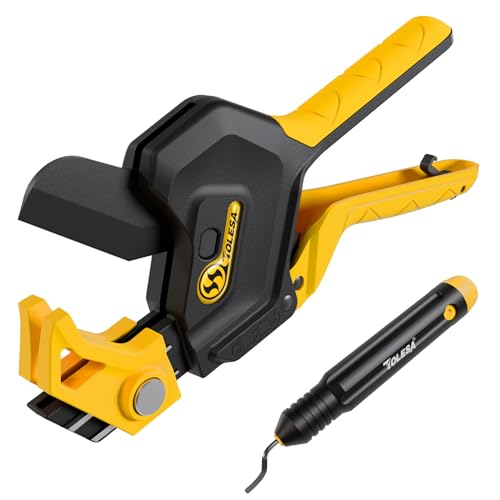
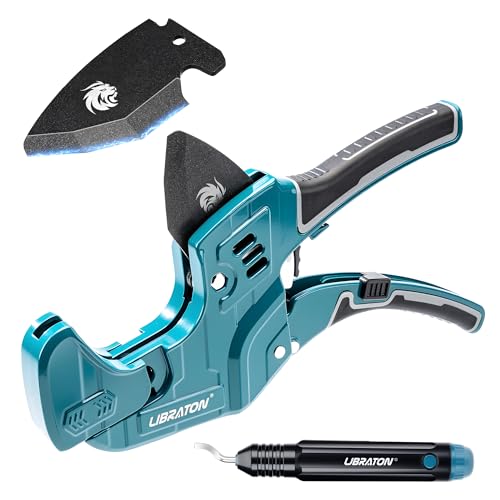
Plastic pipe requires a different cutting action. SHALL, TOLESA, and LIBRATON use ratcheting mechanisms with V-shaped or pointed blades for PVC-family materials, PEX, PE, PP-R, and rubber hose. These tools are not presented as substitutes for steel-pipe wheel cutters. If your work spans both metal and plastic, a mixed-material tubing cutter or a set with separate tools may be more appropriate than a single plastic shear.
Check the outside-diameter range
Capacity is one of the most important specifications. The RIDGID 32820 covers 1/8 inch to 2 inches, while the RIDGID 32870 covers 3/4 inch to 2 inches. Godora reaches 3 inches, and QWORK extends to 3-1/4 inches for tubing and exhaust-oriented repairs. MECHCLAW covers 3/16 inch to 2 inches, with material-specific wall-thickness guidance.
Plastic models generally reach up to 2-1/2 inches. SHALL, TOLESA, and LIBRATON all document that maximum outside diameter, while HORUSDY combines a 1/4-inch to 2-inch main cutter with a smaller tool for 1/8-inch to 7/8-inch tubing. Remember that outside diameter is not interchangeable with nominal pipe size.
A conventional cutter needs room to rotate around the pipe. If the pipe is installed near a wall, inside an engine bay, or under a vehicle, that requirement may be the deciding factor. The RIDGID 32870 is specifically intended for areas where a complete turn is impossible and uses a short handle. QWORK uses a chain linked to multiple cutting wheels and is designed for under-vehicle and cramped repairs. The compact cutters in the HORUSDY and TOLESA sets can also address smaller tubing in narrow spaces.
Long handles and larger frames can be useful when reach or leverage matters, as with the RIDGID 32820 and Godora. They may be less convenient in a crowded installation. Before buying, compare the tool’s length and operating motion with the clearance around the pipe, not just the listed diameter range.
Look at adjustment and cutting control
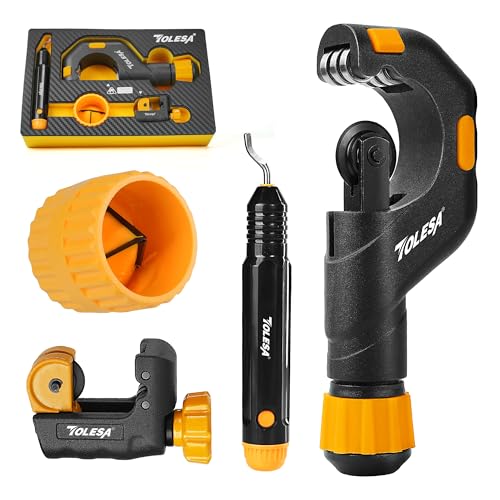
Wheel-style cutters typically advance a cutting wheel as the tool is rotated around the pipe. Ball-bearing rollers can help maintain contact and alignment; MECHCLAW lists dual rows of rollers, while TOLESA’s metal set lists six ball-bearing rollers. Godora specifies a steel ball thrust bearing feed mechanism. These details are relevant when you want a controlled feed rather than a loose or shifting tool.
Ratchet cutters use incremental handle movement instead of requiring a full revolution. SHALL, TOLESA, and LIBRATON document adjustment features that help position the blade for different plastic diameters. A V-shaped blade can help start a cut, but the supplied guidance still emphasizes keeping the blade perpendicular. TOLESA also advises scoring thin PVC before completing the cut, which is a useful handling detail rather than a guarantee of results.
Decide whether a set is worthwhile
A single cutter is simpler to carry and faster to select when one size and material dominate your work. A set can make more sense for service technicians, remodelers, and maintenance users who encounter several tubing sizes. The TOLESA, HORUSDY, and other set configurations include mini cutters, deburring tools, reamers, or storage cases.
Deburring matters because cutting can leave sharp edges. HORUSDY includes an inner-outer reamer, while the TOLESA metal set combines cutting with deburring and reaming. These accessories do not expand the cutter’s capacity, but they can make a kit more useful when the next task is preparing the pipe end. Check whether the included tool is appropriate for your material and whether replacement blades are available.
Review blade and body maintenance
Replaceable blades can extend a cutter’s usable life, but they also create an ongoing consumable cost and require correct replacement. MECHCLAW lists a replaceable alloy-steel blade.
Body material is another trade-off. Aluminum-alloy and die-cast aluminum designs can reduce bulk while providing a rigid frame, as documented for MECHCLAW, SHALL, and TOLESA. Steel construction, as documented for the RIDGID models, suits a more traditional heavy-duty format. QWORK’s listing recommends lubricating its wheels to maintain smooth rotation. Use the manufacturer’s care instructions and do not infer unlimited service life from a material label alone.
How this comparison was scored
The ranking uses only supplied listing evidence. Capacity range receives 25 percent because the usable diameter window determines whether the tool fits the job. Material compatibility receives 20 percent, confined-space access 20 percent, cutting control 20 percent, and durability and maintainability 15 percent. No editorial criterion uses ratings, current listing information, purchase activity, or marketplace labels. This is a specification-based comparison, not a hands-on test.
Final Recommendation
QWORK Exhaust Pipe Cutter ranks first overall in this specification-based comparison under the published weighted criteria.
RIDGID 32820 Model 2-A is the first overall specification-based choice among these best heavy-duty pipe cutters for users who prioritize broad metal-pipe coverage, explicit heavy-wall compatibility, and a substantial long-shank format. It is not the right fit for every installation: the RIDGID 32870 Model 42-A is better suited to restricted steel-pipe access, while Godora is the stronger documented choice when a 3-inch metal-pipe capacity is important.
For plastic work, the SHALL PVC Ratchet Pipe Cutter, TOLESA PVC Ratchet Pipe Cutter, and LIBRATON 2-1/2-Inch Ratchet PVC Cutter each provide a stated maximum of 2-1/2 inches with different adjustment details. HORUSDY is the more complete kit choice when a mini cutter and reaming tools are useful. MECHCLAW and the TOLESA Heavy-Duty Pipe Cutter Set make stronger sense for mixed metal-tubing tasks, and QWORK stands out for chain-style cutting around vehicles or other tight locations. These are the top heavy-duty pipe cutters in this comparison because their documented formats address distinct materials, diameters, and access conditions rather than because of customer sentiment.
Frequently Asked Questions
What should I check first when choosing the best heavy-duty pipe cutters?
Check the pipe’s material, outside diameter, wall thickness where relevant, and the space available for operating the tool. A steel wheel cutter, a plastic ratchet cutter, and a chain cutter solve different access and material problems.
Are ratchet pipe cutters suitable for steel pipe?
The selected ratchet models are documented for PVC, CPVC, PP-R, PEX, PE, rubber hose, and related plastic tubing. The supplied evidence does not establish them as steel-pipe cutters. For steel, use a product whose listing specifically identifies steel, such as the RIDGID 32820 Model 2-A or RIDGID 32870 Model 42-A.
Is a larger capacity always better?
No. A larger maximum may be useful for bigger pipe, but a cutter can be awkward if the job has limited clearance. Capacity also needs to match outside diameter and, for some metal tubing, the stated wall-thickness limits.
A set can provide multiple size ranges and accessories for deburring or reaming. HORUSDY, TOLESA, and similar selected kits are useful when work varies, but a single cutter may be easier to carry and maintain for repetitive jobs.
How can I improve cut preparation?
Keep the blade perpendicular to the pipe and follow the product’s adjustment guidance. After cutting, use an included deburring tool or reamer when appropriate. For thin plastic pipe, TOLESA and related listings advise scoring or rotating the pipe before completing the cut to help reduce cracking.