Buying Guide
The best heavy-duty strength training pull-up bars are not interchangeable. A wall-mounted bar transfers workout forces into a wall, beam, joist, or studs. A doorway bar relies on the frame and contact points. A freestanding power tower uses its own base and floor area. Start by identifying the structure available in your workout space, then compare the documented capacity and adjustment range.
Choose the mounting type first
Wall-mounted bars are the clearest choice when you have a suitable structural surface. ECOTRIC specifies concrete-wall mounting and offers vertical or horizontal setup, while Fitarc identifies studs, joists, beams, and solid concrete as acceptable surfaces. SELEWARE is similarly oriented toward studs, joists, beams, doorways, or concrete. These products can leave more open floor area than a tower, but installation is not a drywall-only project.
A wall-mounted station may also provide more open movement space. ECOTRIC lists 33 1/4 inches from the wall, and Jusgym offers 19- or 27-inch depth settings. More clearance can be useful for exercises that need the body farther from the wall, but it also increases the space you must reserve around the equipment.
Doorway bars are more convenient when drilling is undesirable or the equipment must be removable. KAKICLAY documents a 21.65- to 36.22-inch fit, multiple grip positions, suspension straps, and a foldable design. These features can help in compact rooms, but the frame must still be structurally sound and able to withstand the load and exercise stress. Measure the usable opening, trim depth, and condition of the frame before relying on any doorway model.
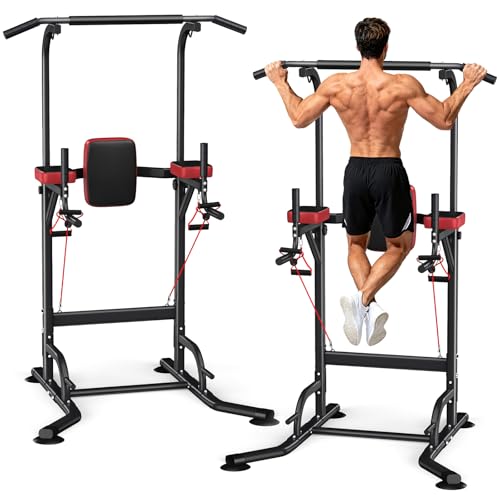
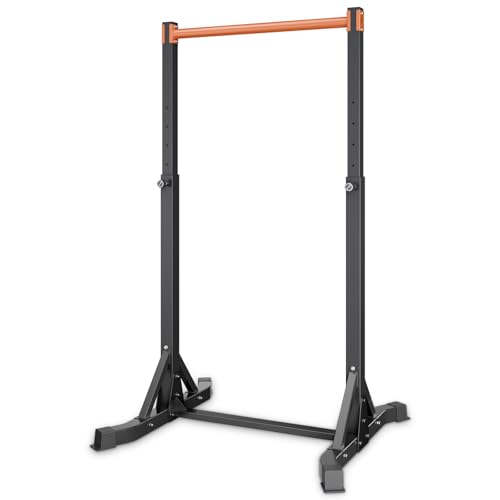
Freestanding towers avoid wall attachment altogether. Dskeuzeew and Leasbar provide pull-up functions in standalone formats. They need floor space and careful assembly, but their height settings can be useful for households with multiple users.
Compare capacity with the installation structure
A stated capacity is only one part of the decision. The selected listings range from 330 to the current price, but the supporting wall, beam, doorframe, or floor must also be appropriate. ECOTRIC, Jusgym, and Leasbar list the current price. Dskeuzeew lists the current price, while Fitarc, Kipika, and OneTwoFit list the current price. VEVOR lists the current price.
Do not treat these figures as a substitute for installation guidance. OneTwoFit recommends concrete or brick and says not to use drywall, plaster walls, or cavity walls. Fitarc gives a specific 32- to 36-inch stud-spacing requirement. Kipika describes solid-wall or wood-beam installation. These details can eliminate a product even when its capacity looks suitable.
Match grips and exercises to your routine
A straight bar may be enough for standard pull-ups and chin-ups, but multiple grips can support more exercise variation. Kipika documents five grip positions, including ball-finger training. KAKICLAY documents multiple angled and close-grip options and includes suspension straps. Fitarc adds two neutral grips, while SELEWARE provides suspension hooks and connecting buckles.
For a broader bodyweight setup, consider a product that independently documents dips, knee raises, push-ups, or core work. OneTwoFit is a wall-mounted pull-up and dip station with padded back and arm supports. The freestanding towers from Dskeuzeew and Leasbar also document dips and knee raises. VEVOR emphasizes wide, narrow, and neutral grips plus leg raises.
Check adjustment and clearance
Height adjustment matters when users differ in stature or ceiling space is limited. Dskeuzeew lists 13 positions from 72 to 87.8 inches. VEVOR lists eight positions from 60.5 to 85.8 inches, while Leasbar documents 10 height settings. Other products use fixed wall or doorway dimensions, so their fit depends more on the installation surface.
Also check the motion area, not just the product dimensions. Jusgym’s two depth choices and ECOTRIC’s deep wall clearance address different movement needs. For doorway bars, verify that the bar, hands, and body will not interfere with the door, nearby walls, or ceiling.
Review installation and storage demands
A practical installation plan should include the surface, hardware, tools, and space for assembly. Wall bars generally need drilling and structural attachment. Doorway bars may install without drilling but still require a sound frame and correct placement. Freestanding towers require assembly and a stable, level area.
Storage is another differentiator. KAKICLAY is designed with a foldable doorway format and can be stored when the opening is needed. Towers are less convenient to relocate after assembly because their bases occupy a dedicated footprint.
Final recommendation
Leasbar 500-pound Adjustable Power Tower ranks first overall in this specification-based comparison under the published weighted criteria.
Leasbar 500-pound Adjustable Power Tower is the first overall specification-based choice among the best heavy-duty strength training pull-up bars because it combines a documented 500-pound capacity, rigid alloy-steel construction, a splayed anti-tipping base, 10 height settings, and a five-level adjustable backrest. ECOTRIC is the stronger alternative for deep-clearance wall mounting, while Jusgym is useful when adjustable depth and steel rings matter. Choose Kipika for grip-focused work, SELEWARE for beam or joist mounting, and KAKICLAY when doorway fit and foldable storage are central constraints. For freestanding training, Leasbar and Dskeuzeew offer the broadest documented capacity and adjustment combinations among the top heavy-duty strength training pull-up bars.
Frequently Asked Questions
How should I choose among the best heavy-duty strength training pull-up bars?
Start with the available structure. Choose a wall-mounted model only when the wall, studs, beam, or joists match its documented requirements. Choose a doorway model when the frame dimensions and condition are appropriate. Select a freestanding tower when drilling is not practical and you have enough floor space.
Is a 500-pound capacity automatically better?
No. A higher listed capacity can be useful, but it does not remove the need for correct installation. ECOTRIC, Jusgym, and Leasbar list the current price, while VEVOR lists the current price and offers extensive height adjustment. The best choice depends on the stated limit, structural fit, movement clearance, and exercise design together.
Which selected bar is best for multiple grip styles?
Kipika documents five grip positions, including a ball-finger grip. KAKICLAY documents multiple angled and close-grip options, and VEVOR lists wide, narrow, and neutral grip space. Compare the grip types with your training goals rather than counting handles alone.
Are doorway pull-up bars suitable for renters?
They may be, because KAKICLAY uses a doorway format with silicone protectors and can be folded for storage. However, a doorway bar still applies force to the frame. Check the opening dimensions, trim, wall construction, and manufacturer restrictions before use.
Do freestanding towers need to be anchored?
The supplied listings describe bases, anti-slip feet, suction cups, or anti-tipping structures, but they do not establish a universal anchoring requirement. Assemble the tower exactly as directed, place it on an appropriate level surface, and follow the product’s stated safety and capacity guidance.