Buying Guide
The best heavy-duty utility knives are not all built around the same blade format. A wide snap-off knife favors deep, forceful cuts; a retractable model emphasizes adjustable exposure and storage; and a folding knife prioritizes carry and compact storage. A fixed carpet or hook knife is a specialist option for flooring and other flexible materials. The right choice depends on the material, cutting frequency, and level of blade control you need.
For thick cardboard, drywall, rubber, rope, laminates, and other demanding materials, a wide 25mm snap-off blade is the largest documented format in this comparison. The OLFA XH-1 and HAUTMEC HT0250-KN both use 25mm blades and list broad heavy-duty applications. Their snap-off segments let you expose a fresh edge without replacing the entire blade.
An 18mm snap-off blade is a balanced choice when you want useful cutting capacity without the broader feel of a 25mm body. The narrower format can be preferable for controlled cardboard cuts, craft work, or situations requiring more maneuverability.
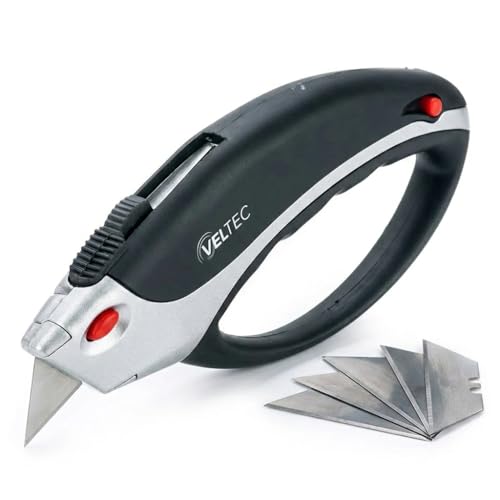
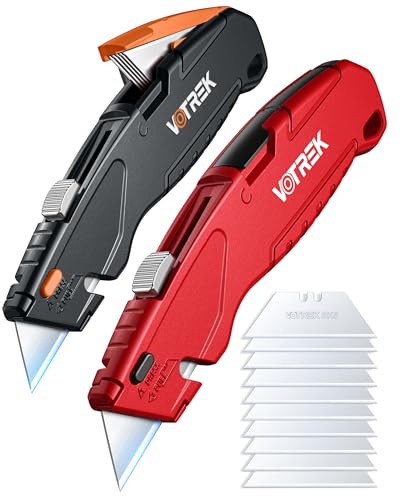
Retractable knives suit users who want adjustable blade exposure and a blade that can be withdrawn into the body. WORKPRO Premium, VOTREK, and Veltec all document retractable systems. VOTREK adds a safety-lock mode, while Veltec documents three positions. WORKPRO Premium uses three adjustable positions and includes extra blades. These designs can be easier to adapt between shallow carton cuts and deeper material cuts, but the available evidence does not establish that any one mechanism performs better in hands-on use.
Folding knives are useful when compact storage or carry matters. The Fiskars Pro folds for storage and documents one-handed opening, while the WORKPRO folding designs include belt clips and quick-change mechanisms. Folding construction can keep the blade enclosed when stored, but users should still verify that the lock is fully engaged before cutting.
Match blade control to the task
A secure lock matters because it keeps the blade at the selected exposure during a cut. The OLFA L-5 and XH-1, HAUTMEC, and OLFA L-1 use ratchet-style control with custom blade positions. This arrangement is useful when the material thickness changes or when you want a particular exposure rather than only fully open and closed settings.
Automatic or click locks are simpler. These mechanisms may appeal to users who prefer a direct adjustment process. VOTREK is more flexible because it documents both retractable and safety-lock modes.
Folding models use a different safety approach. Fiskars documents dual locks, while Klein Tools FLICKBLADE documents two locking positions: one angled for precision tasks and one standard position. Klein’s second role as a scraper also makes it suitable for jobs where removing residue is part of the workflow, provided the scraper function is relevant to your needs.
Consider handle construction and grip
Heavy cutting places more emphasis on the handle than a basic carton opener does. The OLFA XH-1, OLFA L-5, and HAUTMEC use fiberglass-reinforced handles or equivalent reinforced construction, with rubber grip features documented for the first two and HAUTMEC. These details support control and durability in the listed applications, although they should not be treated as proof of tested long-term performance.
Metal-body designs offer another approach. WORKPRO Premium uses aluminum alloy and a powder-coated finish; VOTREK documents an aluminum-alloy design; DEWALT DWHT10038 uses a heavy-duty metal body described as rust resistant; and Fiskars Pro uses full-body metal construction. These models may suit users who prefer a rigid body, while lighter designs can be easier to carry.
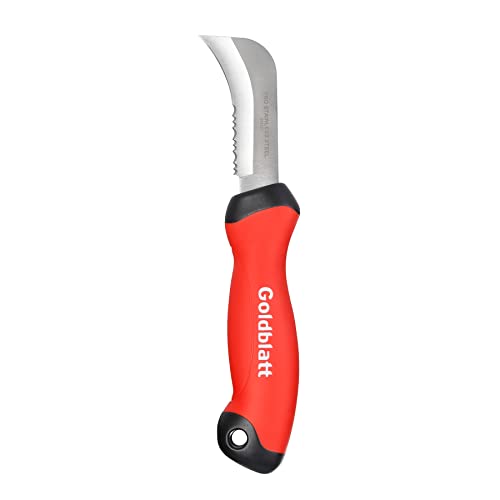
Grip details also vary. Veltec documents an ergonomic non-slip grip, Klein lists an aluminum body but does not provide a detailed handle material description, and Goldblatt uses a soft-grip handle with a matte anti-slip design. For carpet and flooring work, Goldblatt’s handle and fixed blade are paired with a specialty geometry rather than the adjustable blade exposure found on the other styles.
Check replacement-blade logistics
Snap-off knives refresh the edge by removing a used segment. OLFA and HAUTMEC explicitly document segmented blades, and DEWALT lists eight cutting points. This can be convenient for repeated cutting, but replacement blades still need to match the knife’s size and compatible format.
Quick-change systems are useful when you want to replace the whole blade quickly. WORKPRO Premium documents a quick-release button and includes 10 extra blades. VOTREK documents tool-free replacement and stores four razor blades plus two hook blades inside the body. Veltec documents quick-change loading and five reversible SK5 blades, including one installed blade and four stored replacements. Fiskars documents quick blade replacement and compatibility with its CarbonMax system.
Klein Tools FLICKBLADE uses universal utility blades and stores an additional blade in the body. That can make sourcing simpler, but the supplied evidence does not specify a larger storage capacity. Goldblatt’s fixed specialty blade is the least flexible for replacement because the product is built around a particular carpet and hook-knife role.
Think about portability and storage
A pocketable or folding model may be preferable for mobile work. WORKPRO Premium lists a lightweight 3.2-ounce body and dimensions intended to fit in a back pocket. Fiskars folds to a stated 4.5-inch size, and the WORKPRO folding designs include belt clips. These features support carry and storage, but a compact form should not be confused with a higher cutting capacity.
For a toolbox or stationary workshop, a broader snap-off model may be more practical than a folding knife. The OLFA XH-1, HAUTMEC, and OLFA L-5 emphasize handle control and blade positioning for demanding work. If your tasks center on flooring, linoleum, carpet, or roofing, Goldblatt’s fixed blade may be a better match than a general-purpose retractable cutter because those applications are specifically documented.
Final recommendation
OLFA 25mm XH-1 Extra Heavy-Duty Utility Knife ranks first overall in this specification-based comparison under the published weighted criteria.
The OLFA 25mm XH-1 Extra Heavy-Duty Utility Knife is the first overall specification-based choice among these best heavy-duty utility knives. Its 25mm snap-off blade, reinforced rubber-grip handle, stainless-steel channel, and ratchet depth control give it a particularly complete documented combination for demanding materials. The HAUTMEC HT0250-KN is a close alternative with a similarly wide blade and reinforced handle, while the OLFA L-5 is better suited to users who want an 18mm format and chemical-resistant grip.
For portability, WORKPRO Premium and Fiskars Pro are practical choices because their evidence emphasizes lightweight or folding construction. VOTREK and Veltec stand out for internal blade storage, while Klein Tools FLICKBLADE is a distinctive option when a scraper is useful. Goldblatt is the specialist pick for flooring and flexible-material work. Together, these top heavy-duty utility knives cover the main design choices without treating marketplace metrics or customer sentiment as evidence.
Frequently Asked Questions
Among the best heavy-duty utility knives, what size blade is best for heavy-duty utility knives?
A 25mm blade provides the widest documented cutting format in this selection and appears on the OLFA XH-1 and HAUTMEC HT0250-KN. An 18mm blade, used by the OLFA L-5 and DEWALT DWHT10038, can be a more maneuverable choice for general cardboard, drywall, and similar tasks. Choose based on material thickness and the control you need rather than size alone.
Are snap-off blades suitable for construction work?
The supplied listings specifically describe OLFA and HAUTMEC snap-off blades for construction or industrial applications, including drywall, roofing, flooring, rubber, rope, and gasket materials. Snap-off designs allow a used segment to be removed to expose a fresh edge. Always use the correct blade size and follow the manufacturer’s handling instructions.
What is the advantage of a retractable utility knife?
A retractable knife allows the blade to be withdrawn into the body and often provides adjustable exposure. WORKPRO Premium, VOTREK, and Veltec document retractable designs, while VOTREK adds a safety-lock mode. This format may be useful when alternating between shallow packaging cuts and deeper material cuts, but the evidence does not establish a universal performance advantage.
Should I choose a folding or fixed utility knife?
Choose folding when compact storage, belt carry, or one-handed opening is important; Fiskars Pro documents those features. A fixed specialty knife such as Goldblatt may be more appropriate for carpet, linoleum, flooring, and roofing because its blade geometry and applications are specifically oriented to flexible materials. Neither format is automatically better for every job.
How should I compare replacement-blade features?
Look for the replacement method, included quantity, compatibility, and storage. WORKPRO Premium includes extra blades, VOTREK and Veltec store replacements inside the body, and Klein Tools FLICKBLADE uses universal utility blades with built-in storage. Snap-off models refresh the edge by removing a segment, while fixed specialty designs may offer less replacement flexibility.