Buying Guide
Choosing the best petty knives starts with the jobs you want to perform, not with decoration or a single steel label. A petty knife is a compact kitchen knife suited to controlled work such as peeling, trimming, slicing small ingredients, removing stems, and preparing garnishes. The selected models range from 4.6-inch blades to a 6-inch utility knife, so size is the first practical distinction.
Match blade length to the task
A blade around 4.6 to 4.7 inches is a useful compact range for fruit peeling, small vegetables, herbs, and short trimming cuts. The Spyderco Minarai, Tojiro F-801, Kai AE-5202, and Seki Japan TSUBAZO all sit in or near this range. Their shorter formats should be easier to guide around curved ingredients and in small work areas, based on their documented dimensions and intended uses.
A 5-inch blade gives a little more reach without moving far from the traditional petty role.
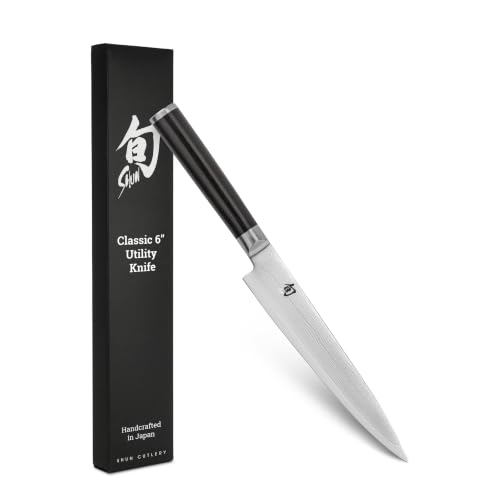
At the longer end, the Yoshihiro measures 5.3 inches, Atumuryou measures 5.5 inches, and the Shun measures 6 inches. These sizes may be useful when a compact knife must handle more substantial trimming or utility work. The trade-off is that a longer blade can feel less nimble for very small peeling or coring jobs. The Shun is therefore best understood as a utility-sized option with petty-like precision rather than the smallest choice in this guide.
Blade material is useful only when the listing provides enough context to compare it. The Shun documents a VG-MAX core and 68 layers of Damascus cladding, along with a 16-degree edge. Yoshihiro identifies a VG10 core, 16-layer hammered Damascus construction, double edge, and HRC 60. Mercer specifies a VG-10 core, laminated high-carbon stainless outer layers, and HRC 60–62. These listings give a clearer basis for comparison than a generic claim of sharpness.
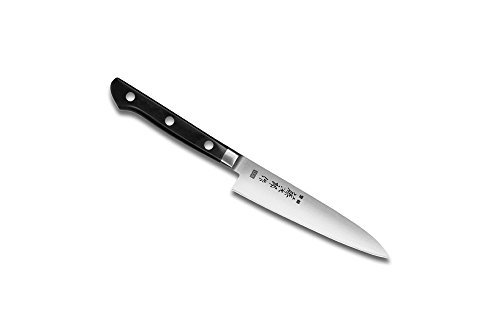
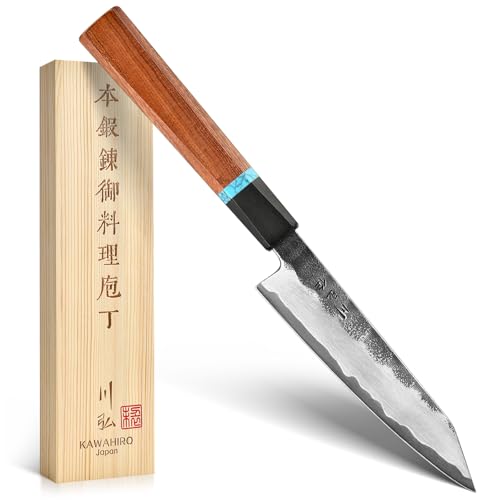
Several other models document VG10 or similar steels without giving every detail. KAWAHIRO states a VG10 core, three-layer construction, and HRC 62. Atumuryou gives VG10, three-layer construction, HRC 60–62, and a 12–15-degree edge on each side. Misono uses high-carbon 13-chrome stainless molybdenum steel, while Tojiro combines a cobalt-alloy core with 13-chrome stainless sides. These specifications point to different construction approaches, but they do not prove identical cutting performance.
Stainless construction may be attractive when corrosion resistance and simpler ownership are priorities. The Spyderco uses CTS BD1N stainless steel, and the Seki Japan TSUBAZO uses a stainless-steel blade. Yoshihiro is described as stain resistant. Still, the supplied evidence does not make every model dishwasher-safe, and Japanese knives generally deserve careful handling unless a listing explicitly says otherwise.
Consider edge style and handedness
Edge style affects how broadly a knife can be shared. The Tojiro F-801 is explicitly ambidextrous and double edged, making it a straightforward choice for kitchens used by both left- and right-handed cooks. Yoshihiro also specifies a double edge. Spyderco identifies a plain edge, while Atumuryou states an edge angle on each side. These details are more useful than assuming an edge type from the word “petty” alone.
Because single-bevel construction is not documented for the selected ten, this guide does not recommend a handedness or technique based on that design. For the models here, confirm the seller’s current product information if a particular edge orientation is essential.
Handle shape matters during short, controlled cuts. Shun uses a D-shaped Pakkawood handle and states that it supports both left- and right-handed users. Spyderco uses an octagonal wa-style polypropylene handle. Kai describes an inverted-triangle shape, while Misono uses black reinforced wood. These are materially different designs, so personal grip preference remains important even when the specifications look strong.
A Western handle may feel familiar to cooks who prefer a fuller, riveted grip. Yoshihiro pairs its blade with a mahogany Western-style handle, and Mercer lists a triple-riveted Delrin handle with an ergonomic design and rounded spine. Mercer’s handle construction is especially explicit, while Yoshihiro provides a natural-wood option with a full-tang Western format.
Decorative materials can add visual appeal but should not replace basic fit considerations. KAWAHIRO lists premium woods and turquoise inlay, and Atumuryou uses stabilized wood and resin. Those details are relevant to construction and presentation, but the evidence does not establish that ornamental materials improve cutting results. Focus first on the blade length, edge style, handle shape, and care instructions.
Plan for maintenance
The best petty knives still need appropriate care. Yoshihiro specifically calls for hand washing and immediate drying, especially after acidic ingredients, and recommends water whetstones for sharpening and honing. Mercer also advises hand washing, rinsing, and complete drying, while warning against long submersion. These instructions are practical considerations rather than minor footnotes.
A stainless blade may reduce corrosion concerns, but it does not eliminate the need to dry a knife after washing. Wood and reinforced-wood handles also deserve attention to moisture. Kai’s integral base is described as helping prevent moisture and rust from entering, but that feature should not be treated as permission for prolonged soaking.
Use the ranking responsibly
This is a specification-based comparison, not a hands-on test. Scores reflect the supplied evidence for petty-task fit, blade information, control design, construction detail, and care practicality. They do not use customer opinions, popularity, purchase activity, or marketplace labels. When a listing gives no edge angle, hardness, or steel grade, the score reflects that missing detail rather than filling the gap with an assumption.
For a compact shared-kitchen choice, start with the Tojiro F-801 or Seki Japan TSUBAZO. For richer construction documentation, compare Shun, Yoshihiro, Mercer, and Atumuryou. For a traditional compact profile, Misono, Kai, and Spyderco offer different handle and blade approaches. The right selection depends on whether your priority is short-blade maneuverability, detailed steel information, handle style, or simpler stainless construction.
Final Recommendation
Shun Classic 6-inch Utility Knife ranks first overall in this specification-based comparison under the published weighted criteria.
Shun Classic 6-inch Utility Knife is the first overall specification-based choice among these best petty knives. Its VG-MAX core, 68-layer Damascus cladding, stated 16-degree edge, D-shaped Pakkawood handle, Japanese manufacture, and warranty create the most specification-aligned documented package, although its 6-inch length is not the most compact.
The top petty knives for more specialized needs are Yoshihiro for hammered Damascus construction and documented food-release design, Misono for a light 13 cm format, and Tojiro for an explicitly ambidextrous double edge. Mercer is a strong option when a triple-riveted handle and HRC 60–62 steel specification matter. Spyderco and Seki Japan TSUBAZO are sensible compact stainless-oriented alternatives, while Kai, KAWAHIRO, and Atumuryou add distinctive handle or layered-steel details.
Frequently Asked Questions
What are the best petty knives for fruit and vegetable prep?
The Shun Classic, Misono No. 532, Tojiro F-801, Spyderco Minarai, and Seki Japan TSUBAZO all document compact or utility-oriented uses such as peeling, slicing, trimming, or small-ingredient preparation. Choose by blade length and handle preference rather than assuming one steel is ideal for every task.
Is a 4.7-inch petty knife or a 6-inch utility knife more useful?
A 4.7-inch model such as the Tojiro F-801 or Seki Japan TSUBAZO is the more compact format for peeling and detail work. The Shun Classic’s 6-inch blade offers more reach and multipurpose utility but may feel less nimble for very small ingredients. The better size depends on how much of your prep involves close, short cuts.
Are these petty knives suitable for left-handed users?
The Tojiro F-801 is explicitly described as ambidextrous and double edged. Shun states that its D-shaped handle works for left- and right-handed users. The supplied evidence does not establish handedness for every other selected model, so check the current product information before choosing one for a left-handed cook.
What care do these Japanese-style knives need?
Follow the supplied care directions for each model. Yoshihiro and Mercer specifically call for hand washing and thorough drying, and Yoshihiro advises immediate drying after acidic ingredients. Avoid prolonged soaking unless the product information expressly permits it. A stainless blade can be lower maintenance, but drying remains a prudent part of knife care.
Do Damascus layers automatically make a petty knife better?
No. Damascus layering is one construction detail, not a complete performance test. Shun, Yoshihiro, and Kai document Damascus-related construction, while Mercer and Atumuryou provide other detailed layered-steel specifications. Compare the entire specification set, including size, edge style, handle design, hardness where stated, and care requirements.