Buying Guide
The best heavy-duty utility racks are not interchangeable. A broad garage shelf, a narrow pantry unit, and a rolling wire rack solve different storage problems. Start by measuring the available width, depth, and ceiling clearance. Then compare the listed capacity, shelf material, adjustment system, and stability features. A high total figure is useful, but it does not resolve whether the shelves fit your containers or whether the rack is intended to carry that load while stationary or moving.
Match the rack to the load
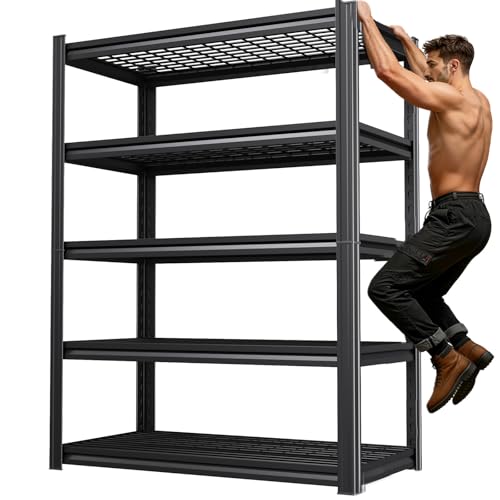
Capacity is the first filter for tools, automotive supplies, storage bins, and bulk household goods. Metallitrend lists a 3,000-pound total capacity, JOJUOU lists a 2,500-pound total capacity for its wide wire unit, PrimeZone lists a 2,200-pound capacity, VEVOR lists a 2,000-pound total capacity with a 400-pound per-shelf figure, and LEVELEVE lists a 2,020-pound capacity. These are listing claims rather than independent test results. Spread items across the tiers and follow the manufacturer’s installation guidance.
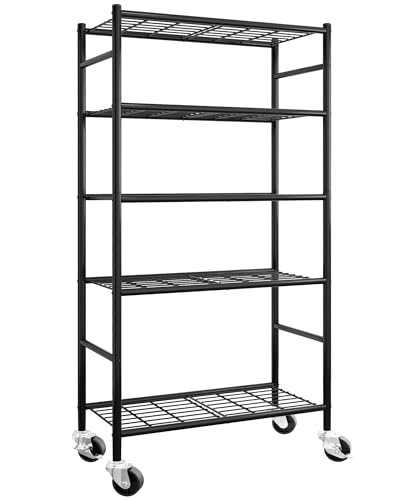
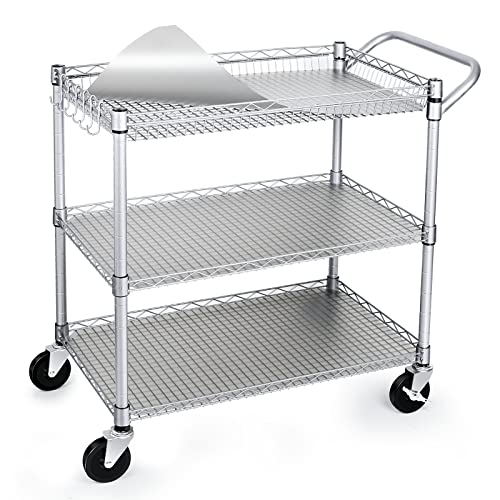
Smaller indoor racks can still be useful for moderate loads. Sakugi’s fixed-foot unit lists a 1,000-pound capacity, while its wheeled version distinguishes between a 1,000-pound fixed capacity and a 150-pound wheeled capacity. Amazon Basics also gives different capacity figures for leveling feet, stationary wheels, and moving wheels. For heavier storage, fixed-foot use is the more appropriate configuration when the listing provides a higher fixed rating.
Choose wire, mesh, MDF, or plywood shelves
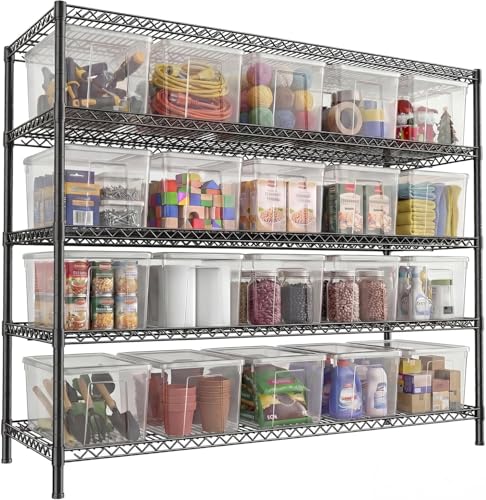
Open wire and mesh shelves allow airflow and make contents easier to see. KORVENA specifically describes its mesh design as improving airflow and helping reduce moisture, rust, and dust buildup. Amazon Basics and both selected Sakugi models also use wire or mesh shelves. These designs suit garage and workshop storage, although small loose items may need bins so they do not fall through openings.
Solid surfaces provide a more continuous platform for boxes and loose supplies. VEVOR uses MDF boards, while the compact JOJUOU model specifies high-density MDF boards. Metallitrend describes reinforced plywood shelves with steel supports and three crossbars per tier. Wood-based boards may be easier for small items, but the supplied evidence does not establish water resistance for every board material. Consider the room and the stored items before using them in damp conditions.
Consider shelf adjustment and reconfiguration
Adjustable shelves help when containers, tools, and equipment vary in height. The selected JOJUOU, PrimeZone, VEVOR, Metallitrend, KORVENA, LEVELEVE, Amazon Basics, and Sakugi units document adjustable shelf positions. Amazon Basics specifies one-inch increments, while several other listings describe repositionable or freely adjustable levels without stating an increment. If precise spacing is important, confirm the adjustment details before buying.
Some racks provide more than shelf-height adjustment. PrimeZone can be assembled vertically or separated into two horizontal workbench-style sections. VEVOR, KORVENA, and Metallitrend also describe split-unit configurations. This can help when a tall rack is unsuitable for a room or when storage needs change. Confirm the intended configuration before assembly and distribute the load across the resulting units.
Evaluate stability and installation
Look for features that address uneven floors, wall support, or item movement. Metallitrend includes rubber footpads, dual guardrails, and anti-tip wall brackets. Sakugi’s fixed model includes non-slip leveling feet and a wall-fixing kit, while its wheeled model adds side bars and wall-fixing hardware. These features provide more documented support than a basic frame alone, but they do not replace correct installation.
KORVENA and PrimeZone use connector-based assembly, and VEVOR describes a press-to-assemble system with a rubber hammer and gloves. Amazon Basics specifies no-tool assembly. Assembly claims help with planning, but they are not proof of finished-rack strength. Follow the supplied instructions, place the unit on a suitable surface, and use wall-fixing hardware where provided.
Measure depth, height, and access
Depth affects storage capacity and walkway clearance. LEVELEVE and Sakugi’s fixed model are about 12 inches deep, while the compact JOJUOU is listed at about 13.7 inches and Amazon Basics at 14 inches. These dimensions can work well in narrow basements, closets, laundry rooms, or pantries. The wider JOJUOU wire rack is 20 inches deep and offers more shelf area, but it needs more floor clearance.
Height is also important. Several selected models stand between about 71 and 73.5 inches tall. Measure around doors, lights, garage tracks, and low ceilings. Leave enough room to place items on the top shelf without striking the ceiling. Tall units also benefit from stable footing and, where supplied, wall-fixing hardware.
Final recommendation
Metallitrend 72-Inch 5-Tier Garage Rack ranks first overall in this specification-based comparison under the published weighted criteria.
Metallitrend 72-Inch 5-Tier Garage Rack is the first overall specification-based choice in this comparison.
Its listed 3,000-pound capacity, reinforced shelves, guardrails, anti-tip brackets, adjustable levels, and split configuration make it a strong match for demanding storage. The best heavy-duty utility racks for other needs include JOJUOU for broad shelf space, VEVOR for split-unit flexibility, Amazon Basics for mobility, and KORVENA for ventilated mesh storage. Together, these top heavy-duty utility racks cover the main trade-offs without relying on customer sentiment or hands-on claims.
Frequently Asked Questions
Among the best heavy-duty utility racks, what should I measure before buying?
Measure floor width and depth, available height, doorway clearance, and the space needed to walk around the unit. Also measure your largest bins or equipment. A 12- to 14-inch-deep rack such as LEVELEVE, Sakugi, or Amazon Basics may fit narrow areas better than the 20-inch-deep JOJUOU model.
Are adjustable shelves important on a heavy-duty rack?
They are useful when stored items have different heights. Most selected racks document adjustable shelf positions, allowing fewer wasted gaps and better use of vertical space. If you need precise spacing, look for a listing that states an increment, such as Amazon Basics’ one-inch adjustment, rather than assuming every system uses the same interval.
Is a rolling utility rack suitable for heavy items?
It depends on the configuration and the product’s stated limits. Amazon Basics and Sakugi provide wheels and leveling feet, but each lists lower capacity when the rack is on wheels or being moved. Use fixed feet for heavier storage when the listing provides a higher fixed rating, and avoid moving a heavily loaded rack unless the design and load clearly support it.
When is mesh or wire shelving preferable?
Mesh and wire shelves provide visibility and airflow, which can help in garages, workshops, and utility rooms. KORVENA specifically documents airflow-related benefits. They may be less convenient for very small loose items, so use containers when objects could slip through shelf openings.
Should a tall rack be secured to a wall?
Use the supplied wall-fixing or anti-tip hardware when available, especially for tall racks or storage areas with uneven floors. Metallitrend, Sakugi, and KORVENA document wall-support features. Proper leveling and following the installation instructions remain important because the supplied evidence does not establish stability in every installation environment.