Buying Guide
The best heavy-duty securing straps are not defined by the word “heavy-duty” alone. Compare the stated capacity, webbing material, attachment hardware, strap dimensions, and intended load. A motorcycle transport strap, a soft loop, and a reusable bundling strap can all secure something, but they are not interchangeable.
Start with the documented capacity
Look for a stated working-load limit or load capacity, then distinguish it from break strength. Break strength describes the force at which a strap may fail under specified conditions; it is not automatically the load that should be carried. Jack Boss supplies both a 1,500-pound maximum break strength and a 500-pound working-load capacity. Ayaport’s endless ratchet set lists a 2,500-pound break strength and 900-pound load capacity. Those figures answer different questions.
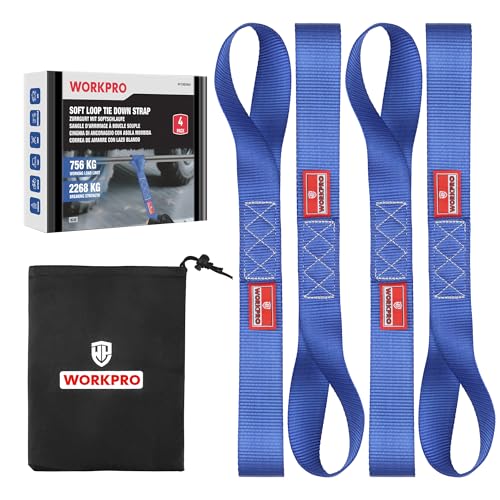
For vehicle or equipment transport, products with documented capacities and purpose-built hardware are easier to evaluate. Rhino USA lists a 3,033-pound figure for its 2-inch retractable ratchets, while WORKPRO lists a 5,000-pound break strength for each soft loop. A soft loop is an anchor component, not a complete tie-down system; it still needs compatible hooks or another tensioning strap. Use the lowest relevant capacity in the complete setup and follow the manufacturer’s instructions.
Several selected products are better suited to smaller loads. TRIWONDER lists a 440-pound break strength, and Clay&Fire gives an approximate 660-pound load-bearing figure. These may fit luggage, camping gear, household goods, or compact cargo, but the supplied evidence does not support treating them as substitutes for higher-capacity vehicle tie-downs.
Choose the fastening style
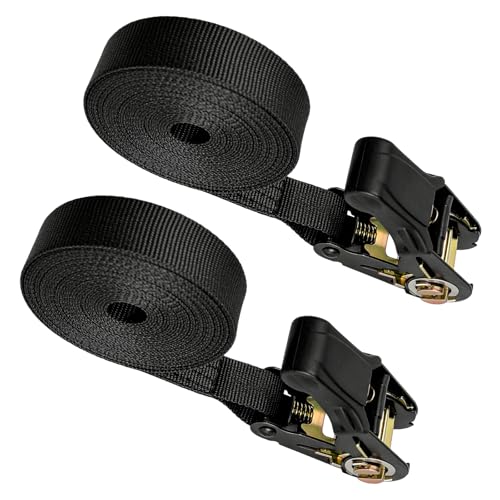
Ratchet straps provide mechanical tension through a handle and spool. They are useful when a load needs incremental tightening. Rhino USA and Jack Boss use ratchet systems, while Ayaport’s endless version combines a ratchet with a hook-free loop path. Ratchets can be bulkier than cam buckles, so check whether the available anchor space can accept the hardware.
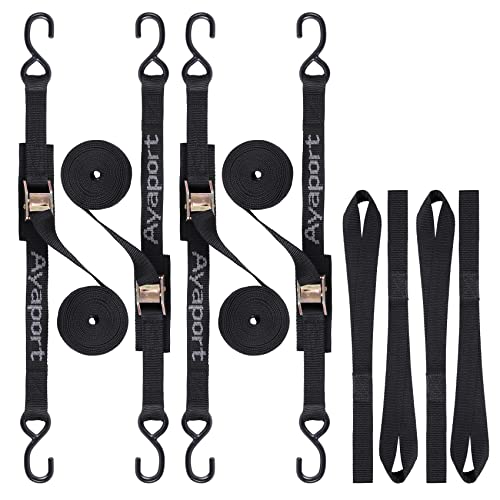
Cam-buckle straps tighten by pulling webbing through a spring-loaded buckle. They are generally simpler to thread and release. Ayaport’s four-pack, TRIWONDER’s cinch straps, and Clay&Fire’s lashing straps all document cam-buckle designs. That makes them appropriate for quick bundling and many light or moderate securing tasks, but the supplied evidence does not establish that they deliver the same mechanical tension as a ratchet.
Soft loops use flexible webbing rather than a metal hook at the contact point. WORKPRO and JCHL describe designs intended to protect vehicle handles, paint, or equipment surfaces. They are useful when a hook could scratch a finish or when an anchor needs to wrap around a handlebar or frame section. A loop alone does not tighten a load; it is normally paired with a separate ratchet or cam-buckle strap.
Hook-and-loop and reusable ratchet-lock straps serve another purpose. ENVISIONED uses hook-and-loop material with a stainless-steel buckle for compact bundling. RUIYUE uses a ratcheting locking head for adjustable organization around cables, poles, pipes, racks, and equipment. These formats are convenient for repeated bundling but lack the documented vehicle tie-down capacities found on the primary ratchet products.
Match width and length to the job
Width affects how a strap fits hardware and the contact area on the load. The selected products range from 1-inch formats for compact cargo to Rhino USA’s 2-inch straps and ENVISIONED’s 1.5-inch cinch straps. Wider is not automatically better if the buckle, anchor, or load path is designed for a narrower strap.
Length should be checked against the route around the load. Jack Boss lists 15-foot straps, Rhino USA lists 10-foot straps, and Ayaport’s endless set lists 8-foot straps. Shorter products can be easier to manage on small items, while longer straps provide more routing options around larger equipment. Control excess webbing so it cannot become loose or interfere with moving parts.
Coated S-hooks on Rhino USA and Jack Boss are documented as helping protect cargo from damage. Soft loops provide another way to reduce direct metal contact. These features address surface contact but do not replace proper anchor selection or inspection of the webbing.
For outdoor use, look for material and hardware details rather than assuming every product has the same weather resistance. Ayaport documents a stainless-steel ratchet on its endless straps. ENVISIONED specifies stainless steel and weather-resistant materials. RUIYUE describes a corrosion-resistant stainless-steel locking head and outdoor applications. A listing that only identifies a strap as heavy-duty provides less evidence about long-term exposure.
Inspect before and after use
Check the webbing for cuts, fraying, pulled stitching, melted sections, or contamination. Examine hooks, buckles, ratchet teeth, release mechanisms, and soft-loop stitching. Confirm that the strap is routed without sharp edges or pinch points. During transport, recheck the load when safe to do so.
Do not use a luggage, cable-management, or small-cargo strap as a substitute for a rated vehicle tie-down unless its documentation specifically supports that use. The selected set covers very different jobs, from motorcycle transport to household organization. The right choice is the one whose capacity, dimensions, and fastening system match the complete application.
Final recommendation
Rhino USA Retractable Ratchet Straps ranks first overall in this specification-based comparison under the published weighted criteria.
The final choice among the best heavy-duty securing straps depends on the documented features that match your intended use.
Rhino USA Retractable Ratchet Straps are the first overall specification-based choice among these selections because they combine a 2-inch width, 10-foot length, retractable storage, coated S-hooks, soft loops, and a documented 3,033-pound figure. They are a particularly complete option for vehicle and roof-rack tie-downs.
For four-point vehicle securing, Jack Boss Ratchet Tie Down Straps provide longer 15-foot webbing, coated hooks, soft loops, and a stated working-load capacity. WORKPRO Soft Loop Tie Down Straps are the better fit when surface protection and multiple soft attachment points matter, while JCHL offers eight soft loops for keeping a larger supply available.
Ayaport’s Cam Buckle Tie Down Straps are a simpler choice for motorcycle and light vehicle applications, and the Ayaport Stainless Steel Endless Ratchet Straps are useful where hooks cannot fit. For smaller cargo, TRIWONDER and Clay&Fire offer compact cam-buckle formats. ENVISIONED and RUIYUE are better viewed as organization and bundling tools than replacements for rated vehicle tie-downs. These are the top heavy-duty securing straps only when matched to their documented use, capacity, and dimensions.
Frequently Asked Questions
Are break strength and working-load capacity the same?
No. Break strength is a failure threshold stated by the listing, while working-load capacity is the load limit identified for use. Jack Boss supplies both figures, showing why the distinction matters. When a product provides a working-load limit, use that figure for planning and do not assume the break-strength number is a safe operating load.
Are soft loops complete tie-down straps?
No. WORKPRO and JCHL soft loops are connection components designed to create protected anchor points. They do not include a ratchet or cam buckle for tensioning. Pair them only with compatible hardware and ensure the complete securing system is suitable for the load.
When should I choose a cam buckle instead of a ratchet?
Choose a cam buckle when quick threading, release, and compact hardware suit the load. Choose a ratchet when the application benefits from mechanical tension and the anchor area has room for the handle and spool. The documented capacities and intended uses should decide the final choice.
Can compact bundling straps secure a motorcycle?
Not based on the supplied evidence alone. TRIWONDER and Clay&Fire document smaller cargo, luggage, camping, and household uses, while Ayaport and Jack Boss specifically list motorcycles or similar vehicles. Use a product whose documentation covers the load and whose capacity is appropriate for the complete system.
What should I inspect on the best heavy-duty securing straps?
Inspect webbing, stitching, hooks, buckles, ratchet teeth, release parts, and soft-loop contact areas. Do not use a strap showing cuts, fraying, pulled stitching, deformation, or damaged hardware. Confirm that routing avoids sharp edges and that loose webbing is controlled.