Buying Guide
The best heavy-duty utility carts are defined by more than a large number in a listing title. A useful comparison should consider how the cart will be loaded, where it will roll, how much organization is needed, and whether the materials suit the environment. The products above fall into two main design families: open metal or wire carts for shelving and service work, and solid-bed garden carts for outdoor hauling. Plastic service carts sit between those groups, offering broad shelves with surfaces that are generally easier to clean.
Start with the load type
Capacity should be the first filter, but the stated limit is not the only consideration. The Gorilla Carts and Sekey garden cart are designed around beds for yard materials such as landscaping supplies, logs, rocks, and equipment. Their removable sides can turn the enclosed bed into a flatbed, which is useful when the load is long or unusually shaped. A flatbed also reduces the need to lift bulky items over a tall side wall.
For boxed supplies, tools, dishes, or containers, a shelf cart may be more useful than a wagon-style bed. The WDT and BolDuck models list 990-pound capacities and three levels of storage, while the VEVOR and Garvee carts list 550-pound capacities across two shelves. Always check whether the published capacity applies to the complete cart, each shelf, or evenly distributed weight. WEN specifically describes its 500-pound rating as evenly distributed across two shelves, and Garvee provides separate shelf figures in addition to its total rating.
Match the construction to the setting
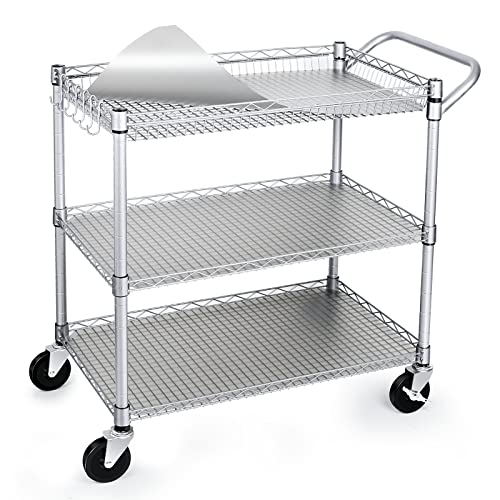
Metal carts can be a sensible choice for commercial-style shelving, especially when adjustable tiers, wire baskets, and accessory hooks matter. The WDT and BolDuck carts use metal shelving and include liners or organizing accessories. Their chrome-plated or anti-rust surfaces are documented in the listings, but buyers should still consider whether the cart will remain in a damp location.
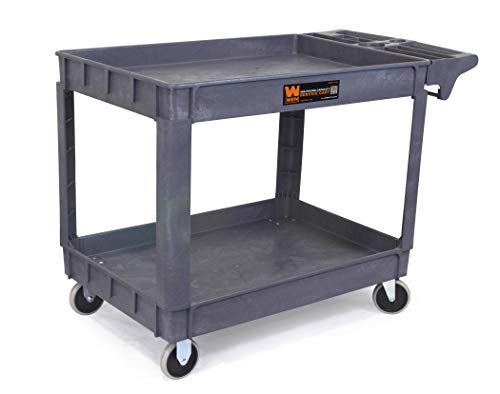
Polypropylene, HDPE, and structural foam carts offer a different set of advantages. VEVOR, Garvee, YITAHOME, ELAFROS, and WEN describe surfaces that resist some combination of water, corrosion, rust, stains, chips, or dents. These materials can also be easier to wipe clean after workshop, kitchen, or cleaning tasks. The documentation does not establish that every plastic cart is suitable for every outdoor condition, so look for a product with explicit weather-related features when exposure to rain or sun is expected.
Evaluate wheel and handle design
Wheel size and caster configuration influence how a cart behaves in a workspace. The VEVOR, Garvee, YITAHOME, and ELAFROS two-shelf carts list five-inch swivel casters, with two locking wheels. That arrangement favors turning in tighter spaces while allowing the cart to be secured when parked. WDT and BolDuck list four-inch silent industrial casters, which may be a better fit where rolling noise matters.
Outdoor garden carts use a different mobility setup. Gorilla Carts lists four 10-inch pneumatic tires, while Sekey lists 10-inch rubber tires and a rotating handle. Larger outdoor tires are intended for surfaces such as grass, dirt, gravel, and pavement according to the supplied descriptions. They also take up more space than standard service-cart casters, so measure doorways, storage areas, and turning paths before ordering.
Handles deserve equal attention. An ergonomic push bar can improve control when the cart is loaded, while dual side handles, as found on Liboocare, offer another way to push or pull. Built-in handle compartments on VEVOR, Garvee, and WEN provide places for small accessories. These features are convenient, but they do not replace checking the cart’s total dimensions and clearances.
Choose shelves, tubs, or a flatbed
Three-tier carts are useful when supplies need to be separated by category. WDT and BolDuck add adjustable shelves, which can accommodate taller items more easily than fixed levels. Liboocare uses three tiers with raised edges, making it oriented toward organized indoor transport. Open wire shelves improve visibility and airflow, but small items may need liners or containers to prevent them from shifting.
Two-tier carts generally provide more vertical clearance per level. VEVOR, Garvee, YITAHOME, ELAFROS, and WEN are suitable when the load includes larger boxes, tool cases, or containers. ELAFROS lists deep tub shelves, which may help keep items contained during movement. WEN’s extra-wide shelves are another option when footprint matters more than compact storage.
A garden cart is the better design when the main task is collecting loose outdoor material or carrying oversized loads. Gorilla Carts and Sekey document removable sides and flatbed conversion. That feature is more flexible than a fixed shelf layout, but these carts are less suited to organizing many small items into separate levels.
Check assembly and storage requirements
Several selected carts describe relatively simple assembly, but the required method varies. BolDuck and WDT state that assembly takes about 15 minutes without tools. Assembly claims are listing information rather than independent verification, so inspect the instructions and hardware before use.
Dimensions are especially important for the larger carts. WEN lists a 46-inch length, YITAHOME lists a roughly 45-inch dimension, and Sekey’s garden cart is more than 41 inches long. These designs may carry more or larger material, but they need adequate storage and turning space. Smaller carts such as ELAFROS can be easier to place in a garage or service corridor, though their shelf area is more limited.
Consider maintenance and floor protection
A cart that will be used around food, cleaning supplies, or workshop materials benefits from a surface that is easy to clean. VEVOR, WEN, Garvee, and YITAHOME describe cleanable or water-resistant plastic construction. Metal carts with open wire shelves may offer ventilation and visibility, but shelf liners can be helpful for small or unstable loads.
For indoor floors, check the wheel material and caster description. WEN lists non-marring casters, while several other models specify swivel casters with brakes. A brake can keep the cart stationary, but it should not be treated as a substitute for careful loading. Keep heavier items low, distribute weight across the shelves or bed, and follow the manufacturer’s stated capacity.
Final Recommendation
WDT 990 lb Commercial Metal Utility Cart ranks first overall in this specification-based comparison under the published weighted criteria.
Gorilla Carts Steel Utility Cart 800 lb is the highest-scoring returned product and the first overall specification-based choice. Its combination of powder-coated steel, 800-pound capacity, 10-inch pneumatic tires, stable four-wheel design, and removable sides gives it broad utility for outdoor hauling. Among the top heavy-duty utility carts, Sekey’s 1,000-pound garden cart is the stronger capacity-led alternative, while WDT and BolDuck are better suited to organized commercial-style shelving.
For a solid plastic service cart, VEVOR offers a useful balance of shelf capacity, five-inch locking casters, and cleanable polypropylene construction. Garvee, YITAHOME, and ELAFROS provide similar two-tier formats with different emphasis on weather resistance, footprint, and tub depth. WEN is the most suitable pick when extra-wide shelves are more important than compact storage. Liboocare adds three-tier organization and anti-tangle wheels, though its supplied dimension fields should be reviewed carefully before purchase.
The best heavy-duty utility carts depend on the job rather than one universal design. Select a convertible garden cart for loose or oversized outdoor loads, an adjustable metal cart for commercial organization, or a plastic two-tier cart for broad shelves and easier maintenance.
Frequently Asked Questions
What should I look for in the best heavy-duty utility carts?
Start with the type of load and the surface where the cart will roll. Review the stated total and per-shelf capacities, then check the construction, wheel size, brakes, dimensions, and storage layout. A flatbed conversion is especially useful for oversized outdoor materials, while adjustable shelves help organize tools, containers, or service supplies.
Neither material is universally better. Metal carts such as WDT and BolDuck provide open shelving and adjustable storage for commercial-style work. Plastic carts such as VEVOR, Garvee, YITAHOME, and ELAFROS describe resistance to water or corrosion and may be easier to clean. Choose according to the environment, load shape, and maintenance needs documented for the model.
Which selected cart is best for outdoor hauling?
Gorilla Carts and Sekey are the clearest outdoor-hauling choices because both document steel garden-cart construction, removable sides, and large tires. Gorilla Carts lists an 800-pound capacity and pneumatic tires, while Sekey lists a 1,000-pound capacity, rubber tires, and a rotating handle. Confirm the dimensions and intended load before use.
Do utility-cart capacity ratings apply to each shelf?
Not always. Some listings provide both total and shelf-specific figures, while others only state a total rating. VEVOR lists the current price per shelf alongside its 550-pound total, and Garvee lists the current price per shelf with a 550-pound total. WEN specifies the current price of evenly distributed weight across two shelves. Follow the most specific manufacturer guidance available.
How can I keep a rolling cart stable?
Place heavier items on the lowest shelf or in the bottom of the bed, distribute the load evenly, and use the locking casters when parked. Avoid exceeding the stated capacity and check that the route is clear before moving. Large outdoor carts may need more turning room, while narrow service carts require attention to shelf edges and item containment.