Buying Guide
The best heavy-duty wood chisels are defined less by a single marketing label than by how their documented construction matches the work. A demanding mortise job calls for an impact-ready striking end and a blade structure suited to repeated blows. Fine paring and trimming place more emphasis on bevel geometry, control, and a width that fits the cut. This comparison uses public listing specifications only; it does not claim hands-on performance.
Choose a set or a single chisel
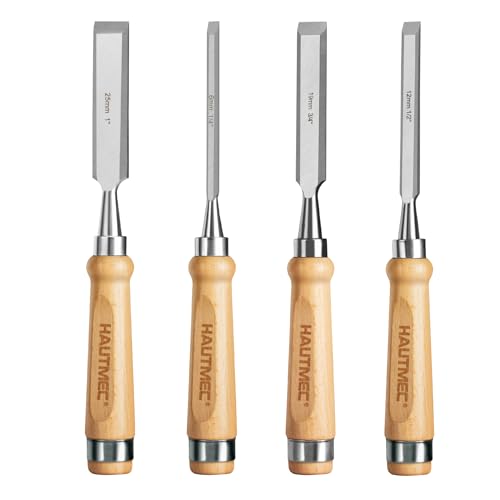
A set is usually the more flexible starting point. CENFORGE and WORKPRO each document six widths from 1/4 to 1-1/2 inches, covering narrow corners, general joinery, and wider material removal. HAUTMEC provides four sizes from 1/4 to 1 inch, while IRWIN and Jorgensen also focus on four-piece coverage. These formats let you switch widths without building a collection one tool at a time.
A single chisel can make more sense when the task is specific. Vanquish is a 1/2-inch option for focused mortise work. KAKURI supplies a 1-5/8-inch Japanese-style tool, while Buck Bros. and Crescent each offer a broad 2-inch chisel. These wider tools may be appropriate when the cut calls for more coverage, but they cannot replace a complete range.
Match impact construction to the job
For mallet-driven work, look for a documented striking cap, full metal core, full tang, through tang, ferrule, or reinforced handle. CENFORGE and WORKPRO specify metal strike caps. IRWIN lists a fully forged steel core and extra-large strike cap. HAUTMEC’s long set has metal butt caps and stainless ferrules, while Vanquish identifies through-body core penetration and a zinc-alloy striking end cap.
The single-chisel options also provide useful construction details. Buck Bros. documents a full-tang blade and a non-slip handle. Crescent specifies a full metal core from the strike cap to the tip. DEWALT lists thick metal strike caps. These details support an impact-oriented selection, but the supplied evidence does not establish a performance ranking from real-world testing.
Consider blade material and stated hardness
Blade steel and heat treatment are useful comparison points when they are explicitly documented. CENFORGE, WORKPRO, HAUTMEC, and Vanquish identify chrome-vanadium steel in their listings. Jorgensen provides the most specific hardness range at HRC 60–64, while Buck Bros. lists 55 HRC. DEWALT specifies tempered carbon steel, and KAKURI identifies laminated Japanese high-carbon steel.
Do not treat a hardness number as a complete description of cutting behavior. The evidence here does not provide independent testing, sharpening intervals, or measured edge life. Instead, use the stated material and hardening information to distinguish documented specifications from unsupported assumptions.
Check bevel and edge geometry
Bevel geometry affects how a chisel is positioned for different woodworking tasks. CENFORGE documents precision-ground bevel edges and a sharpening setup for 25- or 30-degree angles. WORKPRO states a 28-degree edge. KAKURI describes a chamfered blade, and the other selected products identify beveled or precision-ground edges where supplied.
A beveled edge is a useful general-purpose design for joinery, trimming, and carving. A broad blade can remove more material per pass, while a narrow blade is easier to place in tighter spaces. Choose geometry and width together rather than assuming one angle or profile suits every cut.
Prioritize grip and storage details
Handle design matters when the chisel is struck repeatedly or held for controlled paring. WORKPRO uses PP and TPR non-slip handles, CENFORGE uses rubberized ergonomic handles, and Vanquish lists an acetate soft-grip handle. HAUTMEC combines extended beech handles with a balanced profile. Crescent adds parallel flats to reduce roll-off, a practical feature for a busy bench.
Storage and maintenance can affect how easy a set is to keep ready. CENFORGE and WORKPRO include sharpening equipment and cases. HAUTMEC supplies edge guards and a protective box. KAKURI states that its blade can be restored with a whetstone, but the listing does not include one. Single chisels such as Crescent and Vanquish require separate storage and sharpening arrangements.
Use the size range as a decision filter
For general home woodworking, a range that includes 1/4, 1/2, 3/4, and 1 inch is a practical foundation. Larger 1-1/4- and 1-1/2-inch tools add coverage for broader cuts. A 2-inch chisel is more specialized, while a 3/8- or 1/2-inch single tool can be useful for detail or mortise work.
Before choosing, identify the cut width, whether the tool will be struck, and whether you need a case or sharpening guide. This simple checklist prevents paying for a broad set when one chisel is enough, or choosing a single width when varied joinery is planned.
Final recommendation
WORKPRO 10-Piece Wood Chisel Set ranks first overall in this specification-based comparison under the published weighted criteria.
CENFORGE 10-Piece Wood Chisel Set is the highest-scoring returned product and the first overall specification-based choice among the best heavy-duty wood chisels. Its six sizes, Cr-V steel, striking caps, sharpening guide, stone, and case give it the broadest documented coverage in this comparison. WORKPRO is a close alternative with a similar six-size format and a stated 28-degree edge. Choose HAUTMEC for extended reach, IRWIN for impact-focused four-piece coverage, or KAKURI when a broad Japanese-style single chisel fits the task. For shoppers comparing the top heavy-duty wood chisels, the deciding factor is usually set coverage versus a specialized single-tool design.
Frequently Asked Questions
What should I look for in the best heavy-duty wood chisels?
Start with the task: repeated mallet work favors a strike cap, full metal core, full tang, or reinforced ferrule. Then compare blade material, stated hardening, bevel geometry, handle design, and width coverage. A complete set such as CENFORGE or WORKPRO is more adaptable, while a single broad tool such as Crescent or Buck Bros. is more focused.
Are six-piece sets better than single chisels?
They are more versatile, but not automatically better for every job. CENFORGE and WORKPRO cover six common widths and include maintenance equipment, which is useful for varied woodworking. Vanquish, KAKURI, Buck Bros., and Crescent each target a particular width or design. Choose a set when you expect varied cuts; choose a single chisel when the required width is already known.
Which selected chisel is suited to deep mortises?
HAUTMEC Long Wood Chisel Set is the clearest fit because its listing specifically describes an extended profile for reach and leverage in deep mortise cuts. Vanquish is another focused option for 1/2-inch mortise work, with through-body construction and a striking end cap. The right choice still depends on the required width and the rest of your tool setup.
Do these chisels include sharpening equipment?
CENFORGE and WORKPRO include a sharpening stone and honing guide. The other selected products do not list those same accessories, although KAKURI states that its blade can be restored with a whetstone. If ongoing edge maintenance is important, an included guide and stone can simplify setup, but the supplied evidence does not establish sharpening speed or edge life.
What size is a useful starting point for general woodworking?
A set containing 1/4, 1/2, 3/4, and 1-inch chisels provides a useful spread for many joinery and repair tasks. Wider 1-1/4- and 1-1/2-inch sizes add material-removal coverage. If you are buying only one tool, select the width that matches the cut you expect to make most often rather than assuming the widest blade is the most versatile.