Buying Guide
The best indoor dummy cameras are decoys, not recording devices. They do not provide video, alerts, storage, or remote access. Their practical purpose is visual signaling: a camera-shaped housing, a simulated lens, and often a blinking red LED can suggest that a surveillance system is present. The products in this comparison were selected from listing specifications and feature descriptions rather than hands-on testing.
Start with the layout
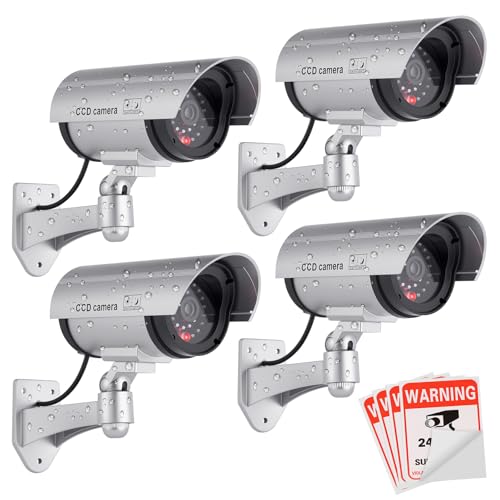
First decide how many locations need a visible decoy. A single-room installation may suit the SABRE, while a pair can cover two entrances, a hallway, or a room and stairwell. For larger homes, offices, classrooms, shops, and other shared spaces, the Mandala Crafts six-pack, FITNATE four-pack, or Kanayu four-pack can distribute units across more locations.
Coverage is not the same as camera performance. A multi-pack gives you more physical decoys, but it also means more mounting points and, for battery-operated models, more battery compartments to maintain. Sketch the intended positions before choosing a pack size. Prioritize visible locations such as an entry hall, living-room approach, office entrance, garage access point, or store-facing interior area. Avoid describing a dummy camera as monitoring a space because the products listed here do not document recording capability.
Choose a design style
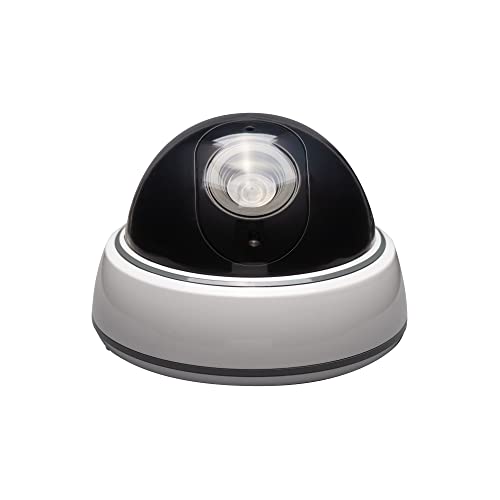
Dome models have a rounded housing that commonly suits ceilings and walls. The WALI SDW-2, PATIKIL, BNT, SABRE, Kanayu, and Mandala Crafts products document dome-style designs. Bullet styling, as used by the WALI TC-W2, may be a better visual match when a longer camera profile fits the room or mounting surface.
The Serounder takes a different approach. Its listing describes a motion sensor, an activation light, and motorized pan movement. That makes it a more active-looking design in this selection, but it also introduces more operating parts than a static dome or bullet decoy. FITNATE emphasizes adjustability instead: its bracket can rotate from side to side and tilt vertically, which helps when the desired camera angle is not straight ahead.
Consider the light behavior
A flashing red LED is a common documented feature across this category. It can make the decoy more noticeable, particularly in a dim hallway or near an entry point. However, light behavior varies. BNT specifically notes that its red light is set not to illuminate during the day. SABRE describes nighttime visibility, while YSUCAU describes solar operation in a well-lit environment and battery use for indoor or nighttime flashing.
Treat these statements as design information, not proof of a particular deterrence outcome. A flashing light may be useful when the camera needs to be noticed, but some buyers may prefer a less visually prominent unit in a bedroom, apartment corridor, or office. Check the intended placement and lighting conditions before selecting a model.
Review power requirements
None of the selected products includes a conventional wired power connection in the supplied evidence. Wireless installation is a recurring advantage, but battery requirements differ. WALI TC-W2 and SDW-2 use two AA batteries per camera. PATIKIL, Kanayu, and several other models also document two-AA operation. SABRE uses three AA batteries, FITNATE requires three AA batteries per unit, and Serounder uses three AA batteries.
For a single camera, the difference may be minor. Across four or six units, it becomes a planning consideration. Record the installation date and check the light periodically. Do not assume that a battery-operated LED will remain active indefinitely; the supplied listings do not provide a consistent runtime standard. YSUCAU is the exception in design, offering solar assistance, although its listing says indoor or nighttime use may still call for two AA batteries.
Check mounting surfaces and hardware
Most selected models describe screw-based wall or ceiling mounting. WALI, BNT, PATIKIL, SABRE, and the other basic dome options include some form of screws or mounting hardware. Kanayu adds tape to its listed installation options, while Mandala Crafts describes screw or tape mounting on surfaces including stucco, wood, and brick. Adhesive mounting can be convenient, but the supplied evidence does not establish how well it will hold on every surface, so inspect the surface and follow the product instructions.
Adjustability matters when the mounting point is high, off-center, or constrained by furniture. FITNATE documents the broadest adjustment details in this group. Serounder also lists a fully adjustable bracket. Fixed domes may be simpler when the desired position is obvious and the camera only needs to face a room entrance.
Indoor placement and durability
Although these are indoor-focused picks, many listings describe indoor/outdoor suitability. PATIKIL details several ABS material and weather-resistance properties. FITNATE describes a waterproof case, and Kanayu states that its cameras are made to withstand various weather conditions. Those claims may be useful for a covered porch, garage, or utility area, but they should not be treated as a substitute for an official protection rating because none is supplied here.
For indoor use, focus on visibility, mounting security, and access for battery replacement. Keep the device where the housing and flashing light can be seen without placing it in a location likely to be knocked or obscured. A dummy camera should not block a doorway, interfere with lighting, or create a trip hazard from mounting materials.
Final recommendation
Kanayu 4-Pack Fake Dome Cameras ranks first overall in this specification-based comparison under the published weighted criteria.
The final choice among the best indoor dummy cameras depends on the documented features that match your intended use.
Serounder Motion-Activated Dummy Camera is the first overall specification-based choice among the selected products. Its motion sensor, activation light, motorized pan movement, adjustable bracket, and wireless installation give it a broad documented feature set.
Choose Kanayu when four locations need coverage, PATIKIL when a detailed ABS durability description matters, or YSUCAU when solar-assisted operation fits the room. Among the top indoor dummy cameras focused on simple pairs, WALI’s TC-W2 and SDW-2 are straightforward alternatives, while Mandala Crafts is a practical bulk option.
Remember that every selection is a decoy. Select the package size, light behavior, battery arrangement, and mounting style that suit your layout, and do not expect recording or monitoring functions that the listings do not describe.
Frequently Asked Questions
Do the best indoor dummy cameras record video?
No. The selected products are described as fake, dummy, simulation, or decoy security cameras. Their documented features include housings, flashing LEDs, mounting hardware, battery operation, and in one case motion-triggered movement. The supplied evidence does not describe video capture, storage, networking, alerts, or remote viewing.
Are batteries included with these dummy cameras?
The listings generally say batteries are not included. Requirements vary by model: WALI TC-W2 and SDW-2 document two AA batteries per camera, while SABRE and FITNATE document three AA batteries. Serounder also uses three AA batteries. Check the individual listing before installation, especially for multi-packs.
Which selected model is useful for several rooms?
Mandala Crafts provides the six-camera package documented in this comparison. Kanayu and FITNATE each provide four units. A larger pack can place visible decoys in more locations, but it also increases the number of mounting points and battery compartments that need attention.
Can a dummy camera be mounted indoors without wiring?
Yes, the selected listings commonly describe screw-based installation without electrical wiring. WALI, PATIKIL, BNT, SABRE, and other models include mounting hardware. Kanayu and Mandala Crafts also describe tape-based options. Confirm that the mounting surface is suitable and use the supplied instructions.
Is a flashing red LED always active during the day?
Not necessarily. BNT specifically says its red light is set not to illuminate during the day. YSUCAU describes solar operation in well-lit conditions but says indoor or nighttime use may require batteries. Light behavior is model-specific, so review the relevant product description before choosing a placement.