Buying Guide
The best insulated lunch bags should match the food volume, containers, and carrying routine you actually have. Listing specifications can narrow the field, but they do not replace hands-on testing. The comparison above therefore focuses on documented construction and design features rather than performance assumptions.
Choose capacity around your usual load
Capacity ranges widely in this group. The 8.7L Femuar is suited to one personal meal with snacks, while the 13L LOVEVOOK and 15L Lifewit provide more room for containers and drinks. The 18L MIYCOO and 23L Maelstrom are better suited to multiple meal containers or shared outdoor food. A larger bag can be useful, but unused space may make a tote feel unnecessarily bulky.
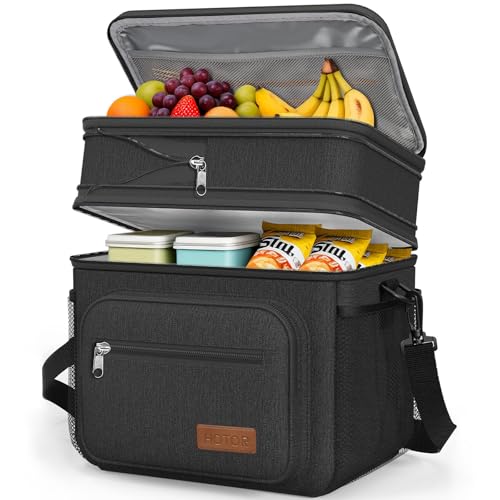
Expandable models offer a useful compromise. The HOTOR 12L double-layer design can zip its upper compartment away, and the Maelstrom expands from its original height to a listed 23L. The HSHRISH tactical model also adds four liters through its upper compartment. These formats make sense when weekday and weekend packing needs differ.
Compare insulation materials and claims
The supplied listings mention EPE or pearl-cotton foam, PEVA, EVA, aluminum foil, or combinations of these materials. LOVEVOOK lists 5mm EPE foam, while HSHRICH lists 6mm insulation foam and an aluminum liner. Femuar lists 4mm EPE foam, and Lifewit lists 3mm EPE foam. These thickness figures describe construction, not independently verified results.
Several listings give time-based claims. LOVEVOOK states separate periods for hot meals, snacks, and drinks, and HSHRISH states up to eight hours. MIYCOO describes triple insulation for hot, cold, and fresh food. Use such claims as listing evidence, not as a guarantee: actual temperature retention depends on starting food temperature, ice packs, ambient conditions, and how often the bag is opened.
Look for a cleanable, leak-resistant interior
A seamless or heat-welded liner is useful when carrying sauces, fruit, or chilled drinks. The selected products variously specify PEVA, EVA, or aluminum-lined interiors and describe them as leakproof, waterproof, or easy to wipe. The Lifewit, Femuar, HOTOR double-layer, and MIYCOO listings are especially explicit about smooth or wipe-clean interiors.
Exterior water resistance is a separate feature. Oxford fabric appears on several models, while Maelstrom uses waterproof nylon and the LOVEVOOK designs use polyester or nylon-related construction. These details can help with splashes and everyday handling, but they should not be interpreted as permission to submerge any bag.
Decide whether compartments help or hinder
A single main compartment is simple and accommodates irregular containers. Lifewit uses this classic approach, while the wide-opening LOVEVOOK model adds an internal divider that separates dry items from fresh meals. Double-deck models such as BAGSMART, HOTOR, HSHRISH, and Maelstrom divide food by level. The HSHRISH and HOTOR listings also identify pockets for utensils, napkins, bottles, or ice packs.
More pockets improve organization but can reduce uninterrupted interior space. Check the stated dimensions and consider the shape of your lunch containers. A wide mouth is particularly helpful for tall bottles and stacked boxes; LOVEVOOK documents an approximately 135-degree opening, and BAGSMART documents a 180-degree opening.
Match carrying hardware to your routine
A reinforced handle works well for short carries. A removable, adjustable shoulder strap adds hands-free flexibility and appears on the LOVEVOOK, MIYCOO, HSHRISH, Femuar, Maelstrom, and HOTOR designs. The LOVEVOOK 13L model adds a purpose-built 40-ounce tumbler pocket, while the larger tactical models emphasize hand, shoulder, and crossbody options.
Also consider empty weight and structure. The BAGSMART small tote is listed at 0.75 pounds, while the larger LOVEVOOK model is listed at 1.3 pounds. Structured bodies may protect containers and stand upright, but they can occupy more room when stored. Flexible totes are easier to compress, though the supplied listings do not provide a universal measure of collapsed size.
Final recommendation
LOVEVOOK 15.5L Wide-Opening Lunch Bag ranks first overall in this specification-based comparison under the published weighted criteria.
The LOVEVOOK 15.5L Wide-Opening Lunch Bag is the first overall specification-based choice among these best insulated lunch bags. Its documented thermal layers, dry-wet separation, wide access, container-stabilizing divider, and tumbler buckle give it the most complete feature set for varied daily packing. The Maelstrom is the better fit when maximum capacity matters, while the Femuar is more appropriate for a smaller personal load. For a dedicated large-drink pocket, choose the LOVEVOOK 13L model. Together, these are practical top insulated lunch bags for distinct carrying needs, not claims from hands-on testing.
Frequently Asked Questions
Among the best insulated lunch bags, what size should I choose for a work lunch?
An 8.7L to 13L bag is a reasonable starting range for one meal, snacks, and a drink. Femuar lists 8.7L, while LOVEVOOK lists 13L for its large version. Choose 15L or more if you regularly carry multiple containers, several drinks, or food for more than one person.
Are double-deck lunch bags better than single-compartment bags?
Neither layout is automatically better. A double-deck bag such as the BAGSMART or HOTOR can separate foods and use vertical space efficiently. A single-compartment tote such as Lifewit may be easier for irregularly shaped containers. Select the layout that matches your containers and whether separation is important.
How should I clean an insulated lunch bag?
The selected listings commonly describe smooth, wipe-clean liners. Remove food promptly, wipe spills with a damp cloth or napkin, and allow the interior to dry before closing it. Do not assume a bag is machine washable or submersible unless its own documentation says so.
Do insulated lunch bags need ice packs?
Insulation helps slow temperature change, but it does not independently refrigerate food. Follow appropriate food-handling practices and use a suitable cold source when you need chilled items to remain cold.
What makes an insulated lunch bag suitable for outdoor work?
Look for a structured body, reinforced stitching, water-resistant outer fabric, leak-resistant lining, and a carrying method that works for longer walks.