Buying Guide
The best waterproof lunch boxes are not all built for the same routine. A small school carrier, a structured office tote, and a large outdoor lunch bag can all protect food from splashes while differing substantially in insulation, capacity, and carrying comfort. Start by deciding how much food you carry, whether you need separate compartments, and how much exterior exposure the bag will face.
Waterproof protection versus water resistance
Listing language matters. Some products are described as waterproof or leakproof, while others specify water-resistant, splash-resistant, or mild waterproof fabric. Those terms should not be treated as identical. A leakproof liner can help contain a spill inside the bag, while a water-resistant exterior may protect against occasional light rain or splashes. None of the selected products provides a formal IP ingress rating.
For the most specification-aligned documented protection, look for a sealed or heat-pressed liner, waterproof EVA or PEVA, and an exterior fabric described as waterproof or water-resistant. The HSHRISH 15L bag combines 900D oxford fabric with a leakproof aluminum lining. The MIYCOO 18L tote uses waterproof EVA inside and waterproof nylon outside. Smaller school designs such as LOKFAR, CaCTOUR, and Bentgo also document water-resistant or waterproof materials, but their fabric-focused construction is intended for ordinary daily use rather than immersion.
Insulation and temperature-retention claims
Insulation is usually supplied through foam, aluminum foil, PEVA, EVA, or a combination of those materials. Several large totes specify 6mm insulation, including HSHRISH and HSHRICH. The MIYCOO 15L uses a thermal-insulation layer and allows ice cubes in its leakproof liner. These details indicate how the product is constructed, but they do not guarantee a particular food temperature in every environment.
If you carry food for a long shift or outdoor activity, choose a thicker insulated design and leave room for an ice pack or ice cubes when the listing supports them. A smaller bag may be easier to carry but can provide less room for cold packs alongside containers. The child-focused Bentgo and CaCTOUR bags are better matched to school portions and snacks than to a full day of large beverages and multiple meal containers.
Capacity and compartment layout
Capacity should match the contents, not just the advertised maximum. The 18L MIYCOO tote is designed for multiple lunch boxes, fruit, beverages, cups, and tableware. The HSHRISH and Gafetrey bags use dual compartments, which can separate hot and cold items or keep wet foods away from dry snacks. Expandable designs such as holuxer and MIYCOO 15L let you adjust the upper section when your load changes.
A single main compartment is often simpler for a regular lunch. LOKFAR provides a 7.2L format with interior pockets and a wide three-sided opening, making packing easier. Genteen provides an 8L tote for a more compact daily load. Pocket count is useful only when those pockets fit the items you actually carry; external storage can also increase the bag’s overall footprint.
Carrying comfort and portability
Handles work well for short walks, while a detachable shoulder strap is more useful for commuting, travel, or carrying other items at the same time. HSHRISH, HSHRICH, MIYCOO 18L, and holuxer provide more than one carrying method. Gafetrey also includes a shoulder strap, but its heavier construction may be more noticeable when fully loaded.
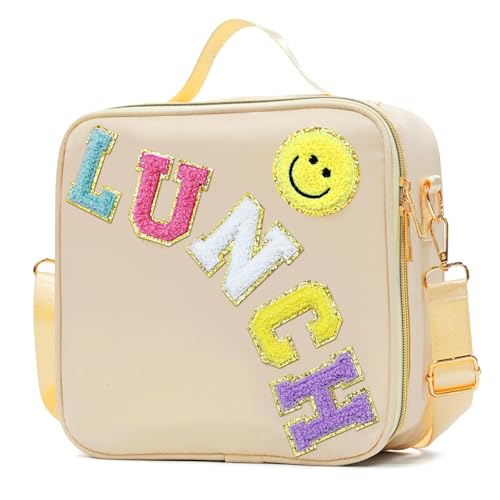
For children, attachment hardware can matter more than a long shoulder strap. CaCTOUR has a detachable buckle handle for a backpack, and Bentgo provides a buckle handle, carrying handle, and adjustable shoulder strap. Genteen’s adjustable hand straps offer straightforward portability for office or school use.
Cleaning and everyday maintenance
A smooth liner that can be wiped with a damp cloth is easier to maintain after a spill. MIYCOO 15L, MIYCOO 18L, LOKFAR, Genteen, and HSHRICH explicitly describe easy-clean or wipe-clean interiors. PEVA, EVA, and aluminum-lined interiors are common in the larger waterproof lunch bags because they provide a relatively smooth surface.
Before buying, check whether the opening is wide enough to reach the bottom and whether the closure leaves exposed fabric around the liner. A three-sided zipper, such as the one on LOKFAR, can simplify loading and cleaning access. Double-deck bags may offer better organization but have more seams and sections to inspect after a spill.
Which size is right?
Choose a compact 7L-to-8L bag for one meal, a drink, and a few snacks. Move toward 12L when you need accessories and a larger container. The 15L-to-18L class is more appropriate for multiple containers, larger drinks, outdoor shifts, or shared food. Remember that capacity does not describe the bag’s loaded weight, so a large tote full of beverages can become tiring even when the empty bag is manageable.
Final Recommendation
HSHRISH Expandable 15L Lunch Bag ranks first overall in this specification-based comparison under the published weighted criteria.
The final choice among the best waterproof lunch boxes depends on the documented features that match your intended use.
HSHRISH Expandable 15L Lunch Bag is the highest-scoring returned product and the first overall specification-based choice. Its 900D water-resistant fabric, leakproof lining, expandable dual compartments, insulation, and shoulder strap cover the main requirements for demanding daily use. Among the top waterproof lunch boxes, it offers one of the clearest combinations of capacity and rugged construction.
Choose MIYCOO 18L if maximum capacity is your priority, MIYCOO 15L for layered storage, or holuxer when expandable capacity and multiple carry modes matter. Gafetrey is better suited to outdoor work, while HSHRICH emphasizes pocket organization. For smaller daily loads, LOKFAR and Genteen offer more compact formats. CaCTOUR and Bentgo are the more targeted choices for younger schoolchildren.
Because this is a specification-based comparison, the rankings reflect documented materials, layouts, insulation features, capacity, and carrying design. They are not hands-on test results and do not predict performance beyond the supplied listing evidence.
Frequently Asked Questions
What should I look for in the best waterproof lunch boxes?
Look for a documented waterproof or water-resistant exterior, a leakproof or sealed liner, insulation materials, and a closure that suits your routine. Also compare capacity and carrying options. A large bag with excellent protection may still be inconvenient if you only carry a small meal.
Are waterproof and leakproof lunch bags the same?
No. Waterproof usually describes resistance to water reaching the outside or entering through the fabric, while leakproof commonly describes the liner’s ability to contain a spill. A product can have one feature without fully providing the other, so read the material and lining descriptions together.
Is a double-compartment lunch bag better?
It can be better when you need to separate wet and dry foods, hot and cold items, or a main meal from snacks. HSHRISH, Gafetrey, holuxer, and MIYCOO 15L document divided or layered storage. A single compartment may be easier to pack when your meal is small and uniform.
What size lunch bag is suitable for work?
An 8L bag can suit a standard individual lunch, while 12L provides more room for drinks, utensils, and snacks. A 15L-to-18L bag is better for multiple containers, long shifts, outdoor work, or larger beverages. Measure your containers before choosing, because stated capacity does not guarantee that every shape will fit efficiently.
No. This comparison uses public listing descriptions and specifications, including claims about waterproof fabric, water resistance, leakproof liners, insulation, and cleaning. It does not represent hands-on testing, laboratory testing, or customer-opinion analysis.