Buying Guide
The best adjustable pot racks are not all built for the same storage problem. Some are tall, tiered frames that turn cabinet height into separate shelves for pots and pans. Others are low, expandable organizers that create slots for lids, baking sheets, trays, cutting boards, and frying pans. Start by deciding whether you need vertical separation or horizontal compartment storage; that choice affects fit more than the number of tiers or dividers.
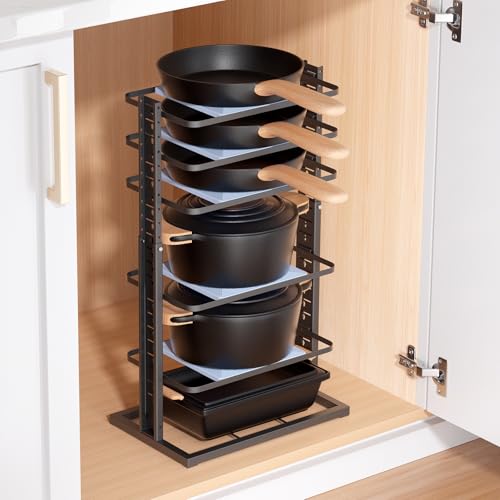
Vertical racks such as the LAMU 6-Tier Adjustable Pot Rack, LAMU 8-Tier Heavy Duty Pot Rack, MUDEELA 8-Tier Heavy Duty Organizer, KOMFORA 8-Tier Adjustable Pot Rack, and ORDORA 8-Tier Adjustable Organizer are designed around stacked levels. Their adjustable shelves or dividers can keep cookware separated and visible. This format is useful when a cabinet has enough height and depth for handles, lids, and the rack frame.
Expandable horizontal racks take a different approach. PanPanPal, Simple Houseware, LuckySlycyc, MUDEELA’s 14-Divider Expandable Organizer, and Toplife use adjustable compartments. They are especially suitable for lids, trays, cutting boards, bakeware, and pans that are easier to store upright than stacked. Several can be split into two units, which can help distribute storage between cabinets or use one section on a countertop.
Measure the complete storage space
Do not compare only the rack’s advertised length. Measure cabinet width, height, and depth, then account for cookware handles, lid knobs, and the clearance needed to remove an item. MUDEELA’s eight-tier listing specifies a minimum cabinet size of 25.2 inches wide, 17.7 inches high, and 10.98 inches deep after stored cookware is considered. KOMFORA lists a minimum cabinet size of 24 by 18.5 by 9 inches. These requirements show why a rack that fits by itself may still be unsuitable when loaded.
Height adjustment matters most for vertical designs. LAMU’s six-tier model adjusts from 14 to 24.57 inches, making it useful where cabinet height varies. The LAMU five-tier design documents a 14.1- to 25.2-inch height range, but it is not included in this top 10 because its five-level format trades capacity for a narrower dual-pillar footprint. For horizontal organizers, check both the collapsed and expanded lengths. A 12- to 23-inch range gives flexibility, but the expanded rack still needs room to operate without pressing against cabinet walls.
Match capacity to cookware weight
Capacity claims should be read alongside the rack’s construction and layout. The LAMU 8-Tier Heavy Duty Pot Rack and MUDEELA 8-Tier Heavy Duty Organizer each document the current price of total support, while KOMFORA states a 53-pound capacity. Those figures are useful specification points, but they do not remove the need to distribute heavy cookware sensibly across tiers.
When a product does not list a numeric load limit, rely only on the features actually documented. Heavy-duty iron construction, thick bases, dual supports, rubber feet, non-slip tubing, and snap-in dividers can describe design intent, but they are not substitutes for a stated capacity. The best adjustable pot racks for cast iron should therefore be selected from listings that provide both a suitable structure and enough capacity information for your collection.
Look for protection and stability features
Cookware protection can come from covered dividers, pads, silicone feet, rubber tubing, or deep U-shaped grooves. ORDORA documents rubber covers on its dividers. PanPanPal lists non-slip feet and deep U-grooves, while MUDEELA’s 14-divider model uses anti-damage strips and anti-slip rubber tubing. These features may reduce direct contact, sliding, or tipping, but the supplied listings do not establish performance under every cookware combination.
A stable base is particularly important for low-profile expandable racks. Simple Houseware lists a thick base and notched divider curves. LuckySlycyc lists a non-slip base and deep U-shaped dividers. For vertical racks, look at the frame arrangement and whether the rack supports one-sided or two-sided placement. A configuration that fits your cabinet may be more useful than a rack with more nominal tiers but insufficient side clearance.
Consider setup and access
Tool-free assembly is common across this category. PanPanPal describes one-minute assembly, MUDEELA’s expandable model describes 60-second setup, and ORDORA, KOMFORA, and Simple Houseware describe tool-free installation or assembly. The LAMU eight-tier model uses a four-step setup and may require tapping end plugs, while the LAMU five-tier model includes an Allen wrench. Assembly time is only one part of usability; leave enough room to lift cookware out without catching handles on neighboring dividers.
The top adjustable pot racks should make the item you want visible and reachable. A high-capacity rack is not helpful if wide lids block access to smaller pans or if a cabinet door cannot close. Organize heavier items on the most stable, accessible levels and reserve narrow compartments for lids, trays, or cutting boards.
Final recommendation
MUDEELA 14-Divider Expandable Organizer ranks first overall in this specification-based comparison under the published weighted criteria.
The final choice among the best adjustable pot racks depends on the documented features that match your intended use.
LAMU 6-Tier Adjustable Pot Rack is the highest-scoring returned product and the first overall specification-based choice. Its 14- to 24.57-inch height range, adjustable tiers, H-shaped support structure, protective pads, and three placement scenarios give it unusually broad fit flexibility. The LAMU 8-Tier Heavy Duty Pot Rack and MUDEELA 8-Tier Heavy Duty Organizer are stronger alternatives when documented load capacity and higher vertical storage matter most. For lids and flat cookware, PanPanPal and the two 14-divider MUDEELA and LuckySlycyc models are among the top adjustable pot racks because their expandable, compartment-based layouts are easier to customize. Always verify cabinet dimensions and cookware clearance before selecting any model.
Frequently Asked Questions
What should I measure before buying the best adjustable pot racks?
Measure the cabinet’s usable width, height, and depth. Then add the space occupied by pot handles, lid knobs, and the clearance needed to remove cookware. Listings for KOMFORA and MUDEELA show that loaded-cabinet requirements can exceed the rack’s basic dimensions.
Are vertical or horizontal pot racks better for lids?
Horizontal expandable designs are generally the more directly documented choice for lids, trays, cutting boards, and bakeware. PanPanPal, LuckySlycyc, MUDEELA’s 14-Divider Expandable Organizer, and Toplife all describe adjustable compartments for these items. Vertical racks can also hold lids when their dividers or tiers provide enough clearance.
Which selected rack has the most documented capacity?
The LAMU 8-Tier Heavy Duty Pot Rack and MUDEELA 8-Tier Heavy Duty Organizer each list the current price of total capacity. KOMFORA lists the current price. The other selected products do not provide a numeric total capacity in the supplied evidence, so avoid treating construction descriptions as equivalent load ratings.
Several selected models describe tool-free assembly, including ORDORA, PanPanPal, Simple Houseware, MUDEELA’s 14-divider organizer, and KOMFORA. The LAMU eight-tier model uses four assembly steps and may require tapping end plugs. Read the included instructions and confirm the final configuration before loading cookware.
Can one organizer be used in two locations?
Some expandable designs can be divided into two separate racks. LuckySlycyc, MUDEELA’s 14-Divider Expandable Organizer, and Toplife document this capability. That can help separate lids from pans or distribute storage across two cabinets, but each location still needs enough width and stable support.