Buying Guide
Choosing among the best large colanders starts with the kind of work you do most often. A high-capacity basket is useful for a large pot of pasta or a full harvest of produce, while an over-sink model can make draining easier when counter space is limited. Sets can provide more flexibility, but they also add pieces to wash and store.
Choose capacity by batch size
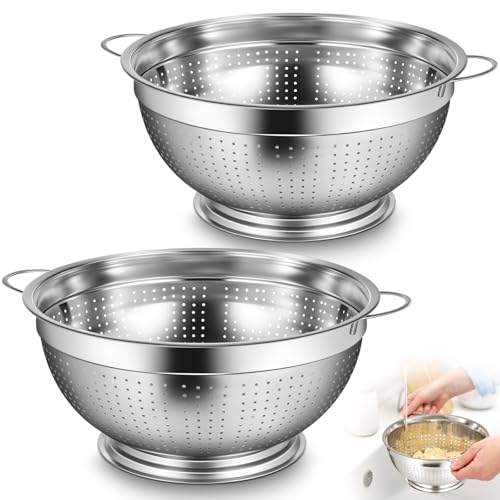
Capacity is the most obvious distinction in this comparison. Maxdot documents a 16-quart size, making it the most specification-aligned fit for unusually large family or commercial-style batches. ROTTOGOON lists a 7-quart maximum, and Tiawudi lists 6 quarts. These sizes give more room than the many 5-quart models in the group.
A 5-quart colander can still be large enough for regular family cooking. OXO, Bellemain, GoodCook, Paoli, QiMH, Pleafind, and STOCKPOT all document a 5-quart large piece or basket. If you usually rinse vegetables, drain canned foods, or prepare ordinary pasta portions, a 5-quart bowl may be easier to lift and store than a 16-quart basket.
Decide between bowl, over-sink, and collapsible designs
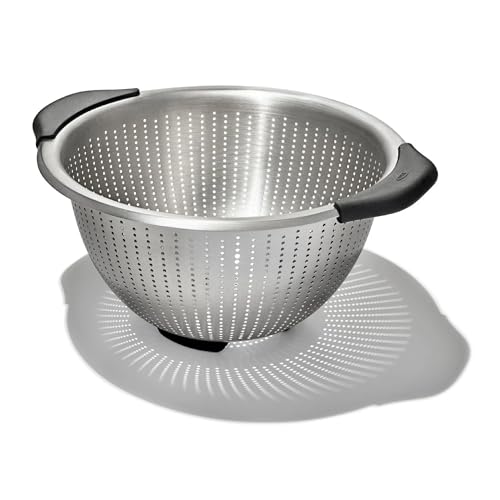
Traditional footed bowls sit on a counter or inside a sink. Maxdot, OXO, GoodCook, and Bellemain document raised feet or solid bases, which can keep the basket elevated while water drains. This style is simple and usually works well when you have a clear countertop or want a colander that can stand independently.
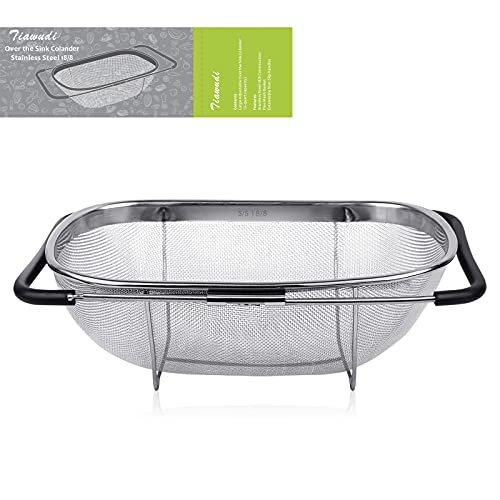
Over-sink models are useful when you want the sink basin to catch the water. Tiawudi documents expandable handles reaching 22.5 inches, while ROTTOGOON expands from 15 to 19.8 inches. The U-shaped support can be helpful, but sink dimensions matter. Measure the usable rim-to-rim span before choosing an adjustable model, especially if your sink has a thick divider or unusual shape.
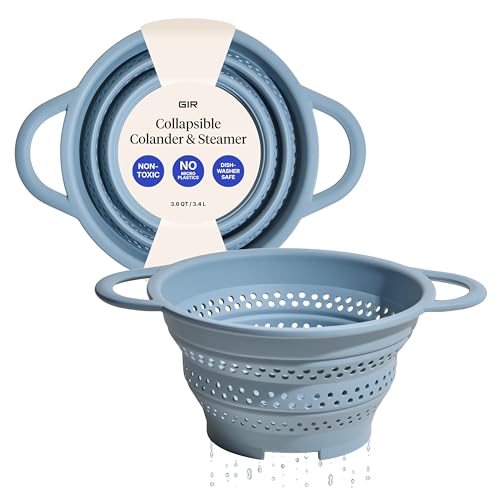
ROTTOGOON is also collapsible, and its listing describes both over-sink and freestanding use. That makes it a practical option for kitchens where a full-size rigid bowl would be difficult to store. Collapsible designs may feel different from stainless steel baskets, so consider whether you prefer a flexible body or a fixed frame.
Match hole design to the food
Hole size affects what the colander can retain. Tiawudi describes a fine-mesh basket, while Bellemain identifies fine micro-perforations. Paoli, QiMH, and Pleafind document 2mm holes or pores. Those specifications are particularly relevant for rice, grains, lentils, quinoa, and other smaller ingredients.
The QiMH listing specifically says its 2mm pore structure is not suitable for objects smaller than 2mm. That limitation is important: no hole pattern should be assumed to retain every ingredient. For ordinary pasta, fruit, and vegetables, a broader perforated design may be sufficient; for small grains, look for a documented fine mesh or microporous construction.
Consider materials and heat handling
Stainless steel is the dominant material in this group. Maxdot, Tiawudi, OXO, Bellemain, GoodCook, Paoli, QiMH, Pleafind, and STOCKPOT document stainless steel construction, with several identifying 18/8 or 304 grades. Stainless steel is a practical choice for shoppers prioritizing a rigid metal body and resistance-related claims documented by the listing.
ROTTOGOON documents BPA-free, food-grade materials and a maximum temperature of 302 degrees Fahrenheit. Its material profile is different from a steel bowl, but the listing supports use with hot foods within that stated limit. Do not transfer that temperature specification to other products.
Check handles and stability
Wet produce and cooked pasta can be heavy. Look for features that help the colander stay steady and make lifting easier. Maxdot documents double-riveted handles and wide non-slip grips. OXO identifies elevated non-slip handles, and GoodCook lists large side handles designed for use with oven mitts. Tiawudi documents rubber-grip handles and resting feet.
For countertop stability, a solid ring base or raised feet can be more useful than handles alone. Bellemain, OXO, and GoodCook each document a stable elevated or ring-style base. Paoli and QiMH focus more on the colander-and-bowl combination, so their listings provide less specific evidence about handles or feet.
Think about cleaning and storage
Several selected models document dishwasher safety, including OXO, Bellemain, GoodCook, ROTTOGOON, Pleafind, QiMH, and STOCKPOT. This can simplify cleanup, but the supplied evidence does not establish identical dishwasher performance across products.
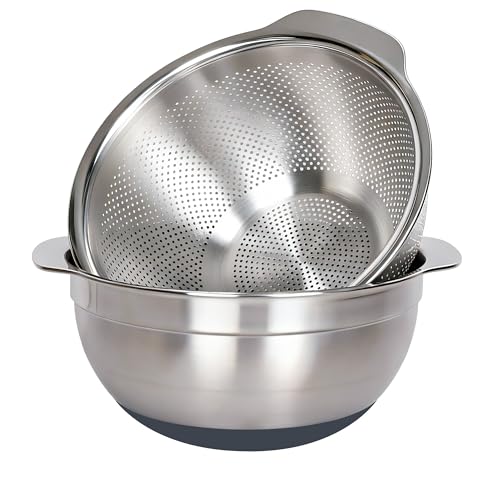
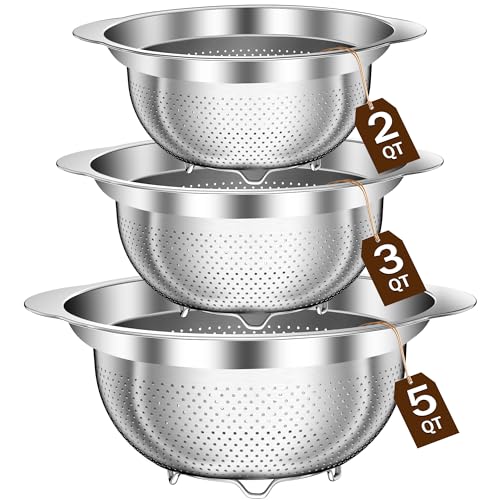
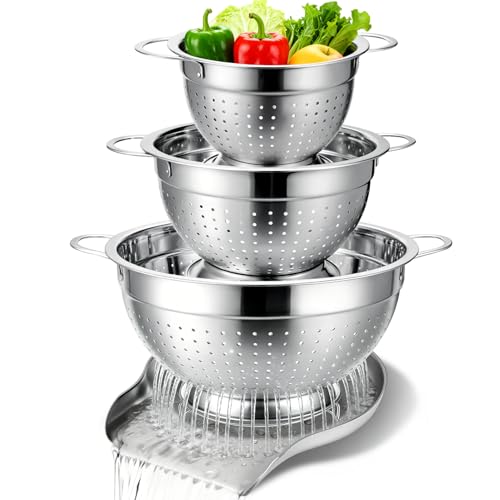
Storage is another major difference. OXO documents nesting inside mixing bowls. Pleafind and STOCKPOT document nesting within their own sets, while Paoli and QiMH pair their colanders with bowls. A set can be space-efficient when designed to nest, but a two-piece or three-piece system still needs room for every component. Maxdot’s two-colander format is best considered when capacity matters more than minimum storage.
Final Recommendation
Maxdot 16-Quart Stainless Steel Colander, 2-Pack ranks first overall in this specification-based comparison under the published weighted criteria.
Maxdot 16-Quart Stainless Steel Colander, 2-Pack is the highest-scoring returned product and the first overall specification-based choice for the best large colanders when maximum batch capacity is the priority. Its documented 16-quart size, footed base, and reinforced handles give it the clearest large-batch advantage.
For a more compact alternative, OXO Good Grips 5-Quart Stainless Steel Strainer emphasizes handling, feet, perforation, and nesting. Tiawudi 6-Quart is the stronger over-sink and fine-filtration choice, while ROTTOGOON is the better fit when collapsible storage and an adjustable sink span matter. Among the top large colanders, Paoli and QiMH are especially useful for shoppers who want a matching bowl, and Pleafind or STOCKPOT suit households that want multiple nesting sizes.
Frequently Asked Questions
What capacity is considered large for a colander?
In this comparison, selected products range from 5 to 16 quarts. A 5-quart model is a common large everyday size, while 6- to 7-quart options provide more room for substantial batches. Maxdot’s documented 16-quart capacity is intended for the largest workloads in this group.
Are the best large colanders made from stainless steel?
Many of the selected models use stainless steel, including Maxdot, OXO, Bellemain, GoodCook, Tiawudi, Paoli, QiMH, Pleafind, and STOCKPOT. ROTTOGOON uses documented BPA-free food-grade materials in a collapsible design. The better choice depends on whether you prioritize rigid metal construction or flexible storage.
Which selected colander is best for rice and small grains?
Tiawudi documents a fine-mesh basket, while Bellemain, Paoli, QiMH, and Pleafind document fine or 2mm-style perforation details. QiMH explicitly notes that items smaller than 2mm are not suitable, so shoppers should match the documented pore size to the ingredient.
Neither design is universally better. An over-sink model such as Tiawudi or ROTTOGOON can use the sink basin to catch water and may save counter space. A footed model such as OXO, GoodCook, or Maxdot can stand independently. Measure your sink and consider where you normally drain food before choosing.
Do colander sets save storage space?
Nesting sets can reduce the footprint of multiple pieces. Pleafind and STOCKPOT document nesting, while Paoli and QiMH include bowls that add prep or storage functions. However, sets still contain more individual pieces, so check the nested height and cabinet space before buying.