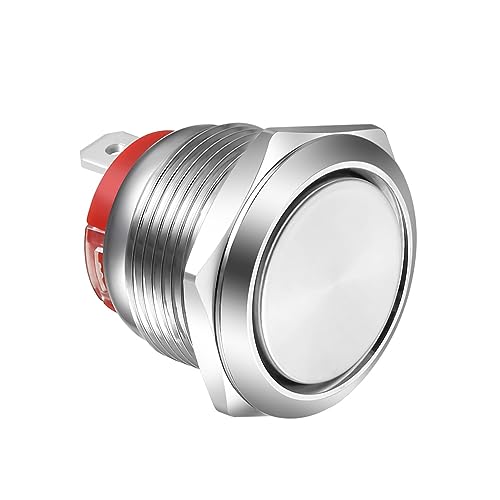
Buying Guide
The best led pushbutton switches are selected by matching mechanical action and electrical details to the panel, vehicle, appliance, or machine where they will be installed. An illuminated button still needs the correct mounting hole, LED voltage, contact arrangement, and switch rating. This comparison uses public listing specifications, not hands-on testing or customer-opinion summaries.
Momentary versus latching action
A momentary switch changes state only while the button is held. Releasing it returns the button to its original position. This suits starter controls, test inputs, jog functions, and reset signals. The Langir 16mm model, APIELE 16mm blue model, and BAOMAIN rectangular set document momentary operation.
A latching switch changes state with each press. One press turns the circuit on and another turns it off. This suits maintained power, lighting, accessory, and equipment controls. ZJWZJH, KWONONG, DAIERTEK, DMWD, HiLetgo, and the white APIELE model document latching behavior. Do not substitute one design for the other without checking the circuit.
Check the LED supply separately
The LED indicator and switch contacts may have different electrical requirements. Several selected products specify 12V LED operation, including the blue APIELE momentary switch, white APIELE latching switch, DaierTek 12mm set, and DAIERTEK 22mm switch. These are suitable only when the LED supply matches the listing.
Other models provide more range. Langir documents a 12–24V AC/DC LED, HiLetgo lists 12–24V operation, and BAOMAIN documents a 12V AC/DC LED. KWONONG states a 5–24V operating range, while DMWD describes a 12–24V DC LED. Distinguish the switch rating from the LED supply requirement before wiring.
SPST or 1NO designs provide one normally open switching path. KWONONG, DAIERTEK 12mm, and DMWD use this simpler arrangement. It can suit a basic on/off control when a normally closed path is not required.
SPDT or 1NO/1NC designs provide more wiring options. Langir, APIELE, HiLetgo, BAOMAIN, and DAIERTEK’s 22mm listing use this arrangement. It may support signal routing or circuits that need a normally closed path. ZJWZJH specifies DPST 2NO contacts for switching two normally open circuits together.
Match the panel hole
The selected products cover 12mm, 16mm, and 22mm formats. DAIERTEK 12mm and DMWD models suit smaller openings. Langir, KWONONG, APIELE, HiLetgo, and BAOMAIN use 16mm holes. ZJWZJH and DAIERTEK’s marine-oriented switch require 22mm openings.
BAOMAIN uses a rectangular cap, while the other selected designs use round heads or ring-style illumination. Measure the existing opening and confirm body depth, terminal clearance, and nut arrangement. The stated hole size is more useful than an approximate product name.
Consider sealing and construction
IP ratings describe protection against dust and water under defined conditions. They do not mean every switch can be immersed or installed without enclosure protection. Selected products range from IP65 to IP67. IP65 appears on APIELE and DAIERTEK listings; IP67 is documented for Langir, ZJWZJH, KWONONG, and HiLetgo. DMWD lists IP66 and IK09 impact resistance.
Construction also matters in exposed locations. Langir lists an alumina shell, ZJWZJH specifies stainless-steel components, and several models identify metal or aluminum-alloy construction. Cable entries and the surrounding panel still need suitable protection. BAOMAIN has no supplied IP rating, so its listing should not be treated as evidence of sealed outdoor use.
Review wiring and included hardware
Prewired sockets, harnesses, and cables can simplify installation. Langir, ZJWZJH, DAIERTEK, HiLetgo, and several APIELE models list a socket or harness. DMWD lists pre-soldered cables, while BAOMAIN lists sockets. Confirm the number of wires and identify which leads serve the switch and which serve the LED. Separate LED leads matter when the indicator should illuminate continuously or only when the equipment is active.
Final recommendation
Langir 16mm Momentary Red LED Switch ranks first overall in this specification-based comparison under the published weighted criteria.
Langir 16mm Momentary Red LED Switch is the first overall specification-based choice among these best led pushbutton switches. Its combination of IP67 protection, 12–24V AC/DC LED compatibility, 15A/250V AC switch rating, metal housing, and supplied socket provides a well-rounded specification set for compact momentary control. For a larger latching panel button, choose ZJWZJH; for a high-current compact latching design, choose KWONONG. Among the top led pushbutton switches, the final choice depends on action, hole size, LED supply, contacts, and enclosure conditions.
Frequently Asked Questions
Verify the mounting-hole diameter, momentary or latching action, contact configuration, switch rating, LED voltage and AC/DC requirements, wiring arrangement, and IP rating. These specifications determine whether the switch can physically fit and electrically serve the intended circuit.
No. These formats require different panel openings, and body dimensions and terminal clearances may also differ. A 12mm DAIERTEK or DMWD switch should not be assumed to replace a 16mm APIELE or Langir switch without confirming the panel fit.
Is a latching switch better than a momentary switch?
Neither is universally better. Latching switches maintain their state after release and suit power or accessory controls. Momentary switches return after release and suit temporary commands such as start, test, or jog inputs. Choose based on the circuit’s intended behavior.
Can the LED be wired independently from the switch?
Some listings document separate or configurable LED wiring. DMWD describes two LED wiring methods, and HiLetgo states that its ring LED can be wired for constant illumination or only when the switch is on. Follow the supplied wiring information rather than assuming every illuminated pushbutton has identical internal connections.
Do IP65, IP66, and IP67 mean a switch is ready for every outdoor installation?
No. They are protection ratings, not a guarantee for every outdoor installation. Cable entry, panel sealing, exposure, mounting orientation, and maintenance still matter. IP-rated products have documented protection levels, but the complete installation must be considered.