Buying Guide
The best dpst pushbutton switches are selected by matching the contact arrangement and switching behavior to the circuit before considering appearance. DPST means the switch operates two poles, but the supplied products do not all use the same normally open and normally closed arrangement. Some specify 1NO 1NC, while others specify 2NO. That difference affects how the control circuit is wired.
Start with the contact configuration. The TWTADE, uxcell, Taiss, RuoFeng, and OELFFOW listings specify 1NO 1NC, which provides one normally open and one normally closed contact. This is useful when a control scheme needs a command path plus a second contact state. The ZJWZJH and APIELE mushroom listings specify 2NO, so both poles are normally open. They may be better for paired switching functions, but they are not direct substitutes for a 1NO 1NC switch.
Do not infer the terminal layout solely from the product name. Check the supplied specification and the number of terminals. The Taiss switch lists four terminals, while the uxcell momentary model lists six. Terminal count and contact wording should be checked against the wiring diagram for the equipment.
Choose momentary or latching action
Momentary switches return when released. They are appropriate for commands that should exist only while the actuator is pressed, such as start, stop, signal, or temporary control inputs. TWTADE explicitly describes a self-reset action, and the APIELE mushroom model describes push-and-hold operation.
Latching switches maintain their state after pressing. The APIELE angel-eye, ZJWZJH, and uxcell red models document push-on, push-off or latching behavior. The Heschen emergency-stop station also stays down until manually turned, making it a specialized maintained interruption control rather than an ordinary start button.
The choice is functional, not merely personal. Replacing a momentary button with a latching design can leave a circuit continuously commanded, while using a momentary model where maintained state is needed can prevent the equipment from remaining on.
Match voltage and current details
Review both the load rating and any indicator-light voltage. The ZJWZJH listing specifies 15A operating current and a 110V-120V LED. The APIELE angel-eye model lists a 110V-220V AC LED, while the uxcell green model specifies a 24V light. These indicator circuits should not be treated as universally compatible with the switch contacts.
Other listed ratings include 10A for several models and 6A AC 250V for the RuoFeng set. A higher documented rating does not automatically make a switch suitable for every installation; the circuit type, voltage, motor load, and applicable requirements still need to be checked. This article reports listing specifications rather than independently verifying them.
Check panel size and wiring method
A 22mm cutout is common across the leading options, including the ZJWZJH, APIELE, TWTADE, and uxcell models. The Taiss listing also states a maximum panel thickness of 5mm. The RuoFeng option uses a larger 30mm button, so its actuator size and required clearance should be confirmed before drilling.
Screw terminals are documented for the APIELE mushroom and TWTADE models. The ZJWZJH includes a wire socket plug, which may reduce connection work. The uxcell momentary listing states six terminals, so it deserves extra attention during wiring. Always compare the physical terminal arrangement with the equipment diagram instead of relying on color alone.
Consider protection and construction
For exposed panels, environmental protection can be a deciding factor. ZJWZJH lists IP67 protection and stainless steel construction. APIELE’s angel-eye and mushroom models list IP65 protection. These ratings are useful specification clues, but installation quality, cable entry, panel sealing, and the actual environment also matter.
Several other switches use plastic-and-metal construction or engineering plastic. The TWTADE listing identifies silver-alloy contacts and an engineering-plastic housing, while OELFFOW describes insulating material and a bottom dust cover. The absence of an IP rating is not proof that a product cannot work in a particular enclosure; it means the supplied evidence does not establish a formal protection level.
Flat-head buttons suit ordinary control panels. Mushroom heads are easier to distinguish by touch and appearance, which is why the Heschen emergency-stop station and the APIELE mushroom model serve different use cases from flat or ring-lit designs. Illuminated switches can show a state or make a control easier to locate, but the indicator voltage must match the circuit.
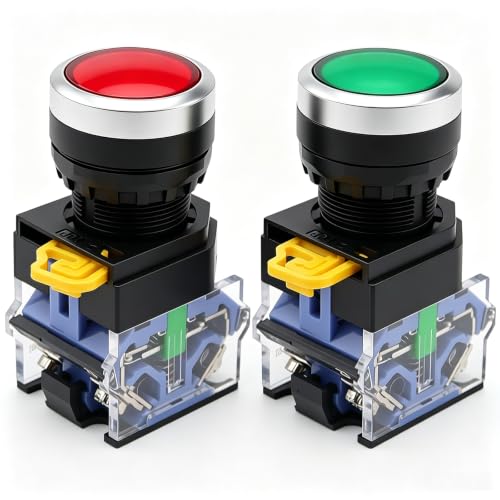
Multipacks are useful when a panel needs matching controls or when spare units are desirable. Taiss provides three colors, RuoFeng provides four larger mushroom buttons, and OELFFOW provides a red-green pair. A single illuminated APIELE or uxcell model may be more appropriate when only one panel position is being filled.
Final recommendation
ZJWZJH 22mm IP67 Latching 2NO Switch ranks first overall in this specification-based comparison under the published weighted criteria.
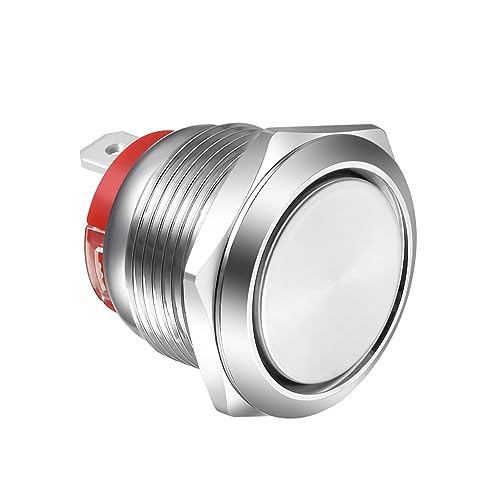
ZJWZJH 22mm IP67 Latching 2NO Switch is the first overall specification-based choice among these best dpst pushbutton switches. Its documented IP67 protection, stainless construction, 22mm fit, 15A operating capacity, 2NO contacts, and supplied socket give it a strong combination of installation and environmental features in this comparison.
The top dpst pushbutton switches are not interchangeable. Choose APIELE’s angel-eye model when an illuminated 1NO 1NC latching control is needed, or choose Heschen when the application specifically calls for an enclosed mushroom emergency-stop station. For ordinary industrial start-stop wiring, TWTADE offers a clearly documented red-green momentary pair. The uxcell 24V illuminated model is a focused choice for a green indicator circuit, while the uxcell red switch keeps maintained control simple.
Before ordering, verify the panel cutout, panel thickness, terminal arrangement, contact state, operating voltage, load type, and light voltage. For outdoor or wet locations, compare the documented IP rating with the actual enclosure and installation conditions. These checks matter more than matching a button’s color or general appearance.
Frequently Asked Questions
Check whether the circuit requires 1NO 1NC or 2NO contacts, then confirm momentary versus latching action. After that, verify voltage, current, mounting-hole diameter, terminal count, and any indicator-light voltage. A switch can look similar to another model while requiring a different wiring arrangement.
Are momentary and latching DPST switches interchangeable?
No. Momentary models return to their initial state after release, while latching models maintain their state until pressed again or reset. TWTADE and OELFFOW document self-reset or momentary behavior; ZJWZJH, APIELE’s angel-eye model, and uxcell’s red model document latching behavior. Select the action required by the control circuit.
When is a mushroom-head switch useful?
A mushroom head can make a control more recognizable and provide a larger actuator. Heschen is specifically listed as an emergency-stop station with a manual turn reset, while APIELE’s mushroom model is a momentary 2NO button. These are different functions, so the actuator shape should not be the only selection criterion.
Does a 22mm switch fit every control panel?
No. A 22mm mounting hole is common among the selected models, but panel thickness, terminal clearance, body depth, and wiring access still need confirmation. Taiss states a maximum panel thickness, while the RuoFeng set uses a 30mm button format. Measure the panel and compare the individual listing before installation.
Are illuminated DPST switches suitable for any voltage?
No. The indicator circuit has its own specified voltage. The uxcell green model lists a 24V light, APIELE’s angel-eye model lists 110V-220V AC, and ZJWZJH lists a 110V-120V LED. Match the light voltage to the intended circuit and do not assume that the contact rating also applies to the indicator.