Buying Guide
The best math role-playing dice are not all designed the same way. In this comparison, the category includes dedicated arithmetic tools, visual number-learning dice, standard polyhedral RPG sets that explicitly list math use, and bulk six-sided dice for classroom activities. The right choice depends first on whether learners need operations and representations or the broader probability and number-range experience of tabletop role-playing.
Choose the number system first
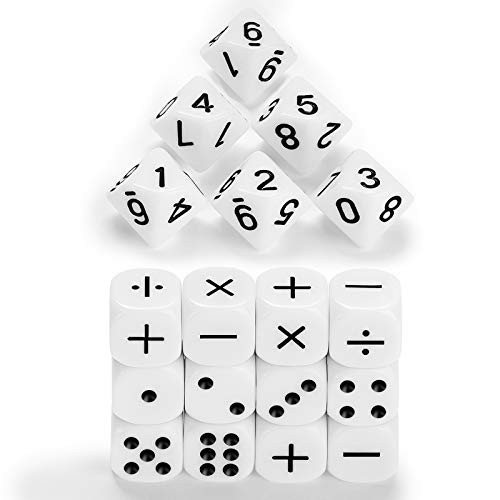
For arithmetic instruction, operation dice are more useful than decorative RPG dice. Gejoy combines operation, dot, and 10-sided number dice, so an instructor can create addition, subtraction, multiplication, or comparison activities without relying only on standard pips. ThinkFun Math Dice takes a different approach: two target dice and three scoring dice create a defined target-number practice format.
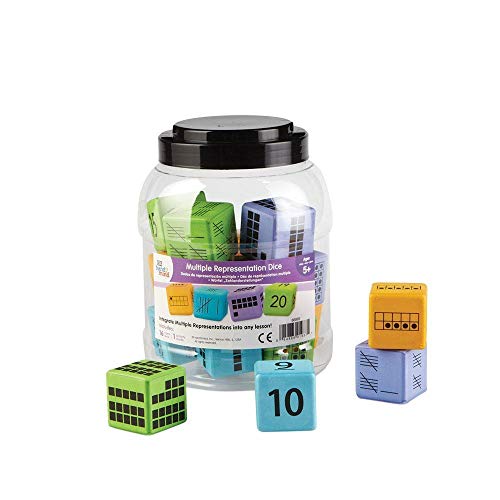
For early learners, hand2mind is the most specialized option in this group. Its dice represent numbers with numerals, ten frames, tally marks, and base-ten forms. That makes the set appropriate for subitizing, counting, sorting, and place-value connections. It is a better match for visual number sense than for RPG mechanics.
Consider polyhedral coverage for RPG play
A conventional role-playing set benefits from several shapes. RUNDIAN, HD Ancient, HD Rainbow, weyano, UDIXI, and Maywin each document seven-die assortments covering D4, D6, D8, D10, D12, and D20 formats, with percentile dice also included or identified. These sets are the better choice when math activities involve comparing ranges, generating random values, or using dice inside a tabletop game.
RUNDIAN adds a hollow metal construction and an aluminum alloy case. That gives it a different storage and presentation profile from the resin sets. HD Ancient emphasizes large black numbers and clear six-and-nine differentiation. UDIXI also documents marked sixes and nines. Those details matter when players need to read results quickly during a lesson or game.
Match material and size to the setting
Resin sets are represented by HD Rainbow, HD Ancient, weyano, UDIXI, and Maywin. Their listings describe lightweight or durable resin constructions, with several also mentioning clear or contrasting numbers. RUNDIAN is the metal option, while the brass products were not selected because their listed six-sided format is less useful for the requested math-and-RPG comparison than the chosen sets.
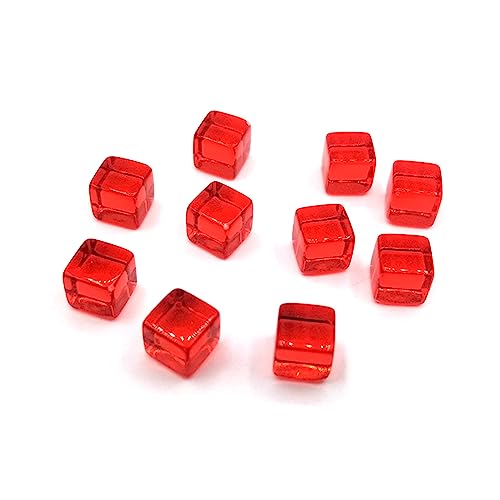
Size can change how practical a set feels. The Gejoy dice are listed at 16 mm, while the NMOWYBPY dice are approximately 8 mm. Smaller dice can be convenient for quantity and storage, but may be less comfortable for users who need large, quickly readable faces. The 16 mm teaching dice provide a compact tabletop size.
Decide whether quantity or versatility matters more
A seven-die polyhedral set gives one of each major RPG format, but it may not be enough for a whole class. NMOWYBPY supplies 200 small acrylic dice in ten colors, making it suitable for stations, team allocation, sorting, and replacement stock. Gejoy’s 18 pieces also support group activities, while hand2mind’s 16-piece set is built around repeated visual-number exercises.
For one learner or a small RPG group, a seven-die polyhedral set is usually the more versatile format. For classroom centers, operation practice, or probability demonstrations, quantity and color separation may matter more than polyhedral range. The best math role-playing dice therefore depend on the activity design, not just on the number of pieces in the package.
Check what the listing does not establish
This is a specification-based comparison, not a hands-on test. The supplied evidence does not establish long-term rolling consistency, classroom durability beyond stated material descriptions, or actual student outcomes. It also does not provide a universal standard for how each product handles repeated use. Phrases such as “well balanced” or “easy to read” should be treated as listing claims rather than independent test results.
Final recommendation
Gejoy 18-Piece Teaching Dice Set ranks first overall in this specification-based comparison under the published weighted criteria.
Gejoy 18-Piece Teaching Dice Set is the first overall specification-based choice in this comparison.
The final choice among the best math role-playing dice depends on the documented features that match your intended use.
Gejoy 18-Piece Teaching Dice Set offers the broadest documented math utility for classrooms and home learning because it combines operation, dot, and 10-sided number dice. It is not the best fit for someone who specifically needs a D20 or a complete RPG polyhedral range.
For structured arithmetic, ThinkFun Math Dice is the more focused alternative. For visual foundational learning, hand2mind is the clearest specialist. If RPG format is essential, RUNDIAN supplies the metal option, while HD Ancient and UDIXI offer especially explicit readability details. The top math role-playing dice for a particular buyer will be the set whose number system, material, size, and quantity match the intended activity.
Frequently Asked Questions
What are the best math role-playing dice for classroom arithmetic?
Gejoy is the most specification-aligned classroom-oriented choice in this selection because it includes operation dice alongside dot and 10-sided number dice. ThinkFun Math Dice is another focused option when the lesson is based on reaching target numbers. These formats provide more direct arithmetic utility than a standard polyhedral set.
Are standard RPG dice useful for math games?
Yes. The selected polyhedral sets document use for math games or teaching and provide several number ranges through D4, D6, D8, D10, D12, and D20 formats. They can support probability, comparison, range, and random-number activities, but they do not replace operation or place-value dice for every lesson.
Which set is best for early number recognition?
hand2mind is the most directly specialized option. Its dice use numerals, ten frames, tally marks, and base-ten representations for numbers from 1 to 20. That documented variety supports visual association and number-sense activities more directly than the RPG-themed products.
Are small dice suitable for group math activities?
NMOWYBPY lists 200 dice at approximately 8 mm each and offers ten colors, so the quantity is useful for group allocation, sorting, and probability stations. However, the smaller size may be less convenient for learners who need larger faces for quick reading. Gejoy lists a 16 mm size and may be easier to handle in compact tabletop activities.
What should I check before buying math role-playing dice?
Confirm the required shapes, number range, notation, piece count, material, and storage method. Operation dice are preferable for arithmetic-symbol practice, visual dice for foundational number concepts, and polyhedral sets for RPG-based probability or random-number activities. Also check whether the listed size suits the intended users and table space.