Buying Guide
Choosing among the best solar scientific calculators starts with the type of mathematics you need to enter, not simply the number of functions printed on the package. The products in this comparison range from compact school calculators to advanced models with matrices, vectors, calculus, complex numbers, and equation tools. They also differ in how much of an expression can remain visible at one time.
Start with the required math level
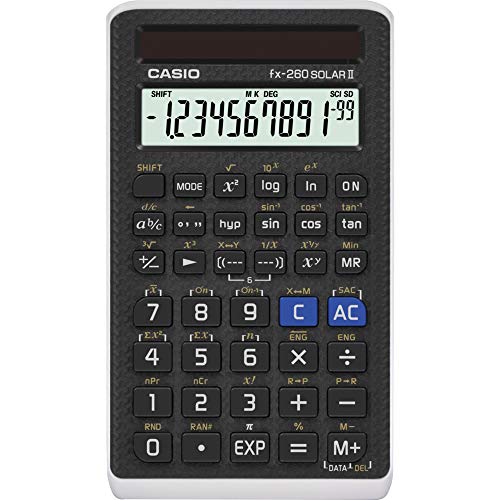
For pre-algebra, algebra, geometry, general science, and introductory trigonometry, a focused model can be easier to learn. The Casio fx-260 Solar II documents fractions, trigonometric and inverse trigonometric operations, permutations, combinations, and factorials. The Texas Instruments TI-30XIIS similarly focuses on core scientific and trigonometric functions, fractions, and conversions. The Sharp EL-531TGBDW expands that baseline to 273 functions and specifically lists biology and chemistry alongside common math subjects.
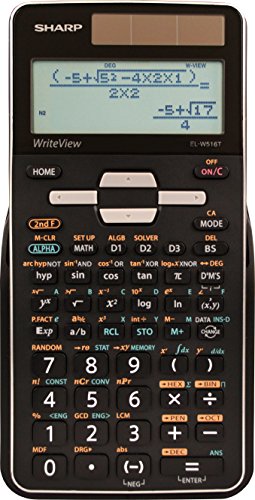
For calculus, engineering, or courses involving several representations of a problem, look at the advanced group. The Sharp EL-W516TBSL lists 640 functions and seven modes, including complex, matrix, list, and equation modes. The CATIGA CS-991NX documents 538 functions with matrices, vectors, complex numbers, equation solving, inequality solving, calculus, physics, chemistry, and engineering coverage. The CATIGA SS-991EX lists 552 functions and adds spreadsheet calculations to matrix, vector, calculus, complex-number, and equation work.
A larger function count is useful only when it corresponds to your coursework. Buyers taking general math may find the menu depth of an advanced calculator unnecessary, while engineering or college science students may benefit from having more operations available without changing devices.
Compare display layouts
Display format affects how easily you can check an entry. Two-line models such as the Texas Instruments TI-30XIIS and Sharp EL-531TGBDW show an input and result together, which is helpful for routine calculations. The ROATEE 401-Function Scientific Calculator also uses a two-line display while documenting a broad set of functions.
Multi-line displays provide more room for expressions and intermediate context. The Sharp EL-W516TBSL has a 16-digit, four-line WriteView LCD. The CATIGA CS-991NX uses a high-resolution textbook-style display for fractions, roots, exponents, and equations. The iPepul model documents a five-line display, and the IPEROT model documents four lines. These layouts may be preferable when you regularly review long expressions or compare steps.
Textbook-style presentation is another useful distinction. Sharp describes WriteView and direct algebraic logic on its selected models, while CATIGA describes expressions appearing in a textbook-like format. These claims indicate an emphasis on readable mathematical notation, but they do not replace checking the rules for your particular class or examination.
Understand solar and backup power
Every selected product documents solar operation, but the power arrangements are not identical. Several use solar power with a battery backup, including the Casio fx-260 Solar II, CATIGA CS-991NX, CATIGA SS-991EX, Sharp EL-531TGBDW, Texas Instruments TI-30XIIS, IPEROT, and ROATEE models. A backup battery matters when indoor light is insufficient or when the calculator is used away from a bright workspace.
The iPepul and Rudnia calculators add Type-C or USB-C rechargeable power to solar support. That gives buyers another charging route, but the supplied evidence does not establish charging time, battery capacity, or how long either model operates between charges. These specifications should be checked before purchase if rechargeable operation is important.
Solar capability should therefore be treated as a convenience rather than a reason to ignore the backup system. Check whether the listing specifies a battery, whether it is replaceable, and whether the product is intended for the lighting conditions where you expect to work.
Consider notes, cases, and carrying
A protective cover can reduce exposure to scratches, dust, and knocks during transport. The Sharp EL-531TGBDW includes a protective hard cover, and the ROATEE model documents a sliding cover that can be placed behind the calculator during use. The CATIGA CS-991NX includes a magnetic hard case. These are meaningful design differences for students who carry a calculator in a backpack or pencil case.
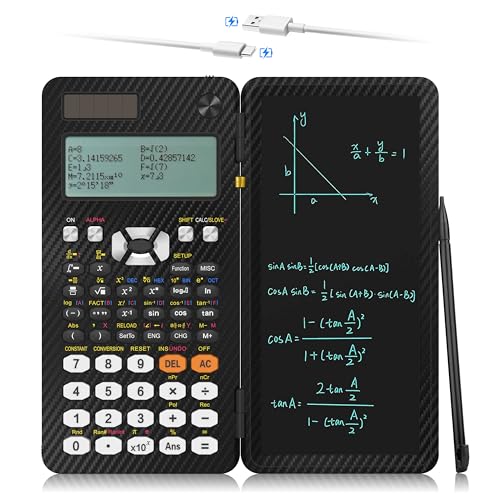
The iPepul and Rudnia models take a different approach by adding a built-in LCD writing pad. Their listings describe space for formulas, notes, answers, or calculation steps. Rudnia also documents a study timer or alarm. These features may help with classroom organization, but they add complexity and should be checked against classroom or test rules before use.
Portability is most specification-aligned among compact models. The Casio fx-260 Solar II is described as a small scientific calculator, and its supplied dimensions are smaller than many advanced alternatives. The CATIGA CS-991NX also documents a slim design. Larger displays and hard cases can be useful, but they may take more room than a basic calculator.
Check exam and classroom rules
The Texas Instruments TI-30XIIS listing states approval for SAT, ACT, and AP exams. The Texas Instruments TI-30XIIS is therefore a notable choice when documented exam compatibility is a deciding factor. Even so, policies can change by exam and administration, so verify the current requirements before relying on any product listing.
The same principle applies to calculators with notepads, rechargeable features, or unusually advanced functions. A device can satisfy the technical definition of a scientific calculator while still being unsuitable for a particular test. Review your course syllabus, testing policy, and permitted-function list before purchasing.
Final recommendation
iPepul 552-Function Calculator with Notepad ranks first overall in this specification-based comparison under the published weighted criteria.
The final choice among the best solar scientific calculators depends on the documented features that match your intended use.
The Sharp EL-W516TBSL is the first overall specification-based choice. Its 640 functions, seven modes, and four-line WriteView display give it the broadest documented technical coverage in this group. For many buyers comparing the top solar scientific calculators, the CATIGA CS-991NX is a strong alternative because it combines 538 functions, textbook-style display presentation, dual power, and a magnetic hard case.
Choose the iPepul or Rudnia if a built-in notepad is central to your study routine. Choose the Casio fx-260 Solar II for a compact, simpler school calculator, or the Texas Instruments TI-30XIIS when the listing’s stated exam approvals align with your testing needs. The Sharp EL-531TGBDW, CATIGA SS-991EX, IPEROT, and ROATEE models fill useful middle and advanced tiers with different combinations of display space, function coverage, and protection.
Frequently Asked Questions
Are solar scientific calculators also battery powered?
Many are. The selected Casio, CATIGA, Sharp EL-531TGBDW, Texas Instruments TI-30XIIS, IPEROT, and ROATEE models document solar power with battery backup or a replaceable battery. The iPepul and Rudnia models document solar support alongside USB-C or Type-C rechargeable power. Always check the individual listing for the exact power arrangement.
Which of the best solar scientific calculators has the most documented functions?
The Sharp EL-W516TBSL has the highest documented count in this comparison at 640 functions. The CATIGA SS-991EX and iPepul model each document 552 functions, while the CATIGA CS-991NX documents 538. Function counts alone do not show how easy a model is to operate, so compare the display, modes, and subjects supported as well.
Is a four-line or five-line display better than a two-line display?
It depends on the work. Two-line models can be sufficient for routine school calculations and show an entry with its result. Four- and five-line models provide more visible expression context and may help with longer equations, fractions, or multi-step work. The Sharp EL-W516TBSL, CATIGA CS-991NX, IPEROT, and iPepul models document more expansive display formats than the two-line options.
Do calculators with notepads work for exams?
The supplied evidence does not establish exam approval for the iPepul or Rudnia notepad models. A writing pad may be useful for schoolwork, but exam rules vary and may restrict devices with additional functions. Confirm the specific policy before bringing one to a test.
What should I verify before buying a solar scientific calculator?
Confirm the required subjects and functions, display layout, backup or rechargeable power, battery details, case or cover, dimensions, and classroom or exam rules. Also check whether the product’s documented feature set matches your course rather than choosing solely by function count.