Buying Guide
The best standard math game dice are not all built for the same lesson. Some are complete games with rules and a defined age range, while others are manipulatives intended for teacher-created activities. Compare the mathematical task first, then check the dice format, quantity, size, and setup details documented in the listing.
Match the dice to the math goal
For broad arithmetic practice, ThinkFun Math Dice lists target dice, scoring dice, and practice tables, giving the activity a structured learning path. ThinkFun Math Dice Junior is positioned for children aged 6 and up and early math skills. Scholastic Math Match Travel Dice Game covers addition, subtraction, multiplication, and division, so it may suit families seeking one introductory product for several operations.
Specialized products can be a better fit when the lesson is narrow. Koplow Games Intermediate Multiplication Dice is aimed at multiplication-table practice. Learning Advantage Place Value & Decimal Dice focuses on positional numbers and decimals, while Didax Educational Resources Fraction Dice is intended for fraction games and activities. These products may be less flexible, but their direct subject alignment can simplify selection.
Choose a game or a teaching aid
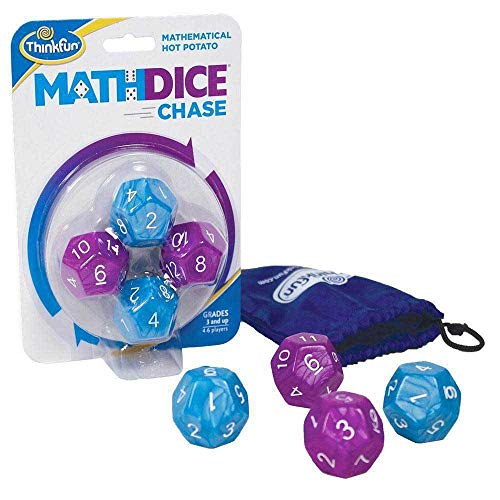
A complete game can reduce planning. ThinkFun Math Dice Junior and ThinkFun Math Dice include instruction support in the supplied evidence, while ThinkFun Math Dice Chase is described as an easy-to-learn group game with a manual. Math Dice Chase also documents a pass-the-dice multiplication race for four to six players, making it a fit for active small-group sessions.
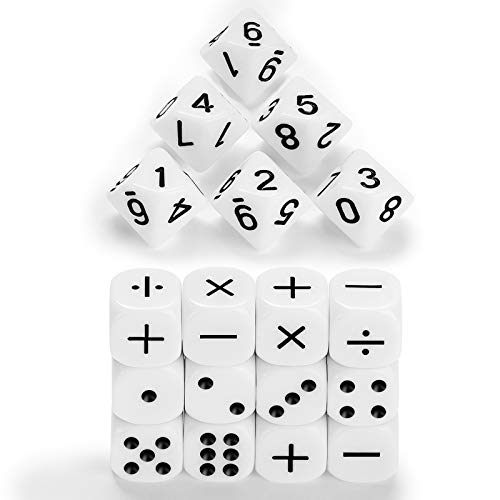
Teaching aids leave more control with the adult. NUOBESTY 24-Piece Math Game Dice Set includes operation signs, polyhedral number dice, and dot cubes. That combination can support equation building, counting, and comparison activities, but the listing does not document a rulebook. Koplow Games Operators Dice similarly focuses on operators, so the teacher or parent will need to supply the activity structure.
Check quantity against the setting
Quantity matters when several learners need to roll at once. The NUOBESTY set lists 24 pieces, and Learning Advantage Place Value & Decimal Dice lists a set of 10. The six-piece Didax fraction set and six-piece Koplow operator set are more naturally suited to a focused station or small group. The Whole Number Dice Game Set is described as a set of eight in its features, although another supplied field lists six; that inconsistency should be clarified before ordering.
For one learner, a larger quantity is not automatically better. A compact game kit may provide enough components while adding a defined challenge. For a classroom, count the documented pieces and consider whether learners will share, rotate, or work in teams. The listings do not establish a universal class size, so the best fit depends on the activity plan.
Consider face type and visual reading
Standard six-sided dice are familiar, but math dice may use symbols, fractions, decimals, or higher-sided number formats. ThinkFun Math Dice Chase documents two pairs of 12-sided dice, supporting its multiplication-race design. NUOBESTY combines several dice formats, which may provide more ways to build problems than a traditional dot-only set.
Size is another practical specification. Koplow Games Operators Dice and Koplow Games Intermediate Multiplication Dice list a standard 15mm-17mm range. The Whole Number Dice Game Set lists 16mm dice, and NUOBESTY lists 16mm pieces. Inspect the supplied size and intended activity rather than assuming every math die has the same markings.
Review storage and portability
Storage can affect whether a product works for travel, tutoring, or repeated classroom cleanup. ThinkFun Math Dice and ThinkFun Math Dice Chase each list a game-go bag. Math Match is identified as a travel dice game, while the other selected products provide varying levels of storage information. The absence of a stated bag or case does not prove that none is included; it means the supplied evidence does not confirm one.
Use the specifications carefully
This is a specification-based comparison, not a hands-on test. It does not establish how smoothly a product rolls, how durable it is in extended use, or how engaging learners will find it. Focus on documented features: mathematical topic, component count, die size, player range, instruction support, and storage. Avoid treating a specialized set as a full game unless the listing describes rules or gameplay.
Final Recommendation
NUOBESTY 24-Piece Math Game Dice Set ranks first overall in this specification-based comparison under the published weighted criteria.
NUOBESTY 24-Piece Math Game Dice Set is the highest-scoring returned product and the first overall specification-based choice.
The final choice among the best standard math game dice depends on the documented features that match the intended use.
ThinkFun Math Dice is a strong option for shoppers who want a compact arithmetic game with target dice, scoring dice, practice tables, and a game-go bag. For the top standard math game dice focused on group activity, ThinkFun Math Dice Chase is the targeted alternative because its listing documents four 12-sided dice, a multiplication race, and play for four to six people. Choose NUOBESTY when symbol dice and equation construction matter most. For a specific curriculum need, select Learning Advantage Place Value & Decimal Dice for decimals or Didax Educational Resources Fraction Dice for fractions. Families wanting broader operation coverage can consider Scholastic Math Match Travel Dice Game, while younger beginners may prefer ThinkFun Math Dice Junior.
Frequently Asked Questions
What are the best standard math game dice for basic arithmetic?
ThinkFun Math Dice is the most directly aligned general arithmetic option in this selection. Its listing identifies target dice, scoring dice, practice tables, and a storage bag. Those details indicate a more complete activity structure than a basic set of standard dot dice, although this comparison does not test gameplay.
Which selected product is best for multiplication practice?
ThinkFun Math Dice Chase is designed around a multiplication race and uses two pairs of 12-sided dice. Koplow Games Intermediate Multiplication Dice is another focused choice because its listing specifically mentions multiplication-table practice and a standard 15mm-17mm size. The better fit depends on whether the learner needs a group game or a teaching aid.
Are standard math game dice useful for fractions and decimals?
Yes, when the markings match the lesson. Didax Educational Resources Fraction Dice is listed for creating fraction games and activities. Learning Advantage Place Value & Decimal Dice is focused on place value and decimals. These specialized products may be more suitable than general arithmetic dice for targeted instruction.
Which math dice set offers symbols for building equations?
NUOBESTY 24-Piece Math Game Dice Set lists operation signs including plus, minus, greater-than, and less-than symbols. It also includes polyhedral number dice and dot cubes. The supplied evidence supports equation and comparison activities, but it does not document a specific rulebook or prescribed game.
How should I choose math dice for a classroom?
Start with the number of learners who will roll simultaneously, then compare the documented piece count and activity format. The NUOBESTY set lists 24 pieces, while the selected specialized teaching aids range from six to 10 pieces. Complete games such as ThinkFun Math Dice Chase may be easier to organize for small groups, while operator or fraction dice may work better at lesson stations.