Buying Guide
Choosing among the best metal can crushers starts with the containers you actually recycle and the place where the tool will be used. The selected products include fixed wall levers, floor pedals, a folding press, and an electric automatic model. Because this is a specification-based comparison, the guidance below interprets supplied listing details rather than reporting hands-on results.
Match the crusher to your can sizes
Can-size compatibility is the first filter. Standard 12-ounce soda cans and 16-ounce beer or seltzer cans are covered by many models, including McKay, HomeBuddy, KASTUN, X5MPLXPMX, and Sinotekk. If you use smaller or larger containers, check the stated range rather than assuming a general-purpose design will fit.
MasterCrush documents the broadest range in this selection: 12, 16, 24, and 32 ounces. That makes it the most flexible choice for mixed household recycling. KOTTO covers 8 through 16 ounces, while YOTAN lists 8-, 12-, and 16-ounce cans. Dial Industries takes a different approach and is specifically limited to approximately 12-ounce cans; its listing says it is not for larger 16-ounce cans.
Some listings also mention plastic bottles. JOYTUTUS is described for aluminum, tin, and plastic containers up to 24 ounces, and MasterCrush, YOTAN, HomeBuddy, and KOTTO also mention bottle use. Treat that as documented compatibility, not as proof that every container shape will work equally well.
Choose wall mounting, floor operation, or electric power
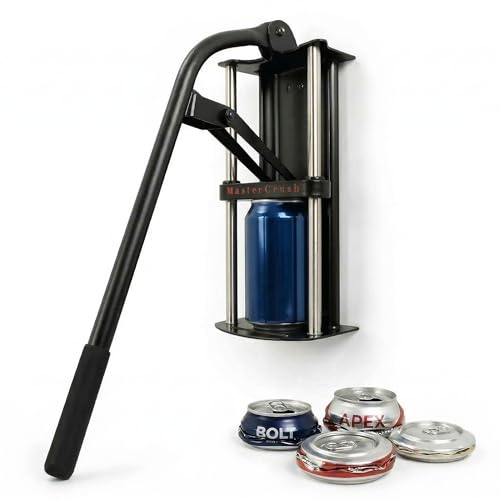
Wall-mounted models keep the crushing point at a fixed height and can be positioned near a recycling or trash bin. MasterCrush, McKay, HomeBuddy, KOTTO, X5MPLXPMX, and Sinotekk include or describe mounting hardware. Before choosing one, identify a solid wall, table, countertop, or other approved surface. A permanent mount can make repeated use convenient, but it is not ideal for renters or mobile setups.
The JOYTUTUS and KASTUN designs avoid that installation commitment. JOYTUTUS is foot operated, portable, and supported by non-slip pads. KASTUN is a folding floor crusher with no wall-mounting requirement, a useful distinction for apartments, dorms, RVs, and other temporary locations. Floor models need enough clear space for stepping and storage, but they avoid drilling.
YOTAN introduces electric operation. Its listing says it connects to a standard household outlet and can operate on a tabletop or wall. The automatic circulation function may be attractive for users who want repeated cycling without repeatedly pulling a manual handle. The trade-off is dependence on power and a setup that is more involved than a basic lever.
Inspect construction and can retention
Construction descriptions help separate a simple manual tool from a more reinforced design. MasterCrush lists powder-coated steel and stainless steel rods. HomeBuddy lists thick sheet steel with reinforced rivets and bolts, while KOTTO lists high-carbon steel, reinforced rivets, and sturdy bolts. X5MPLXPMX provides the most detailed retention language, citing inner-wall brackets, front pillars, and a reinforced base.
Can retention matters because a container needs to remain positioned while the lever or pedal is used. HomeBuddy describes a rubber-lined base, KASTUN mentions a top spike and retaining metal stick, and X5MPLXPMX lists anti-pop pillars. These features are specifications, not a guarantee of a particular result, but they are useful when comparing designs.
Handles also affect the stated operating design. McKay, Sinotekk, and MasterCrush describe cushion, anti-slip, or gripped handles. Dial Industries lists a rotating hand grip and pivoting system, while JOYTUTUS uses a spring-supported pedal. Look for the handling feature that matches your preferred motion instead of assuming every manual crusher feels the same.
Consider the crushed-can destination
A crusher is easier to use when the result can move directly into the appropriate container. KOTTO documents an auto-drop system, and Dial Industries describes automatic dispensing. These are especially relevant when you do not want to pick up wet, sharp, or sticky crushed cans. Other manual wall models may require the user to remove each crushed container.
The selected listings commonly describe space reduction. MasterCrush, KASTUN, McKay, and X5MPLXPMX state results near 20% of original size, while HomeBuddy describes approximately 1-inch pieces and Sinotekk gives a range near 1.1 to 1.5 inches. YOTAN lists compression to approximately 35% of original size. These figures come from product listings and should be treated as stated specifications, not independently verified measurements.
Review included equipment and maintenance notes
Included hardware can simplify installation. MasterCrush, HomeBuddy, KOTTO, X5MPLXPMX, and Sinotekk explicitly mention screws, anchors, or mounting hardware. X5MPLXPMX also lists protective gloves. If a model does not clearly state that hardware is included, confirm the package contents before planning installation.
Maintenance instructions are limited in the supplied evidence, but KASTUN specifically cautions that cans should be emptied of residual drinks because liquid may affect service life. That is a sensible preparation step for any manual crusher. The selected designs also vary in extra functions: McKay, X5MPLXPMX, and Sinotekk include bottle openers, while Dial Industries emphasizes collection and dispensing features.
Final Recommendation
JOYTUTUS Foot-Operated Can Crusher ranks first overall in this specification-based comparison under the published weighted criteria.
The final choice among the best metal can crushers depends on the documented features that match your intended use.
MasterCrush Heavy Duty Wall Mounted Can Crusher is the highest-scoring returned product and the first overall specification-based choice. Its documented 12- to 32-ounce range, steel construction, stainless steel rods, and included mounting screws give it the broadest general-purpose specification profile.
For a portable setup, JOYTUTUS is the stronger fit because its foot pedal, spring design, non-slip pads, and no-installation format suit RVs, apartments, and outings. Choose YOTAN when automatic cycling and tabletop or wall placement matter more than manual simplicity. Dial Industries is the targeted pick for repeated 12-ounce batches because of its pivoting system, automatic dispensing, and collection capacity.
Among the top metal can crushers for fixed manual use, HomeBuddy, KOTTO, McKay, X5MPLXPMX, and Sinotekk offer different priorities: cushioned retention, auto-drop handling, a simple all-steel lever, reinforced anti-pop construction, or a built-in bottle opener. KASTUN is the practical no-drill alternative. Confirm the can sizes, installation surface, operating method, and package contents before buying.
Frequently Asked Questions
MasterCrush documents compatibility with 12-, 16-, 24-, and 32-ounce cans. It is the broadest stated range among the selected products, making it a logical choice for households with mixed can sizes.
Are any selected can crushers suitable for renters or RV owners?
Yes. JOYTUTUS requires no installation and is described as portable for apartments, RVs, and outings. KASTUN also avoids wall mounting and is listed for apartments, dorms, rental homes, RVs, and houseboats.
Do all of these products work with 16-ounce cans?
No. Dial Industries Easy Pull is specifically for approximately 12-ounce cans and its listing says it is not for larger 16-ounce cans. MasterCrush, JOYTUTUS, YOTAN, HomeBuddy, KASTUN, McKay, KOTTO, X5MPLXPMX, and Sinotekk document 16-ounce compatibility in their supplied details.
What is the advantage of an auto-drop or automatic-dispensing design?
KOTTO documents an auto-drop system, while Dial Industries describes automatic dispensing. These features are intended to move crushed cans toward a bin or away from direct handling. They may be useful when the crusher is mounted above the destination container.
Should cans be emptied before crushing?
KASTUN specifically advises emptying residual drinks because liquid may affect service life. Emptying cans also helps keep the surrounding area cleaner, although the supplied evidence does not establish a universal maintenance rule for every model.