Buying Guide
The best oscillating wall-mounted fans should be selected by the space first, then by airflow and controls. A bedroom, office, greenhouse, garage, and warehouse have different requirements. Public listing specifications can identify useful differences, but they do not replace checking wall construction, electrical access, clearances, and the intended operating environment before installation.
Match fan size to the room
The selected models range from 12 to 30 inches. Smaller indoor units such as the PELONIS are easier to place in bedrooms, offices, and RV spaces. A 16- to 18-inch model is a more general-purpose choice for rooms, garages, and workshops. The VAGKRI, Simple Deluxe, Hurricane, and Air King examples all document wall mounting and oscillation while staying below the largest industrial formats.
For open or demanding areas, a 20- to 24-inch fan may be more suitable. The iLiving, VEVOR, hykolity, and BILT HARD listings specify airflow figures from 4,650 to 6,500 CFM. Those figures are listing claims, not independent test results, but they provide a useful way to compare the intended scale of each product. The 30-inch Comfort Zone model is the largest selected option and emphasizes an all-metal build and adjustable arm.
Consider airflow measurement carefully
CFM is useful when it is supplied, especially for large spaces, but not every listing uses the same measurement language. Some products report CFM, while others give wind velocity or a noise figure. The PELONIS lists 15 feet per second wind speed and a 33-foot airflow range; VAGKRI lists 20 feet per second; and Simple Deluxe lists up to 18.03 feet per second. These are not directly interchangeable with CFM.
For a workshop or warehouse, documented high CFM and a sturdy motor may matter more than bedroom-oriented modes. For a bedroom or office, controllability and the stated operating level may be more useful. The PELONIS listing, for example, identifies 36 dB operation, while the VAGKRI lists Normal, Breeze, and Sleep modes.
Check oscillation and tilt range
Oscillation determines how widely air moves from side to side. Several selected fans specify 90-degree oscillation, including iLiving, VEVOR, Hurricane, Air King, VAGKRI, and PELONIS. The hykolity and BILT HARD industrial models specify 80 degrees.
Tilt adds vertical aiming. A fan with both movement types can spread air across a room or target a workstation, plant area, aisle, or seating zone. Industrial models often combine oscillation with a manually adjustable head. Before buying, confirm that the planned wall position leaves enough room for the head to move and that the mounting surface can support the listed weight.
Decide between remote, timer, and pull-chain controls
Remote control is useful when the fan is mounted high or used beside a bed or desk. The VAGKRI, PELONIS, and Simple Deluxe models include remote-based operation in their listings. Timers are helpful for scheduled shutoff, but they should not be assumed when the listing does not document one.
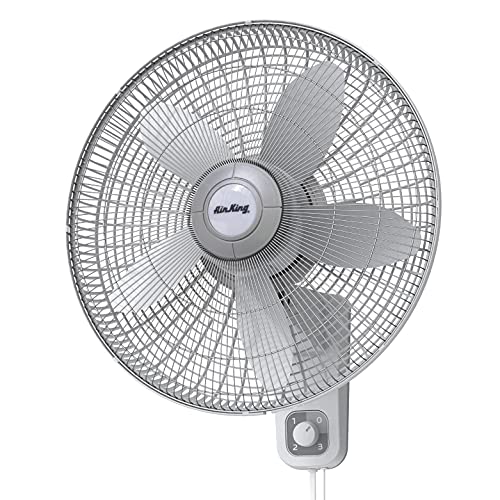
Pull-chain, dial, or cord-mounted controls are simpler and can make sense in workshops and garages. The iLiving uses pull-chain speed control, VEVOR uses a metal pull-string for three speeds, and Air King provides front-mounted rotary and pull-cord controls. These options may be preferable where direct access matters more than remote operation.
Review construction and installation details
A metal grille helps protect the blades, but the supplied evidence varies by model. Industrial choices such as iLiving, VEVOR, hykolity, BILT HARD, Comfort Zone, and Air King document metal or powder-coated components, aluminum or polypropylene blades, or compliant grille designs. The iLiving specifically describes weather-sealed construction and rust resistance for outdoor use. That does not mean every wall fan is suitable for exposure to rain or moisture.
Installation requirements deserve equal attention. BILT HARD and hykolity specify concrete-wall suitability, while Simple Deluxe states that mounting hardware and illustrated instructions are included. A wall-mounted fan still requires a suitable anchor, clearance around the moving head, and a safe power connection. Follow the manufacturer’s installation instructions rather than relying only on the product’s size or weight.
Choose the operating environment
For patios, greenhouses, and other potentially exposed locations, the iLiving is the clearest fit because weather-sealed and rust-resistant construction is expressly documented. For warehouses and jobsites, the 24-inch hykolity and BILT HARD models list high airflow, industrial construction, grounded cords, and compliant grilles. For ordinary indoor spaces, the PELONIS, VAGKRI, Simple Deluxe, Air King, and Hurricane provide more room-appropriate configurations.
The top oscillating wall-mounted fans are not interchangeable: a high-velocity industrial fan can be excessive for a quiet bedroom, while a compact indoor model may not move enough air in a large workshop. Use the documented application guidance, dimensions, and controls as a starting point, then verify the installation location.
Final recommendation
hykolity 24-Inch 6500 CFM Industrial Wall Fan ranks first overall in this specification-based comparison under the published weighted criteria.
Among these best oscillating wall-mounted fans, the hykolity is the first overall specification-based choice because it combines the highest documented airflow with industrial construction, an 80-degree oscillation range, tilt adjustment, a grounded cord, and compliant grilles. The iLiving is a strong alternative for outdoor-oriented use because its listing documents weather-sealed construction, rust resistance, 90-degree oscillation, and three speeds. For large indoor spaces, the BILT HARD 24-inch model also lists 6,500 CFM. VEVOR is a flexible middle-ground option, while the PELONIS and VAGKRI are better suited when indoor controls and comfort features take priority. These top oscillating wall-mounted fans should be ranked by application rather than by a single airflow number.
Frequently Asked Questions
What should I look for in the best oscillating wall-mounted fans?
Start with the intended room and mounting surface. Compare documented airflow, oscillation angle, tilt, speed settings, control type, construction, and any stated environmental suitability. A high-CFM industrial model is not automatically the right choice for a bedroom or office.
Are wall-mounted fans suitable for garages and workshops?
Yes, several selected listings specifically identify garages, workshops, warehouses, or commercial areas. The iLiving, VEVOR, Hurricane, hykolity, BILT HARD, and Comfort Zone models document utility or industrial applications. Check the wall material, electrical connection, blade clearance, and installation instructions before use.
Is a remote control important for a wall-mounted fan?
A remote can be useful when the fan is mounted above reach or used from a bed, desk, or seating area. The VAGKRI, PELONIS, and Simple Deluxe listings document remote control. Pull-chain and dial controls remain practical where simplicity and direct access matter more than remote operation.
Does a larger fan always provide better cooling?
Not necessarily. Larger selected models list higher airflow and are aimed at bigger spaces, but they also need more wall area and may be heavier. A smaller fan with appropriate oscillation, tilt, and controls can be a better fit for a bedroom, office, dorm, or RV.
Can an oscillating wall fan run outdoors?
Only when outdoor suitability is documented. The iLiving listing describes a weather-sealed motor and rust-resistant coating for outdoor applications. Do not infer weather resistance from wall mounting alone; verify the product’s environmental specifications and protect the electrical connection as directed.