Buying Guide
The best metal gate latches are selected by matching the latch design to the gate frame, post geometry, closing direction, and access needs. The listings in this comparison cover several distinct installation families rather than one universal format: automatic gravity latches, two-way farm latches, keyed residential hardware, magnetic pool latches, and chain-link fork latches. Start with the gate measurements before comparing finish or locking style.
Match the latch to the gate frame
Round-tube livestock gates need a clamp or hardware arrangement designed around the tube’s outside diameter. The SANKINS and HILLMASTER two-way farm models specify compatibility with 1-5/8- to 2-inch tubing, while the Lupar and Toplamper options specify narrower 1.5- to 1.9-inch ranges. Those numbers are not interchangeable. Measure the outside diameter of the round tube, then check the required clearance between the gate and post. SANKINS documents approximately 3 to 4 inches of clearance; the HILLMASTER farm latch lists approximately 2 to 2-3/4 inches.
Chain-link gates use a different format. VIVIDA is designed for matching 1-3/8-inch round posts and states a 1.8- to 3.4-inch spacing range. It also specifically excludes square posts. A wall-mount chain-link design is not included in this top 10, so do not assume a chain-link fork latch will work on a flat wall, square post, or oversized frame.
For residential metal fence gates, keyed and adjustable latches can be more suitable than livestock hardware. HILLMASTER’s keyed model accommodates posts from 1 to 6 inches deep and adjusts vertically and horizontally. National Hardware’s N346-201 is specified for materials including metal, wood, vinyl, and composite, with adjustment and compatibility up to 4-9/16 inches.
Choose the access method
Two-way operation is useful when the gate must open from either side. SANKINS, HILLMASTER’s farm latch, Lupar, and Toplamper all document two-way use, with one-handed operation described for the farm-oriented models. This can help when carrying tools, feed, or other items, but the correct tube fit remains essential.
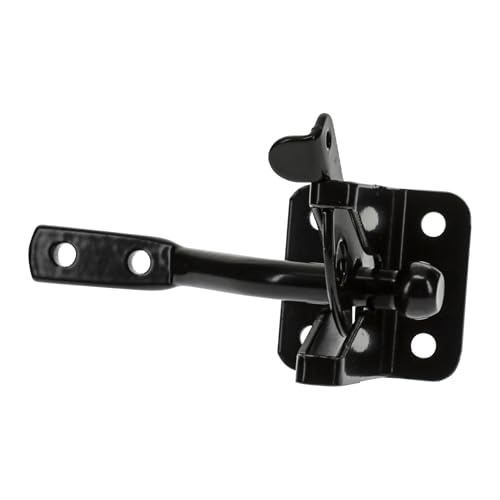
Automatic closing is a different priority. National Hardware’s N184-861 uses a self-latching mechanism that engages when the gate closes and provides fingertip release. The selected automatic option is most appropriate when consistent closure matters more than keyed entry.
A magnetic design can suit pool or child-safety areas. The Nationwide Industries Trident uses magnetic self-latching, has a keyed-alike configuration, and is listed for a 3/8- to 1-1/2-inch gate gap. Its listing identifies use with metal, vinyl, and wood gates. Check the gap and installation surface carefully because a specialized pool latch is not automatically a fit for every residential gate.
Decide how much security you need
A padlock hole or loop lets the owner add a separate padlock. That approach appears on the SANKINS, HILLMASTER farm, Lupar, Toplamper, and VIVIDA designs. It is useful when the lock can be chosen separately, but the latch itself does not include a built-in key cylinder according to the supplied evidence.
Keyed designs provide a more integrated access method. HILLMASTER’s two-sided model includes keys, and National Hardware’s N346-201 includes two keys with a latch and strike plate. The Trident is keyed alike, which the listing describes as allowing multiple units to use the same key. These options may be more convenient for residential access control, although their polymer or mixed-material construction means “metal gate latch” does not necessarily mean every component is metal.
Consider outdoor materials and finishes
Outdoor listings commonly mention galvanized, zinc-coated, plated, powder-coated, or corrosion-resistant construction. SANKINS uses galvanized steel; HILLMASTER’s farm latch uses zinc-coated steel; and VIVIDA specifies hot-dip galvanized steel. Those descriptions support outdoor-oriented selection, but they do not establish a service life in a particular climate.
National Hardware’s keyed model combines a polymer body with stainless steel components and lists resistance to rust, corrosion, and UV damage. The Trident likewise uses UV-resistant nylon polymer and states that it will not rust or corrode. These may be practical alternatives where corrosion resistance is important, even though they are not all-metal assemblies.
Check installation requirements
Included hardware and instructions are documented for many of the selected products, but installation requirements still differ. GH Gate Products requires drilling a 5/8-inch hole through the fence post. Its pull adjusts for 2-1/4- to 5-1/2-inch posts and operates from both sides, making it a useful option when through-post drilling is acceptable.
National Hardware’s automatic latch includes mounting hardware and supports left- or right-handed configurations. The keyed HILLMASTER model includes hardware, keys, and instructions. Farm latches generally require careful tube measurement and clearance checks before mounting. Installation claims in the listings do not replace confirming the gate’s swing, post alignment, frame thickness, and available mounting surface.
Final recommendation
National Hardware LokkLatch Keyed Gate Latch N346-201 ranks first overall in this specification-based comparison under the published weighted criteria.
The final choice among the best metal gate latches depends on the documented features that match your intended use.
National Hardware Automatic Gate Latch N184-861 is the highest-scoring returned product and the first overall specification-based choice. It combines automatic engagement, fingertip release, plated steel, corrosion resistance, included hardware, and left- or right-handed mounting. For round-tube livestock gates, SANKINS is the most specification-aligned specification-based alternative because its tube range, two-way action, galvanized steel, and padlock hole are clearly stated. For keyed residential access, the HILLMASTER Key Lockable 2-Sided Gate Latch and National Hardware LokkLatch Keyed Gate Latch provide the most relevant documented features. Among the top metal gate latches, choose by measured fit first, then select the security and operating method that matches the gate’s daily use.
Frequently Asked Questions
Measure the outside diameter of the round gate tube and the clearance to the post. SANKINS and HILLMASTER’s farm latch specify 1-5/8- to 2-inch tubing, while Lupar and Toplamper specify 1.5- to 1.9-inch tubing. Confirm the listed clearance before ordering and allow for the gate’s actual alignment.
Are keyed gate latches better than padlockable farm latches?
They serve different access needs. Keyed HILLMASTER and National Hardware models provide an integrated key-based method, while SANKINS, Lupar, Toplamper, and VIVIDA provide a padlock hole or loop for a separately selected lock. A keyed latch may simplify routine residential access; a padlockable model may suit changing farm access requirements.
No. VIVIDA is specifically listed for 1-3/8-inch round chain-link posts and a defined spacing range, and it excludes square posts. Measure both post diameter and spacing rather than relying only on the phrase “metal gate.”
What is the benefit of a two-way gate latch?
A two-way latch opens from either side, which can be convenient for farm work or gates positioned along a frequently used path. SANKINS, HILLMASTER’s farm latch, Lupar, and Toplamper document this type of operation. It does not remove the need to verify tube size, clearance, and post alignment.
Which selected latch is intended for a pool or child-safety area?
The Nationwide Industries Trident is the most specifically positioned for that use. Its listing describes magnetic self-latching, keyed-alike access, UV-resistant nylon polymer, included fasteners, and compatibility with metal, vinyl, or wood gates. Confirm the stated gate-gap range and local installation requirements before choosing it.