Buying Guide
Choosing among the best gate opener latches starts with identifying what the latch must do after the gate closes. Most of the selected models are mechanical gravity or spring-assisted latches: the gate closes, the latch engages, and a fingertip release, cable, handle, or key provides access. The right design depends less on appearance than on gate direction, material, gap, thickness, and the way people need to enter.
Start with the gate material and movement
Wood, vinyl, aluminum, and steel gates do not necessarily use the same mounting approach. Several selected products explicitly support more than one material, including the GH Gate Latch Complete Outdoor Latch, DURIGID Spring Loaded Gate Latch Pull, and HILLMASTER Model 612. That broad compatibility is useful for common residential fence projects, but it does not eliminate the need to check the gate frame and post structure.
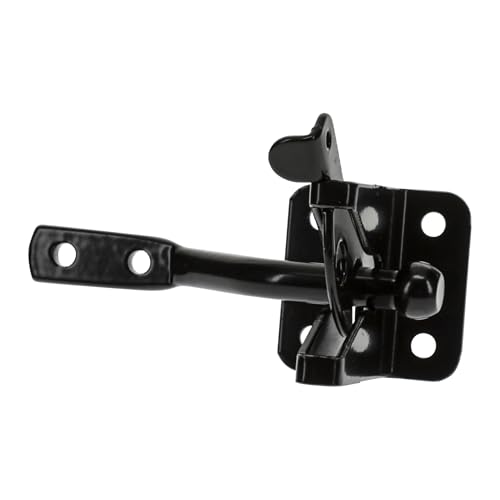
Also confirm whether the gate swings inward, outward, or in both directions. The National Hardware Automatic Gate Latch is described for outswing gates, while the JIAHOO Heavy Duty Gate Latch with Cable Pull supports inward and outward swinging. The HILLMASTER Double-Sided Gate Latch is more specialized: its listing specifies a right-inswing gate only. A mismatch here can prevent the latch from engaging correctly, regardless of the material or finish.
Decide how the gate should open
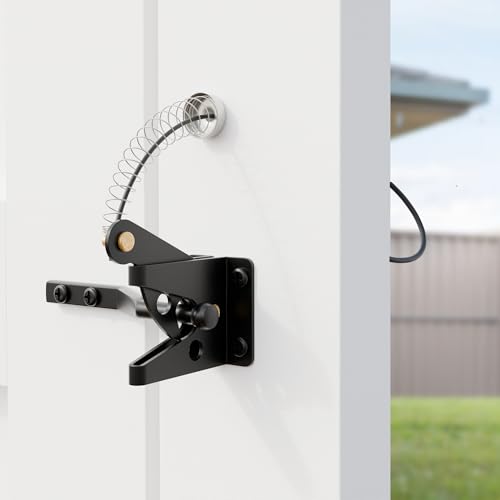
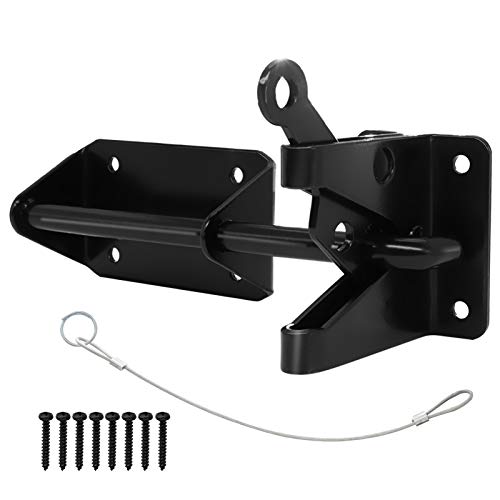
A standard fingertip release works well when the latch is easy to reach. If the latch is mounted on the far side of a fence, a cable pull is more convenient. The GH model combines a traditional gravity latch with an integrated pull and is specifically designed for operation from both sides. DURIGID also documents a cable that can be cut to the needed length.
Two-sided handles offer a different experience from a cable. The HILLMASTER keyed model opens from both directions and adds a built-in key lock, while the HILLMASTER double-sided model provides handles on both sides but limits use to the documented right-inswing configuration. Think about who will use the gate and whether key access, a pull cord, or a simple lever is easiest to operate with the gate closed.
Check gap, thickness, and post dimensions
Fit information is one of the most important parts of the selection process. The JIAHOO latch is stated to work with gaps up to 1.5 inches. HILLMASTER Model 005 is described for gaps up to 1-9/16 inches, while the keyed HILLMASTER model accepts gate-to-post gaps from 3/8 to 1 1/4 inches and posts from 1 to 6 inches deep.
For tubular farm gates, measure the outside diameter rather than guessing from the gate’s general size. The SANKINS 2-Way Lockable Farm Gate Latch fits 1 5/8- to 2-inch round tubing and calls for approximately 3-4 inches of clearance. The HILLMASTER double-sided model instead gives a door-thickness range of 1 3/8 to 3 1/2 inches. These are different fit systems, so a latch made for a round tube should not be treated as interchangeable with a surface-mounted fence latch.
Consider the locking method
A self-latching mechanism helps keep a closed gate shut, but it is not the same as a keyed lock. Many selected products include a padlock hole, including the DURIGID, JIAHOO, HILLMASTER, and SANKINS models. A padlock is generally separate unless the listing says otherwise. The HILLMASTER keyed model is the clearest choice when built-in keyed access is preferred because keys are included and no extra padlock or pin is required for its locking function.
For a basic backyard gate, a gravity latch with a padlock provision may be enough. For a pool, pet, or privacy gate, consider how the release will be reached and whether the lock must be operated from one or both sides. The published descriptions support these design distinctions, but they do not establish compliance with any local pool, child-safety, livestock, or building requirement.
Review outdoor material details
Outdoor finishes vary across the candidates. Powder-coated or plated steel appears on several selections, while the HILLMASTER double-sided model specifies aluminum alloy with a black powder coat and zinc-plated corrosion resistance. The keyed HILLMASTER model combines polymer and stainless steel in its description. SANKINS describes galvanized steel for its farm latch, and National Hardware specifies plated steel and a weather-resistant coating.
These details are useful indicators of intended outdoor application, but they are not hands-on durability results. Look for the material and corrosion-treatment description that best matches the site’s exposure. Coastal, wet, dusty, and high-use locations may place different demands on the hardware, and the supplied listing data does not provide a universal service-life estimate.
Plan the installation
Several products include mounting screws and instructions, but installation requirements are not identical. The GH latch requires a 5/8-inch hole through the fence post. The keyed HILLMASTER latch includes mounting hardware and instructions, while the National Hardware automatic latch is described as supporting left- or right-handed configurations with mounting components included.
Before ordering, measure the post, gate thickness, gate-to-post gap, swing direction, and any existing latch holes. Check whether the latch must mount to wood or whether the listing advises different screws for metal or aluminum. A model can have excellent access features and still be unsuitable if its strike, spindle, cable route, or mounting surface does not match the gate.
Final recommendation
GH Gate Latch Complete Outdoor Latch ranks first overall in this specification-based comparison under the published weighted criteria.
GH Gate Latch Complete Outdoor Latch is the highest-scoring returned product and the first overall specification-based choice. Its documented dual-sided operation, adjustable post fit, weather-resistant pieces, and complete hardware make it the most broadly useful option in this comparison.
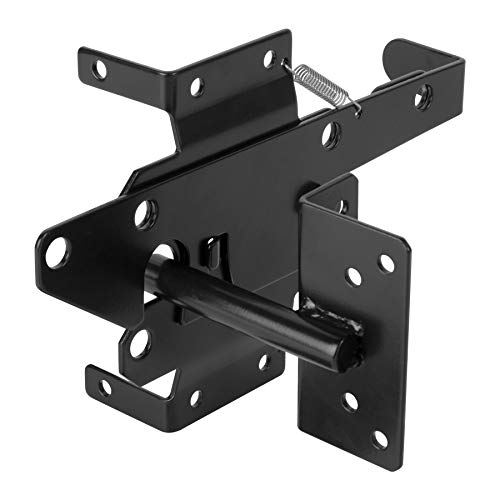
The HILLMASTER Heavy Duty Self-Locking Gate Latch is a better fit when substantial steel hardware and a positive bracket connection matter more than a compact design. National Hardware Automatic Gate Latch suits an outswing installation needing a clearly specified automatic strike. For keyed access, choose the HILLMASTER Key Lockable 2-Sided Gate Latch. For a tubular livestock gate, the SANKINS 2-Way Lockable Farm Gate Latch is among the top gate opener latches because its tube diameter and clearance requirements are explicit.
Before making a final choice, verify the measurements and swing direction. The best gate opener latches are not interchangeable simply because they share a self-locking description; the mounting geometry and release method determine whether a listed design is appropriate for the actual gate.
Frequently Asked Questions
What are the best gate opener latches for a wood privacy gate?
The GH Gate Latch Complete Outdoor Latch, DURIGID Spring Loaded Gate Latch Pull, HILLMASTER Model 612, and SANKINS Self-Locking Gate Latch all document compatibility with wood gates or fences. Choose among them by checking whether you need two-sided operation, a cable pull, a padlock hole, or a simpler fingertip release. Measure the gate-to-post gap before selecting a longer or standard latch.
Do gate opener latches lock automatically when the gate closes?
Several selected products describe gravity or spring-assisted self-latching. The National Hardware Automatic Gate Latch states that its mechanism engages automatically upon closing, and the DURIGID, HILLMASTER, JIAHOO, and SANKINS listings also describe self-locking or automatic engagement. This closing action does not necessarily mean the gate is keyed or padlocked; check the individual locking provision.
Are two-sided gate latches better than cable-pull latches?
Neither design is universally better. Two-sided handles or a dual-sided mechanism are useful when people need to open the gate from either side without routing a cable. A cable pull may be more convenient when the latch is on the opposite side of a fence. The GH model documents dual-sided operation with an integrated pull, while the HILLMASTER keyed and double-sided models document access from both sides in different ways.
What measurements should I take before buying a gate latch?
Measure the gate thickness, post depth or width, gate-to-post gap, swing direction, and any tube diameter if the gate is tubular. The SANKINS farm latch uses round-tube diameter, while the HILLMASTER double-sided model uses door thickness. Other examples provide gap limits, such as JIAHOO up to 1.5 inches and the keyed HILLMASTER model from 3/8 to 1 1/4 inches.
Can a padlock be used with these latches?
Many of the selected latches include a padlock hole, but the padlock is generally not included. The DURIGID, JIAHOO, HILLMASTER, and SANKINS listings document padlock compatibility or a padlock provision. The HILLMASTER keyed model instead includes a built-in key lock and keys. Confirm the lock style and hole arrangement before purchasing a separate padlock.