Buying Guide
The best metal spade drill bits are usually flat paddle bits made from steel, but the wording can be misleading. In the supplied listings, nearly every product is described primarily for wood, plywood, plastic, PVC, fiberglass, drywall, or similar softer materials. Only the Luckyway and COMOWARE listings explicitly name soft metals such as aluminum. None of the supplied evidence establishes that these products are intended for hard steel, stainless steel, or other demanding metal-drilling work. Choose based on the material named by the manufacturer rather than assuming that a metal-bodied bit is a metal-cutting bit.
Start with the material application
First separate construction material from intended work material. Carbon steel, high-carbon steel, heat-treated steel, chrome-plated steel, and titanium-coated carbon steel describe what a bit is made from or how its surface is treated. They do not, by themselves, prove that the bit is suitable for drilling hard metal.
For soft-material versatility, Luckyway and COMOWARE provide the clearest evidence because both specifically list soft metals such as aluminum along with wood, PVC, or fiberglass. For the remaining products, the supplied descriptions center on woodworking. That does not make them poor spade bits; it means their documented application is narrower.
Match the size range to the work
Sets are useful when hole diameters vary. Bosch DSB5013P, Jorgensen, EZUVITA, and Pinoze all cover a broad range reaching from 1/4 inch to 1-1/2 inches. Those sets are suited to projects that may involve several common hole sizes, such as routing openings for wiring, plumbing, or general wood assembly.
The Bosch SB0010 concentrates on sizes from 1/4 inch through 1 inch and includes intermediate diameters. That makes it a sensible choice for smaller and medium holes without adding the larger sizes. Luckyway covers 3/8 inch to 1 inch, while COMOWARE covers six sizes in the same general zone. These compact assortments may be easier to organize when unusually large holes are not part of the job.
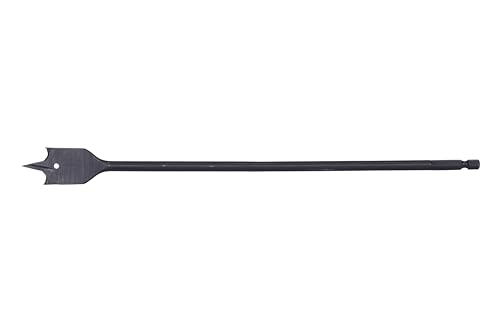
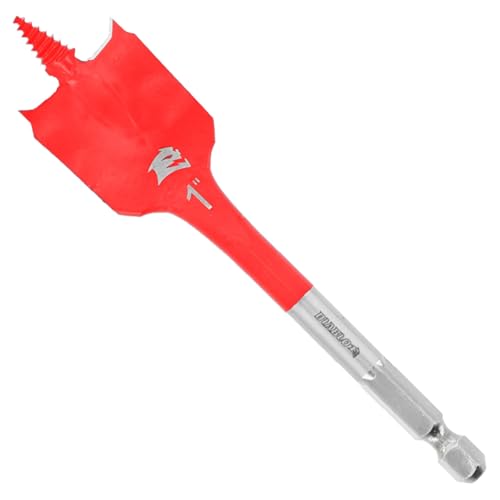
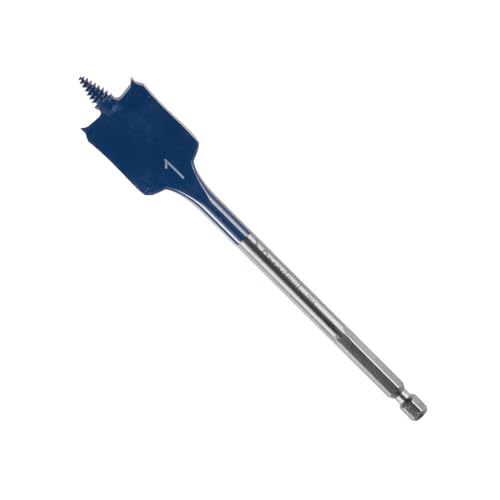
A single bit is more appropriate when the diameter is already known. The Bosch DSB1013, Century 36864, and Diablo DSP1060 each focus on a 1-inch bit. The Century offers a 12-inch overall length, while the Diablo is listed as 4 inches long. The Bosch listing does not provide a useful overall length in the supplied specifications, so it ranks on cutting design and shank features rather than reach.
Compare tip and paddle geometry
Tip design affects how a spade bit starts and moves material. Threaded or self-feeding tips appear on several selected products. Bosch DSB5013P and Bosch DSB1013 use a full-cone threaded tip, while Diablo uses a Speed-TIP design described as self-feeding. Jorgensen also lists a self-feeding threaded tip. These features are documented as helping the bit start or pull through wood, but the supplied evidence does not provide independent test results.
Spurs are another recurring feature. Bosch lists spur-and-reamer tips, Jorgensen uses double-sided cutting spurs, COMOWARE specifies dual-side spurs, and Century uses a raker spur design. Spurs are described as scoring or shaping the outer edge of a hole and reducing breakout. A contoured or curved paddle can also assist chip removal; that feature appears in the Bosch and Diablo listings.
The designs are not interchangeable in every situation. A chisel-point tip, as used by Bosch SB0010, is specifically associated in the listing with rapid partial-depth drilling. A three-point cross cutter, documented by EZUVITA, is another distinct geometry. Consider the kind of hole and material named in the product evidence instead of treating every flat bit as identical.
Check shank and driver fit
Most selected products use a 1/4-inch hex shank. This is useful for compatibility with many drill drivers and, where expressly stated, impact drivers. Bosch DSB5013P has a hex shank power groove, Bosch DSB1013 lists the same type of anti-slip feature, and the Jorgensen, EZUVITA, Pinoze, Luckyway, and COMOWARE sets describe 1/4-inch hex compatibility.
Do not infer impact-driver suitability from a hex shape alone. Jorgensen and Diablo explicitly mention impact-driver use in the supplied evidence. Century also specifies a 1/4-inch hex shank for drills and impact drivers. Other listings establish a hex fit but do not make the same tool claim. That distinction matters when selecting a bit for a high-torque driver.
An extension can help when the drilling point is recessed or difficult to access, but it also adds another connection. EZUVITA and Pinoze include 6-inch extensions, and Pinoze states that the extension can extend reach to 12 inches. Jorgensen includes a quick-load connector, which supports rapid bit changes but is not described as a long extension.
For straightforward, accessible holes, a standard bit may be simpler. The Century single bit is unusual because its overall length is listed as 12 inches without relying on a separate extension. That length may be helpful in deep or obstructed locations, although it may be less convenient in tight spaces.
Look at storage and maintenance details
A case or pouch helps keep a multi-size set together. Luckyway includes a tough case, while Jorgensen, Pinoze, and EZUVITA include pouches or roll-up storage. Storage is especially useful for sets with 10 or more sizes, where loose bits can be difficult to identify.
Maintenance information is less common, which makes Century distinctive. Its flat cutting zone is described as re-sharpenable with a common flat file. That does not guarantee a particular service life, but it gives the owner a documented maintenance option. Coatings and polished finishes are also listed on some products, including COMOWARE’s titanium coating and EZUVITA’s chrome-plated finish. Treat those features as construction details, not proof of performance on hard metal.
Use the right operating expectations
The evidence supports using these products mainly for wood and other softer materials. Jorgensen provides a maximum speed of 1,500 RPM, and EZUVITA advises a low-speed setting for larger sizes of at least 1 inch. Those are useful product-specific instructions. They should not be generalized to every selected bit.
For aluminum or another soft metal, select only a product whose supplied application evidence names that material, such as Luckyway or COMOWARE. Confirm the manufacturer’s current instructions before drilling, and do not use this list as evidence that any spade bit is appropriate for hardened or structural metal.
Final Recommendation
EZUVITA 14-Piece Spade Drill Bit Set ranks first overall in this specification-based comparison under the published weighted criteria.
Bosch DSB5013P is the first overall specification-based choice among the best metal spade drill bits because it combines 13 sizes, a full-cone threaded tip, a contoured paddle, spur-and-reamer tips, and a hex shank power groove. Jorgensen is a close alternative for users who want a pouch, quick-load connector, impact-resistant shaft, and a stated speed limit.
Choose EZUVITA or Pinoze when extension reach is important. Their 6-inch extensions and broad size ranges are the clearest fit for recessed or awkward holes. Bosch SB0010 is better suited to a smaller, partial-depth-focused assortment, while Century is the most distinctive single-bit option because its 1-inch bit has a 12-inch overall length and a documented re-sharpenable cutting zone.
For shoppers specifically seeking the top metal spade drill bits for soft aluminum as well as wood, Luckyway and COMOWARE have the clearest supplied application language. Their listings still do not establish suitability for hard metals. For a known 1-inch woodworking hole, Bosch DSB1013 or Diablo DSP1060 keeps the purchase focused instead of adding unused sizes.
Frequently Asked Questions
The supplied evidence does not support that conclusion. Most selected products are documented for wood, plastic, PVC, fiberglass, drywall, or related softer materials. Luckyway and COMOWARE specifically mention soft metals such as aluminum, but none of the listings establishes suitability for hard steel or stainless steel. Check the manufacturer’s application guidance before using any bit on metal.
What is the advantage of a 1/4-inch hex shank?
A 1/4-inch hex shank is widely compatible with drill drivers, and several listings describe reduced slippage or quick changes. Jorgensen, Century, and Diablo explicitly provide evidence for impact-driver compatibility, while other products establish hex-shank compatibility without making the same impact-use claim. Fit alone should not be treated as a complete operating recommendation.
Should I buy a set or a single spade bit?
Buy a set when you expect to drill multiple diameters. Bosch DSB5013P, Jorgensen, EZUVITA, and Pinoze provide especially broad coverage. A single bit such as Bosch DSB1013, Century 36864, or Diablo DSP1060 is more practical when the required hole size is already known. A single-bit purchase also avoids storing sizes you may not use.
When is an extension useful?
An extension is useful when the drilling location is recessed or difficult to reach. EZUVITA and Pinoze include 6-inch extensions, and Pinoze states that its extension can reach 12 inches. Extensions add a connection between the driver and bit, so a standard bit may be preferable where access is open and the hole is shallow.
Do coatings automatically make a spade bit better?
No. COMOWARE lists a titanium coating, and EZUVITA lists a polished chrome finish, but those details alone do not prove better results or suitability for hard metal. Compare the full specification set, including the stated application, cutting geometry, size range, and shank design. A coating should be considered one construction detail rather than a guarantee of performance.