Buying Guide
Dial calipers are a classic analog measuring tool, and the best metric dial calipers still earn a place on workbenches where battery-free operation and instant visual readings matter. This guide walks through the specifications that separate a basic 150 mm tool from a refined shop-grade instrument, so you can match a model to your work.
Understanding Metric Range and Graduation
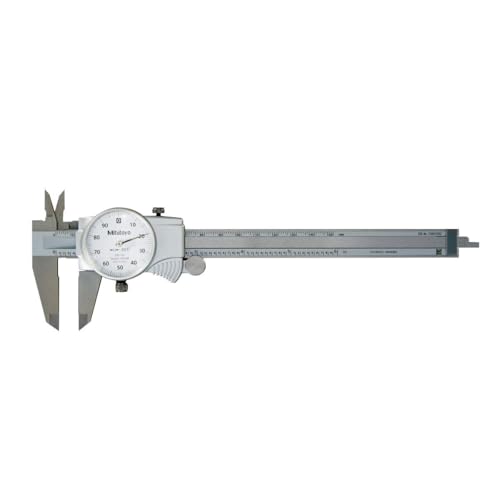
A dial caliper’s metric range defines what parts you can measure without repositioning, while its graduation defines how finely you can read the dial. Most of the best metric dial calipers use a 0-150 mm range, which suits the majority of machining, woodworking, and inspection tasks. Models like the Mitutoyo 505-732 list 0.01 mm accuracy with 1 mm per revolution, while the SPI 17-965-5 lists 0.02 mm graduation paired with a NIST traceability certificate.
Dial Readability and Dual Scale Layout
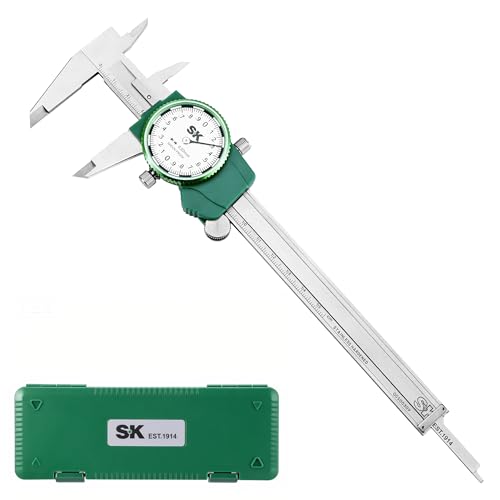
Clear dial markings reduce reading errors during long sessions. The Fowler 520300061 uses black 0.001 inch and red 0.02 mm graduations on a white dial, while the SK 6"/150 mm dial caliper pairs red and black pointers for inch and millimeter values. Larger dial faces and color coding are especially useful when you alternate between units or hand off measurements to a coworker.
Sliding Action and Shock Protection
A smooth, stable slide is essential for repeatable readings. Mitutoyo’s redesigned dial movement on the 505-732 and 505-742J supports a refined feel, and the TiN-coated sliding surface on the 505-732 is designed to extend wear life. The HFS 0-6"/150 mm dial caliper advertises a double shock-proof design, and the SPI 17-965-5 lists a shockproof mechanism as well, both intended to protect the internal gear train from everyday drops.
Frame Material and Long-Term Durability
Hardened stainless steel is the most common frame choice among the best metric dial calipers in this comparison, used by the iGAGING 6-Inch / 150 mm, the Accusize 0-6"/150 mm, and the HFS 0-6"/150 mm models. Some listings also mention satin chrome finishes to reduce glare, as on the Mitutoyo 505-742J, and covered racks, like the Fowler 520300061, which help keep dust and debris out of the gearing.
Measurement Capabilities and Control Features
Four-way measurement covers inside, outside, depth, and step dimensions, and it is standard on nearly every model here, including the SK 6"/150 mm, the iGAGING 6-Inch / 150 mm, and the SPI 17-965-5. Lock screws and thumb rollers add control: the Fowler 520300061 uses a knurled lock plus thumb-operated fine adjustment, the Accusize 0-6"/150 mm uses a precision-ground micro-lapped slide, and several models include a fitted storage case for protection between jobs.
Selecting the Right Range for Your Work
If you mostly measure small parts and components, a 0-150 mm range is typically sufficient. For longer workpieces, the Mitutoyo 505-733 D20FX and the Accusize 0-8"/200 mm expand coverage to 200 mm, while still using 0.01 mm or 0.02 mm graduations. Consider your largest typical part and choose a range that lets you measure it in a single pass to reduce stacking error.
Final Recommendation
Mitutoyo 505-742J 0-6" Dial Caliper ranks first overall in this specification-based comparison under the published weighted criteria.
The Mitutoyo 505-732 0-150 mm dial caliper stands out as the first overall specification-based choice among the best metric dial calipers thanks to its redesigned smooth-sliding movement, TiN-coated wear surface, and dual lock screws that support repeatable readings. For buyers prioritizing color-coded graduations, the Fowler 520300061 offers exceptionally clear black and red markings, while the SPI 17-965-5 adds NIST traceability for quality-controlled environments. Across this list of top metric dial calipers, focus on graduation, sliding feel, and lockable controls to find the model that best fits your shop’s measurement workflow.
Frequently Asked Questions
Among the best metric dial calipers, what makes a metric dial caliper different from a digital caliper?
A metric dial caliper uses a mechanical gear-driven dial to display measurements, so it does not require batteries and offers an instant analog readout. Digital calipers provide a numeric LCD reading and may add features like zero setting and unit toggling, but they depend on power and electronics.
Which graduation is best for precision work?
For most machining and inspection work, 0.02 mm graduation is the standard among the best metric dial calipers, while 0.01 mm models like the Mitutoyo 505-732 offer finer resolution. Choose based on the smallest increment you need to read reliably during routine tasks.
Do I need a 150 mm or 200 mm metric dial caliper?
A 0-150 mm range covers the majority of workshop parts and matches models like the iGAGING 6-Inch / 150 mm and the Fowler 520300061. Choose a 0-200 mm range, like the Mitutoyo 505-733 D20FX, if you regularly measure longer workpieces without repositioning.
Is shock protection important for a dial caliper?
Yes. A shock-proof gear mechanism helps protect the internal pinion and rack from impact damage that can introduce reading errors. Models like the HFS 0-6"/150 mm advertise a double shock-proof design, and the SPI 17-965-5 lists a shockproof construction to support long-term accuracy.
How do I keep my metric dial caliper accurate over time?
Wipe the sliding surfaces clean, store the tool in its fitted case, and verify zero on a known reference before critical measurements. Models with a manual dial calibration, such as the SK 0-150 mm, let you re-zero the bezel without affecting the slide, which helps maintain consistent readings.