Buying Guide
The best vinyl ring terminals are selected by fit first, not by pack size alone. A terminal must match the conductor’s gauge range and the stud or bolt it will sit on. The supplied products cover several useful combinations, including light 22-18 AWG wire, common 16-14 AWG wire, heavier 12-10 AWG wire, and a specialized 4-gauge option. They also include #10, #8-10, 1/4-inch, 5/16-inch, and 3/8-inch stud formats.
Match the wire gauge
Start with the wire, then choose the terminal. The Generic 22-18 AWG Easy-Entry Ring Terminal is the lightest selected option and is explicitly made for 22-18 AWG conductors. Thomas & Betts 14RB-10 covers #18-14 AWG, while the 3M Highland RV14-10Q, Conext Link RTV-516B25, Install Bay BVRT14, Install Bay BVRT38, and Install Bay BVRT10 are documented for 16-14 AWG wire. The Gardner Bender 10-106 and 3M 13-10-P move into the 12-10 AWG range. Conext Link RTV384-5 is the distinct heavy-gauge choice, with a stated 4-gauge fit.
Do not treat color as a substitute for checking the specifications. Several products use blue for 16-14 AWG and yellow for 12-10 AWG, but the actual title and feature data should control the purchase. If the conductor falls outside the listed range, choose another terminal rather than assuming the sleeve color proves compatibility.
Confirm the stud opening
The ring opening must pass over the fastener while remaining appropriate for the connection. The selected products document a broad spread of openings. The Generic 22-18 AWG Easy-Entry Ring Terminal, Thomas & Betts 14RB-10, 3M Highland RV14-10Q, and Install Bay BVRT10 identify a #10 stud or bolt-hole fit. Gardner Bender 10-106 lists a #8-10 stud-size range.
For larger hardware, Install Bay BVRT14 specifies 1/4 inch, Conext Link RTV-516B25 specifies 5/16 inch, and Install Bay BVRT38 plus Conext Link RTV384-5 specify 3/8 inch. These are not interchangeable merely because their wire ranges may overlap. Measure or confirm the fastener size before ordering, especially when a project uses larger battery, grounding, or equipment hardware.
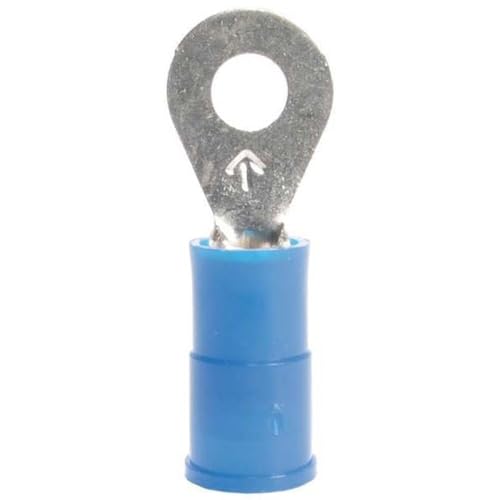
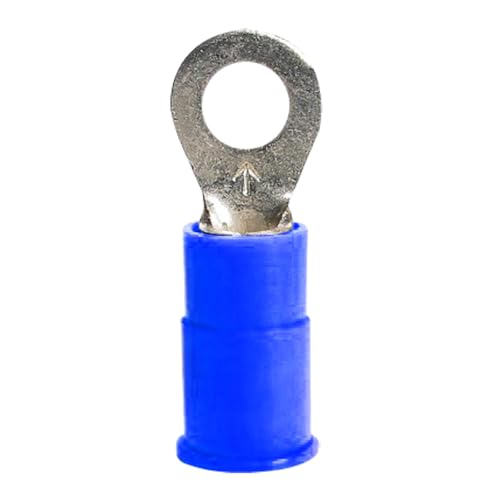
Vinyl insulation is the defining design feature in this group, but the listings do not provide equal levels of construction detail. The 3M Highland RV14-10Q is among the most fully described: its listing identifies a funnel-designed polyvinyl chloride sleeve, a butted-seam barrel, and a standard-style ring tongue. The Generic 22-18 AWG Easy-Entry Ring Terminal also identifies an easy-entry design and butted seam. Gardner Bender 10-106 is described as vinyl-insulated and crimp-type.
Other products establish the vinyl format without documenting the same level of geometry. Install Bay BVRT14, Install Bay BVRT38, Install Bay BVRT10, Conext Link RTV-516B25, and Conext Link RTV384-5 are therefore easier to compare on gauge, opening, color, and quantity than on detailed barrel construction. This distinction matters when a buyer needs a particular wire-entry style or wants to standardize a crimping process.
Look at conductor material and plating
Material information can help distinguish otherwise similar terminals. Conext Link RTV-516B25 and Conext Link RTV384-5 identify copper tin-plated construction. The 3M Highland RV14-10Q specifies electrolytic copper with tin plating, and Thomas & Betts 14RB-10 lists copper with tin plating. Those details provide more documented information about the conductive portion and surface treatment than products whose listings only state vinyl insulation.
The absence of a material claim is not proof that a terminal lacks a particular construction; it simply means the supplied listing does not establish it. Install Bay BVRT14, Install Bay BVRT38, Install Bay BVRT10, Gardner Bender 10-106, 3M 13-10-P, and the Generic 22-18 AWG model should be compared primarily on their documented fit and format rather than on an assumed conductor material.
Choose the pack size for the job
Pack quantity affects convenience and inventory planning. Five Conext Link RTV384-5 terminals suit a narrow 4-gauge task, while the 15-piece Thomas & Betts 14RB-10 and 25-piece formats from 3M Highland RV14-10Q and Conext Link RTV-516B25 are more suitable for limited projects. The 50-piece 3M 13-10-P pack provides more room for multiple 12-10 AWG connections.
The 100-piece Install Bay BVRT14, Install Bay BVRT38, Install Bay BVRT10, and Generic 22-18 AWG Easy-Entry Ring Terminal packs are better aligned with repeated repairs or maintaining a supply. Pack size should not override fit: a large quantity is not useful if the stud opening or wire range is wrong.
Use the evidence level appropriately
This is a public-listing comparison, not a hands-on test. The most reliable selection process is to prioritize products with direct evidence for the dimensions that matter to the installation. For example, the 3M Highland RV14-10Q gives detailed information about wire range, stud size, sleeve, barrel, copper, and plating. The Install Bay options are clearer on opening, gauge, and quantity but provide fewer material details. Both types can be useful, depending on whether the project needs construction documentation or a straightforward bulk supply.
Before crimping, verify the terminal against the wire, fastener, and applicable project requirements. Use the correct crimping method for the terminal design and do not infer current capacity unless the listing provides it. None of the selected products should be treated as universally suitable for every electrical environment.
Final recommendation
3M Highland RV14-10Q Vinyl Ring Terminal ranks first overall in this specification-based comparison under the published weighted criteria.
The final choice among the best vinyl ring terminals depends on the documented features that match your intended use.
3M Highland RV14-10Q is the highest-scoring returned product and the first overall specification-based choice. It offers the most specification-aligned combination of documented 16-14 AWG fit, #10 stud size, vinyl sleeve design, butted-seam barrel, electrolytic copper, and tin plating. For a larger stud, Conext Link RTV-516B25 is a clear alternative; for 4-gauge wire, Conext Link RTV384-5 is the specialized pick. Buyers seeking bulk stock can consider Install Bay BVRT14, Install Bay BVRT38, or Install Bay BVRT10 after confirming the opening. Among the top vinyl ring terminals, the right choice still depends on the wire and fastener in front of you.
Frequently Asked Questions
What should I check first when choosing the best vinyl ring terminals?
Check the wire gauge and stud opening first. A terminal such as the 3M Highland RV14-10Q is specified for 16-14 AWG wire and a #10 stud, while Conext Link RTV-516B25 uses the same broad gauge class with a 5/16-inch stud. Those are different mechanical fits even though their wire ranges are similar.
Which selected terminal is intended for lighter wire?
The Generic 22-18 AWG Easy-Entry Ring Terminal is the selected light-wire option. Its listing identifies 22-18 AWG compatibility, a #10 stud, vinyl insulation, an easy-entry format, and a butted seam. Thomas & Betts 14RB-10 is another lighter-range choice, covering #18-14 AWG with a #10 bolt hole.
Which options document copper and tin plating?
3M Highland RV14-10Q, Thomas & Betts 14RB-10, Conext Link RTV-516B25, and Conext Link RTV384-5 include copper and tin-plating information in the supplied evidence. Other selected products may have additional construction details, but their provided listings do not establish those material claims.
Are 1/4-inch, 5/16-inch, and 3/8-inch terminals interchangeable?
No. The opening must match the fastener used by the project. Install Bay BVRT14 documents a 1/4-inch opening, Conext Link RTV-516B25 documents 5/16 inch, and Install Bay BVRT38 plus Conext Link RTV384-5 document 3/8 inch. Confirm the hardware size before selecting a pack.
Is a 100-piece pack always the better choice?
Not necessarily. A 100-piece pack can make sense for repeated 16-14 AWG work, as with several Install Bay options, or for stocking lighter 22-18 AWG terminals. A smaller pack may be more appropriate for a specialized 4-gauge connection such as Conext Link RTV384-5. Choose quantity after confirming the terminal’s fit and documented design.