Buying Guide
The best one-touch d-ring binders are easiest to compare by separating the opening mechanism from the rest of the binder design. All selected models document a one-touch or EZD-style ring system, but they differ in capacity, cover construction, storage, and intended setup. A slim 1-inch model can suit routine paperwork, while a 4- or 5-inch binder is better reserved for large collections that would otherwise need several smaller volumes.
Start with ring capacity
Capacity is the clearest dividing line in this category. The Avery Heavy-Duty View 5-Inch Binder lists space for up to 1,050 sheets, while the Oxford 4-Inch and Cardinal Premier 4-Inch models each list up to 880 sheets. Those formats are aimed at substantial files and can reduce the number of separate volumes required.
The 3-inch choices provide a middle ground. The Oxford 3-Inch Binder, Cardinal Premier 3-Inch Binder, and Cardinal FreeStand 3-Inch Binder each list 650-sheet capacity. Avery’s 3-inch model lists up to 670 sheets. These sizes may be easier to handle than the largest formats while still accommodating large projects, presentations, or reference files.
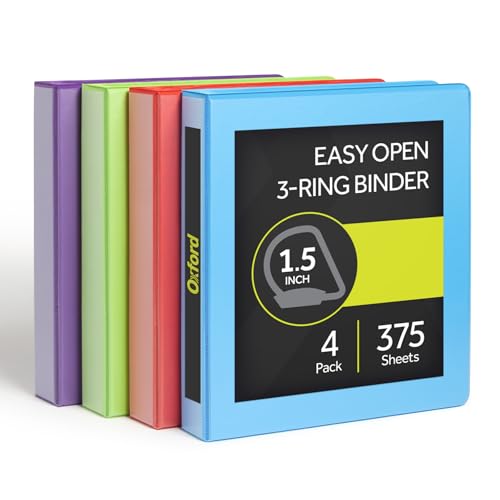
For everyday organization, the 1-, 1.5-, and 2-inch options are more restrained. The Avery 1-Inch model lists 275 sheets, while the Oxford 1.5-inch four-pack lists 375 sheets per binder, Cardinal’s 1.5-inch model lists 400 sheets, and the Avery 2-Inch model lists 540 sheets. Treat these figures as the supplied listing capacities rather than a guarantee for every combination of paper, dividers, and sheet protectors.
Check how the rings open and lock
One-touch access is useful when pages need to be added, removed, or rearranged frequently. Oxford and Cardinal describe a single-motion or single-tap operation with locking slant-D rings. Avery describes one-touch EZD rings and, on the 1-inch Heavy-Duty View model, gap-free ring closure. These details matter because the mechanism is the central reason to choose this binder type instead of a conventional ring binder.
Slant-D rings appear throughout the selected Oxford and Cardinal models. Their listed capacities are higher than the smaller Avery option, but ring shape alone should not determine the purchase. Compare the stated capacity, binder width, and the type of material you plan to store. A larger ring can hold more paper, yet it also creates a wider binder that may be less convenient on a crowded desk.
Compare cover customization
ClearVue or clear view covers allow the front, spine, and back to be customized with inserts. Oxford, Cardinal, and the selected Avery Heavy-Duty View models document some form of clear cover or overlay. This is useful for identifying a subject, project, or archive without opening the binder.
The three-sided customization on the Oxford and Cardinal models is particularly practical when binders are stored vertically. Avery’s selected models also provide clear view areas, although the exact cover wording varies by model. If spine identification is important, confirm that the particular listing documents a spine overlay rather than assuming every clear-cover binder has the same arrangement.
Look at construction and page protection
Construction features differ by brand. Oxford and Cardinal specify reinforced XtraLife hinges, while Avery lists DuraHinge spines and DuraEdge edges on its Heavy-Duty View models. These are documented design features, not proof of performance under every use condition, but they help distinguish reinforced models from basic binders.
Several selected products also specify PVC-free, non-stick, or archival-safe materials. Such wording is relevant when printed pages, photographs, or frequently handled documents are being stored. It does not mean every paper type will behave identically, so consider the material description as one part of the selection rather than as a promise about long-term preservation.
Use pockets to reduce loose-paper clutter
Interior pockets are useful when a document is not punched or when handouts, notes, and accessories need a temporary home. The Oxford and Cardinal models generally document four pockets, and the Avery Heavy-Duty View models also list four clear pockets. The pocket count is more useful than a vague claim of extra storage because it gives you a concrete feature to compare.
The Cardinal FreeStand model adds a different organizational feature: a magnetic cover flap that allows the binder to stand on its own. It also includes five color-coded identification rings. That design is worth considering for shelf storage, especially when several projects need quick visual separation. It is less relevant if the binder will remain flat in a drawer.
Match pack size to your setup
Pack quantity can change the practical fit of a binder. Oxford offers selected 1.5- and 3-inch options in four-packs, while its 4-inch option is a two-pack. Avery and Cardinal’s selected models are single binders. A multi-pack may help build a consistent filing system across classes, departments, or projects, whereas a single large binder is more appropriate when one collection needs a dedicated container.
Color can also support organization. The Oxford 1.5-inch option uses natural pastels, while the Cardinal FreeStand uses color-coded identification rings. These are organizational conveniences, not performance features, so capacity and construction should remain the primary considerations.
Final recommendation
Cardinal Premier ONE-Touch 4-Inch Binder, Black ranks first overall in this specification-based comparison under the published weighted criteria.
Oxford ONE-Touch 4-Inch Binder, Blue, 2-Pack is the highest-scoring returned product and the first overall specification-based choice among the best one-touch d-ring binders. Its documented 880-sheet capacity, four pockets, three-sided ClearVue customization, one-touch slant-D rings, and reinforced XtraLife hinges create a strong specification profile for large files.
Choose the Cardinal Premier ONE-Touch 4-Inch Binder if you prefer a single-binder format with the same stated capacity and a complete set of pockets and cover features. The Avery Heavy-Duty View 5-Inch Binder is the capacity specialist, while the Avery Heavy-Duty 3-Inch and Avery Heavy-Duty 2-Inch models provide more moderate formats with documented DuraHinge and DuraEdge construction.
For several organized files, the Oxford 3-Inch four-pack and Oxford 1.5-Inch four-pack are practical starting points. The Cardinal FreeStand is the more specialized pick for upright shelf storage. In short, the top one-touch d-ring binders are not interchangeable: choose by capacity first, then confirm the cover, hinge, pocket, and pack features that fit your filing system.
Frequently Asked Questions
What size should I choose for routine office or school paperwork?
A 1-inch, 1.5-inch, or 2-inch binder is generally the more manageable starting point for moderate files. The selected Avery 1-inch model lists 275 sheets, while the Cardinal 1.5-inch, Oxford 1.5-inch, and Avery 2-inch options list higher capacities. Choose the smallest documented size that accommodates your papers, dividers, and any sheet protectors you plan to add.
Are one-touch slant-D rings different from EZD rings?
The supplied listings use different brand terminology. Oxford and Cardinal describe one-touch slant-D rings, while Avery describes one-touch EZD rings. Both product families document easy opening, but the exact mechanism and capacity vary by model. Compare the individual listing specifications rather than treating the names as identical across brands.
Which of the best one-touch d-ring binders is better for shelf storage?
The Cardinal FreeStand ONE-Touch 3-Inch Binder is the clearest shelf-storage choice because its listing documents a magnetic cover flap that lets it stand on its own. It also includes five color-coded identification rings. Standard binders may still work on a shelf, but the FreeStand is the only selected model with that specific freestanding feature.
Do clear view covers appear on every selected binder?
All selected models document some form of clear view, ClearVue, or customizable cover feature, but the details vary. Oxford and Cardinal specify front, spine, and back customization, while Avery’s descriptions emphasize clear view covers or overlays. Check the model’s supplied cover description if a specific panel is important.
Should I buy a single binder or a multi-pack?
A multi-pack is useful when you are separating subjects, projects, or departments and want a consistent system. The selected Oxford models include two- or four-binder packs. Avery and Cardinal’s selected products are single-binder formats, which may be preferable when one large file needs a dedicated container or when you do not need several matching binders.