Buying Guide
The best remote control floor fans are not all built for the same job. A tower fan prioritizes a narrow footprint and controls suited to bedrooms or offices. A pedestal fan usually offers more height and head adjustment for directing air across a room. High-velocity floor fans emphasize airflow and rugged construction for garages, gyms, workshops, and larger open areas. The right choice depends on where the fan will stand, how much direction control you need, and whether you want gentle circulation or forceful air movement.
Match the fan type to the room
For a bedroom or office, a tower design can be easier to place beside furniture. The Honeywell QuietSet HYF260 documents five sound and power settings, oscillation, a timer, and panel dimming. The Lasko 42-Inch T42951 adds a nighttime setting, 60-degree oscillation, and a 7.5-hour timer. These features are useful when you want remote control without bright indicators or frequent manual adjustments.
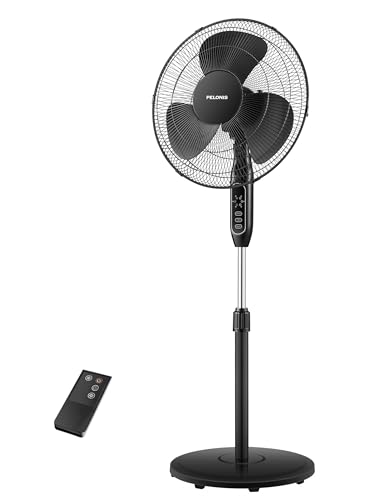
Pedestal fans are more adaptable when airflow needs to reach a bed, desk, sofa, or standing work area. The PELONIS model adjusts from 42 to 48 inches and includes tilt, 90-degree oscillation, a seven-hour timer, and overheat protection. The Amazon Basics 16-Inch Pedestal Fan combines height and tilt adjustment with three speeds and three modes. The Lasko Cyclone goes further in height range, from 41 to 53.5 inches, and documents 90-degree oscillation for larger rooms.
Check airflow and coverage claims
A numeric airflow figure can help identify fans intended for demanding spaces, but it should not be treated as a complete performance test. The Veoppca 20-Inch model lists up to 5200 CFM, while the FUGOO 18-Inch lists 4000 CFM. Those products are better aligned with garages, gyms, workshops, and large open areas than with a small bedside table. The AHAWILL high-velocity model lists six speeds and reversible airflow but does not supply a CFM figure, so its versatility is clearer than its precise output.
For ordinary rooms, oscillation and aiming features may matter more than a headline airflow number. A 90-degree oscillation range can distribute air across a wider section of a room, while tilt lets you aim the stream upward or downward. The Comfort Zone fan combines both with adjustable height, and the SONBION adds manual vertical movement to its automatic side-to-side oscillation.
Compare remote and timer functions
Remote controls are most useful when they operate more than power. Look for speed, oscillation, mode, and timer access. The PELONIS and Amazon Basics models document several of these controls. The Lasko tower remotes also manage nighttime settings, while the SONBION supports timer periods from one to seven hours. Timers can reduce the need to leave a fan running indefinitely, but the available duration varies considerably.
The AHAWILL model adds app control and rear buttons, giving it three documented control methods. That may be useful in a workshop or garage where the fan is wall-mounted. The high-velocity Veoppca model keeps the control scheme simpler with remote power, speed, and 1-, 2-, and 4-hour timer settings.
Consider placement, height, and storage
Measure both the fan and the space around it. Pedestal products need room for their base and may be less convenient beside narrow furniture. The Comfort Zone fan addresses storage with a folding quad-pod base. The tower models occupy a slim vertical footprint, while the industrial fans are designed around large airflow and may be wider or heavier in appearance.
Height adjustment is valuable when airflow must clear a bed or desk. The Lasko Cyclone has the broadest documented pedestal height range in this selection, and the SONBION uses interchangeable support tubes for different configurations. If the fan will move between rooms, also consider handles and listed weight. The Lasko T42951 includes a carry handle, while the SONBION lists a lightweight three-pound build.
Review construction and safety details
Construction should fit the environment. The FUGOO uses metal housing and aluminum blades and is ETL-listed. The AHAWILL is described as an all-metal industrial fan, while both Veoppca models include wall-mounting hardware and UL certification in their supplied features. These details are relevant for garages and work areas, but they do not by themselves establish a measured durability result.
For residential use, look for practical stability and protection features. The PELONIS lists a weighted base and automatic overheat protection. The Comfort Zone includes a metal safety grill, and the SONBION lists a solid base and plastic construction intended not to rust or corrode. Follow the product’s assembly and placement instructions, especially when using a wall bracket or a tall pedestal.
How this comparison was scored
This is a specification-based comparison using supplied public listing data, not a hands-on test and not a summary of customer opinions. Scores emphasize documented airflow capability, room coverage, remote and timer functions, physical adjustment, placement flexibility, and construction or safety utility. No customer ratings, review totals, popularity indicators, or marketplace labels were used in the published criteria. Because listings differ in the measurements they provide, a missing specification was treated cautiously rather than assumed.
Final Recommendation
Veoppca 20-Inch Industrial Floor Fan ranks first overall in this specification-based comparison under the published weighted criteria.
The FUGOO 18-Inch High Velocity Floor Fan is the highest-scoring specification-based choice among these best remote control floor fans. Its stated 4000 CFM airflow, eight speeds, tilt head, metal construction, aluminum blades, and ETL-listed compliance make it especially suitable for large rooms, garages, gyms, and commercial-style spaces. It does not document a timer, so bedroom shoppers may prefer the PELONIS or one of the Lasko tower models.
For the top remote control floor fans in ordinary residential rooms, the PELONIS is the most balanced pedestal option because it combines 90-degree oscillation, adjustable height, tilt, remote control, a seven-hour timer, and overheat protection. The Honeywell QuietSet HYF260 is a better fit when a slim tower and quiet-oriented controls are priorities. Choose the Veoppca 20-Inch when maximum documented airflow is more important than a compact footprint, or the Comfort Zone when folding storage is a deciding factor.
Frequently Asked Questions
Among the best remote control floor fans, what size fan is suitable for a bedroom?
A 16-inch pedestal model such as the PELONIS or Amazon Basics can suit a bedroom when adjustable height and broad airflow are useful. A tower such as the Honeywell QuietSet HYF260 or Lasko 42-Inch T42951 may fit better where floor width is limited. Room size, furniture placement, and preferred airflow direction matter as much as the listed fan diameter.
Are tower fans or pedestal fans better for remote control use?
Neither design is universally better. Tower fans generally offer a slim footprint and convenient nighttime controls, while pedestal fans provide height and head adjustment. The best remote control floor fans for you depend on whether space-saving placement or flexible airflow aiming is more important.
Do high-velocity fans work for home use?
They can, particularly in large rooms, garages, gyms, and workshops. The FUGOO and Veoppca models document high airflow figures and directional tilt, but their industrial formats may be less suitable for quiet bedside use. Review the available speed range, placement space, and whether the listing provides timer control before choosing one for a living area.
How important is an oscillation range?
Oscillation helps distribute airflow across a wider area instead of directing it at one fixed point. Several selected pedestal fans document 90-degree oscillation, while the Lasko tower models list 60 degrees. Tilt or vertical adjustment is also useful when airflow must reach a particular bed, desk, or seating height.
What should I check before installing a wall-mountable floor fan?
Confirm that the supplied bracket is intended for the chosen installation, use appropriate fasteners for the wall surface, and leave sufficient clearance around the fan. The Veoppca and AHAWILL listings document wall-mount options, but installation details should be checked against the product instructions before mounting.