Buying Guide
Choosing the best high-velocity wall-mounted fans starts with the space, not just the largest CFM number. Industrial wall fans are intended to move air through garages, workshops, warehouses, gyms, greenhouses, and other large areas. A suitable choice should also provide a mounting arrangement that works with the wall, enough directional control for the room, and construction suited to the environment.
Match airflow to the room
CFM is the central specification in this category, but it should be read alongside fan size and coverage. The ROVSUN 30-inch model lists the highest maximum airflow at 10,600 CFM. The BILT HARD and hykolity 30-inch models each list 9,500 CFM, while the Uthfy 26-inch model lists 9,200 CFM. These models are oriented toward large spaces where substantial air movement is the priority.
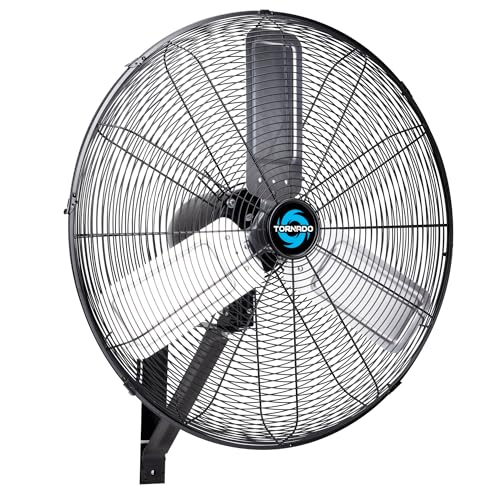
The Tornado and Landeagle models both list 7,200 CFM, making them substantial choices without moving to a 30-inch housing. The iLiving 18-inch weatherproof fan lists 6,360 CFM, and the selected 20-inch models range from 4,750 to 5,400 CFM. Smaller fans can be easier to position, but their documented maximum airflow is lower. Use the published figures as a comparison point rather than assuming that a maximum setting represents every speed.
Consider oscillation and tilt
Oscillation helps distribute airflow across a broader horizontal area, while tilt aims the air at a particular zone. Uthfy specifies 90-degree horizontal oscillation and 30-degree vertical tilt. Landeagle also lists 90-degree oscillation, and the iLiving 20-inch outdoor model documents the same horizontal range. The BILT HARD and hykolity 30-inch fans specify 80-degree oscillation, while ROVSUN documents 75-degree oscillation with a vertical adjustment range.
A fixed direction can be preferable when airflow needs to reach a workbench, doorway, aisle, or exercise area. The BILT HARD 20-inch outdoor model is notable for its 180-degree tilt, as are the HiCFM and some other fixed-aim designs. Check whether the listing describes horizontal movement, vertical adjustment, or both; these are different forms of coverage.
Select construction for the environment
Indoor industrial fans commonly use metal housings, powder-coated steel, and aluminum blades. The Tornado, BILT HARD, hykolity, Landeagle, and HiCFM listings all document combinations of these materials or related industrial components. Such construction can be appropriate for workshops and commercial spaces, but it does not automatically establish outdoor weather resistance.
For patios, gazebos, greenhouses, or humid locations, the iLiving 18-inch, iLiving 20-inch, and BILT HARD 20-inch outdoor models provide more relevant evidence. The iLiving listings describe weather-sealed or weatherproof designs and rust-resistant coatings. BILT HARD describes a fully enclosed motor and an outdoor-oriented design. Even with these claims, installation should follow the manufacturer’s environmental guidance and keep electrical connections appropriately protected.
Compare controls and operating features
Pull chains are common in this category and provide straightforward access to three speed settings. The ROVSUN, Tornado, Landeagle, and iLiving models use documented multi-speed controls. The BILT HARD and hykolity 30-inch models list three distinct airflow levels, which makes their performance settings easier to compare on paper.
The HiCFM model is the control specialist in this selection. Its supplied listing documents a remote, speed and oscillation adjustment, a 0.5-to-7.5-hour timer, natural or normal wind modes, and a 12-meter remote range. These features may be useful when the fan is mounted high or in a location that is difficult to reach. Remote operation should not replace checking the physical installation and power connection.
Check safety and installation details
Wall-mounted industrial fans need a suitable structural surface and adequate clearance. The BILT HARD and hykolity 30-inch listings specifically state that their mounting is suitable for concrete walls. The Tornado listing calls for expansion bolts on concrete or metal racks and does not recommend wooden walls. These details are important because a heavy fan and oscillating head place demands on the bracket and mounting points.
Safety documentation varies by product. UL or ETL references appear in the listings for several selected models, including Tornado, Uthfy, iLiving, HiCFM, BILT HARD, and hykolity. Other documented features include OSHA-compliant grilles, grounded cords, thermal protection, enclosed motors, and GFCI plugs. Treat each feature as model-specific rather than assuming it applies to every fan in the category.
Think about noise and maintenance
Only some listings provide a numerical noise specification. Landeagle states operation below 45 dB, while Tornado lists a maximum noise level of 69 dB. Those figures can help compare documented specifications, but they do not replace considering the room, mounting surface, and operating speed. Metal blades and housings may also require periodic cleaning in dusty workshops or commercial areas.
In general, avoid transferring an indoor-only specification to a damp or exposed installation. Also check cord length, bracket hardware, wall material, and the available electrical supply before selecting a location.
Final Recommendation
ROVSUN 30-Inch Industrial Wall Fan ranks first overall in this specification-based comparison under the published weighted criteria.
The final choice among the best high-velocity wall-mounted fans depends on the documented features that match your intended use.
ROVSUN 30-Inch Industrial Wall Fan is the highest-scoring returned product and the first overall specification-based choice for buyers prioritizing documented airflow. Its 10,600 CFM maximum, three speeds, 75-degree oscillation, and vertical adjustment give it a broad specification profile for large spaces.
The BILT HARD and hykolity 30-inch fans are compelling alternatives when UL documentation, defined airflow levels, grounded cords, and concrete-wall installation guidance matter. Uthfy is a strong fit for buyers who want 90-degree oscillation and documented thermal protection in a somewhat smaller 26-inch format. Tornado and Landeagle provide capable mid-size industrial designs, with Tornado emphasizing certification detail and Landeagle documenting low operating noise.
For exposed or humid locations, iLiving’s 18-inch weatherproof model, BILT HARD’s 20-inch outdoor fan, and iLiving’s 20-inch oscillating model offer the clearest environment-specific evidence. HiCFM is the practical choice when remote operation, a timer, and extensive control options are more important than maximum airflow. Together, these are the top high-velocity wall-mounted fans for comparing airflow, coverage, construction, and controls from published specifications.
Frequently Asked Questions
What should I look for in the best high-velocity wall-mounted fans?
Start with documented CFM, fan size, oscillation or tilt range, construction, control type, and mounting requirements. Then match those details to the room and installation surface. A high CFM figure is useful, but it does not explain whether the fan can direct air across the desired area or whether its construction suits a patio, greenhouse, or workshop.
Are all industrial wall fans suitable for outdoor use?
No. By contrast, iLiving’s selected models describe weather-sealed or weatherproof construction, and BILT HARD’s 20-inch model is presented as an outdoor fan with a GFCI plug. Always follow the individual product’s environmental documentation.
Is oscillation better than tilt for a wall-mounted fan?
They solve different airflow problems. Oscillation sweeps air horizontally across an area, while tilt directs airflow toward a particular zone. Models such as Uthfy, Landeagle, and iLiving’s 20-inch fan document 90-degree oscillation. BILT HARD’s 20-inch outdoor model and HiCFM document 180-degree tilt. Select oscillation for broader movement and tilt for targeted positioning, or choose a model that documents both.
Which selected fan has the most control options?
HiCFM documents the broadest control set: remote operation, three speeds, oscillation adjustment, a 0.5-to-7.5-hour timer, natural or normal wind modes, and manual tilt. Pull-chain models remain simpler and may be preferable when direct operation is convenient. The important comparison is whether the controls remain accessible after the fan is mounted high on a wall.
What wall should support a large wall-mounted fan?
The answer depends on the product and bracket. The BILT HARD and hykolity 30-inch listings specify concrete-wall mounting, while Tornado calls for expansion bolts on concrete or metal racks and does not recommend wooden walls. Confirm the supplied hardware, fan weight, clearance, and structural support before installation. A qualified installer may be appropriate when the wall material or mounting location is uncertain.