Buying Guide
Choosing among the best outdoor dog houses starts with fit, not appearance. A house should give the dog enough room to stand, turn, lie down, and enter without forcing the owner to rely on vague size labels. The supplied listings use different measurements and breed guidance, so compare the opening, interior, and overall footprint where those details are available. A larger exterior does not automatically mean a larger usable sleeping area, especially when a porch, storage cabinet, or raised platform occupies part of the structure.
Match the shelter to your dog
Small and medium dogs have the widest choice in this comparison. RUNSHED documents an interior of approximately 37 by 22 inches and suggests dogs weighing 40 to the current price. PawHut’s 56-inch porch model is listed for dogs under the current price, while the WHEGETED house is described for small and medium dogs. These details are more useful than choosing solely by an “XL” label.
For larger dogs, look at the documented footprint and interior claims together. Ketive lists a 55.1 by 33.1 by 34.8-inch structure with a 9.36-square-foot interior and a stated support capacity. The LZBEITEM metal house lists 39.7 by 35.8 by 33.3 inches and 9.8 square feet of interior space. VIXZEN’s large resin house is 38.62 by 36.26 by 38.07 inches. Measure your dog from nose to tail base and from floor to the top of the head, then compare those measurements with the entrance and interior information supplied by the manufacturer.
Choose the right construction
Plastic and PP houses are practical when you want smooth surfaces and relatively simple maintenance. VIXZEN, Fancyango, YITAHOME, and ZENY all document PP-based construction. Their listings emphasize waterproof or weather-resistant use, raised floors, and straightforward cleaning. These houses generally have fewer fabric parts than portable shelters and do not require the same type of wood-panel upkeep.
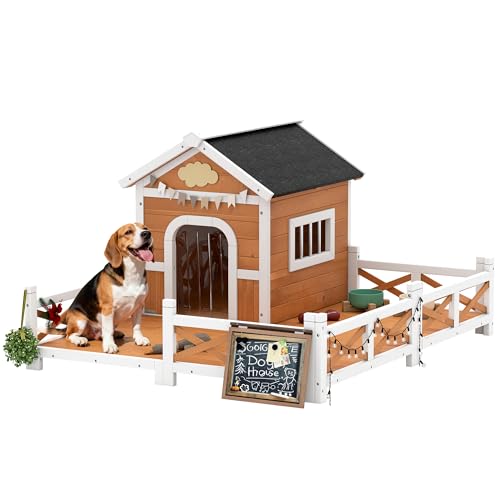
Wooden houses can provide a more enclosed, conventional shelter. RUNSHED uses thick pine and weatherproof roofing felt, while WHEGETED uses pine with weatherproof sealing and a mineral-style roof covering. The PawHut porch designs use solid fir wood. Wood may be appealing when you want a house with a porch, a sloped roof, or a more furniture-like appearance, but placement and upkeep still matter. Keep the structure on a suitable surface and follow the supplied assembly and care instructions.
Metal-frame designs provide another option. LZBEITEM uses a steel frame, and Ketive reinforces its wooden panels with an iron frame. These products may be worth considering when a rigid structure is a priority. Ketive specifically describes its frame as chew resistant, while LZBEITEM focuses on a durable metal structure and removable floor. Neither listing should be treated as proof of behavior under every dog’s chewing habits, so use these descriptions as design information rather than a guarantee.
Fabric shelters are different again. Veehoo combines a water-resistant polyester enclosure with an elevated bed, mesh windows, ground stakes, and windproof buckles. It can be attractive for owners who need a lighter shelter or a bed-like layout. However, fabric does not create the same rigid barrier as a wood, plastic, or metal house. Consider the intended location, wind exposure, and whether a more enclosed structure is appropriate.
Prioritize elevation and drainage
An elevated floor is one of the most repeated practical features in the selected products. It can separate the sleeping area from damp ground, dirt, cold surfaces, and standing water, but the listings do not establish identical performance in every environment. YITAHOME lists a 3.1-inch raised floor, PawHut’s 56-inch model lists a 2-inch raised base, and Ketive lists a 2.1-inch raised floor. Veehoo uses an elevated bed rather than a conventional enclosed floor.
Look for more than elevation alone. A sloped roof can direct rain away from the entrance, as documented for VIXZEN, ZENY, WHEGETED, and Fancyango. Wide eaves on YITAHOME are intended to help deflect rain. Curtains on RUNSHED, WHEGETED, PawHut, and Ketive may provide an additional barrier, but the evidence does not establish that any one curtain makes a house suitable for severe weather without other precautions.
Check ventilation and seasonal features
Outdoor shelters need airflow as well as protection from rain. RUNSHED has top ventilation, WHEGETED describes an integrated ventilation system, and Veehoo uses mesh windows with roll-up flaps. Plastic models such as ZENY and YITAHOME include vents, while VIXZEN’s selected model has adjustable shutters. These features can help owners manage airflow, but they are not a substitute for choosing a shaded, well-drained location.
Insulation claims vary. This comparison does not assume every plastic or wooden house provides equivalent thermal insulation. If cold-weather use is important, pay closer attention to the presence of a curtain, insulated wall construction, raised floor, and roof design rather than relying on the phrase “all weather.”
Consider cleaning and assembly
Cleaning access can influence whether a shelter remains practical. RUNSHED and WHEGETED include removable floors. PawHut’s selected porch house has an openable top and removable floor, while Ketive provides a top-opening roof and two removable bottom panels. VIXZEN, YITAHOME, and ZENY also document removable or openable roof access. These features can make it easier to remove bedding and inspect the interior.
Assembly details differ. RUNSHED, WHEGETED, and PawHut describe pre-drilled holes or included hardware. Fancyango and YITAHOME emphasize relatively quick setup, while Veehoo is designed for tool-free assembly. Assembly time is listing information, not an independent test result, so allow extra time and confirm that the house is stable before use. Ground nails or stakes can be useful where included, but they do not eliminate the need to choose a secure location.
Final recommendation
RUNSHED Insulated Wooden Dog House ranks first overall in this specification-based comparison under the published weighted criteria.
RUNSHED is the highest-scoring returned product and the first overall specification-based choice among these best outdoor dog houses. Its combination of thick pine, weatherproof roofing felt, removable curtain, ventilation, raised floor, removable floor panel, and specific size guidance gives it the most complete documented feature set for a snug small- or medium-dog shelter.
Ketive is a better fit when a large dog needs a spacious wooden structure with an iron frame. Veehoo is the distinct choice for a raised-bed fabric shelter, while PawHut’s 56-inch model suits owners who want a porch. For compact plastic designs, YITAHOME and ZENY offer useful combinations of elevation, vents, and cleaning access. Taken together, these are top outdoor dog houses for different layouts rather than interchangeable products.
Use the product dimensions and breed guidance as a starting point, and consider the dog’s sleeping position, the site’s drainage, prevailing weather, and how often the house will need cleaning before choosing.
Frequently Asked Questions
How should I size one of the best outdoor dog houses?
Measure your dog’s body length from the nose to the base of the tail and its standing height. Compare those measurements with the product’s entrance and interior information. RUNSHED provides interior guidance, while YITAHOME lists a door height and several products provide overall dimensions. Leave enough space for turning and lying down without selecting a house so large that it loses the enclosed feel your dog may prefer.
Are elevated outdoor dog houses better for wet ground?
An elevated floor can separate the shelter from damp soil, dirt, and cold surfaces. Several selected products document raised bases, including RUNSHED, Ketive, YITAHOME, PawHut, and ZENY. Elevation alone does not guarantee a dry interior, so also consider drainage, roof design, entrance coverage, and where the shelter will be placed.
Which selected house is easiest to clean?
Look for removable floors, openable roofs, and smooth surfaces. PawHut’s 56-inch model has an openable top and removable floor; Ketive has a top-opening roof and removable bottom panels; and VIXZEN, YITAHOME, and ZENY document roof access or smooth surfaces. These features can make routine cleaning more accessible, but bedding and the surrounding area still require separate care.
Do outdoor dog houses need ventilation?
Ventilation helps provide airflow inside an enclosed shelter. RUNSHED, WHEGETED, Veehoo, ZENY, YITAHOME, and VIXZEN each document vents, mesh windows, or adjustable airflow features. Ventilation should be considered alongside rain protection and placement. A shelter in direct sun or a poorly drained location may remain uncomfortable even when vents are present.
What is the difference between a rigid house and a fabric shelter?
Rigid houses in this comparison use materials such as wood, PP plastic, resin, or metal framing. They generally create a more defined enclosure. Veehoo uses water-resistant polyester, mesh windows, stakes, and an elevated bed, making it more portable and bed-like. The better choice depends on whether you prioritize a fixed structure, a raised sleeping surface, portability, or a more enclosed design.