Buying Guide
Choosing among the best insulated dog houses starts with the dog, not the outside dimensions alone. A shelter should provide enough room for the dog to enter, turn around, lie down, and change position, but an excessively large interior may be harder to keep warm. Compare the listed interior measurements whenever they are available, and use breed or weight guidance only as a starting point. A dog’s body length, shoulder height, sleeping posture, coat, and tolerance for cold all affect the practical fit.
Match the house to the dog
The largest options in this comparison are the GUTINNEEN Extra Large Heated Dog House and the GUTINNEEN Extra Large Heated Dog House with Bowl. Their listed dimensions are approximately 59 to 60 inches in the longest direction and 35.4 inches high, with support claims up to the current price. These are the most suitable specifications for owners comparing shelters for genuinely large dogs, provided the entry and interior fit the individual animal.
The GUTINNEEN Extra Large Insulated Dog House is another large-format option, with a 50.9-by-37.4-by-37.2-inch listing and guidance for dogs up to the current price with a 15- to 30-inch shoulder height. The Aivituvin Insulated Wooden Dog House also lists capacity up to the current price, but its exterior is smaller. Check usable interior space rather than assuming that a large label means the same thing across brands.
For smaller occupants, the RUNSHED Insulated Wooden Dog House provides especially useful guidance: an approximately 37-by-22-inch interior for dogs weighing 40–the current price. The Deblue Insulated HDPE Dog House is smaller still, with 26.8-by-21.3-by-26.8-inch listed dimensions. The GUTINNEEN Large Insulated Dog House with Bowls and the Lovinhut Insulated Dog House fall between these extremes in exterior scale. Measure the dog before choosing, particularly if the house will be used overnight or during cold weather.
Compare insulation types
Insulation evidence varies considerably. The most specification-aligned documented thermal designs use a liner over all six sides. The GUTINNEEN heated models and the Aivituvin Heated Insulated Dog House specify 0.78-inch liner or sponge material. The GUTINNEEN Extra Large Insulated Dog House states that insulation covers the walls, floor, and roof, while Lovinhut describes full-sided foam insulation. These details are more useful than a generic “winter-ready” label because they identify where the thermal material is placed.
The Deblue shelter uses a six-sided liner plus double-layer HDPE with an air cavity. RUNSHED relies on thick pine, weatherproof roofing felt, a removable PVC curtain, and thermal-balancing language. BuddyManor identifies an insulated shelter and a PVC entrance curtain but does not state a liner thickness. Aivituvin’s wooden shelter provides strong frame and weather evidence, but the supplied listing gives less insulation detail than the liner-based designs.
Insulation does not create heat by itself. It slows heat transfer and can help reduce drafts, but placement, ventilation, door design, ground contact, and the dog’s own body heat also matter. A curtain can block wind, yet it should not obstruct entry or ventilation. The RUNSHED ventilation system and the rollable curtain on its design illustrate why airflow should be considered alongside warmth.
Decide whether built-in heat is appropriate
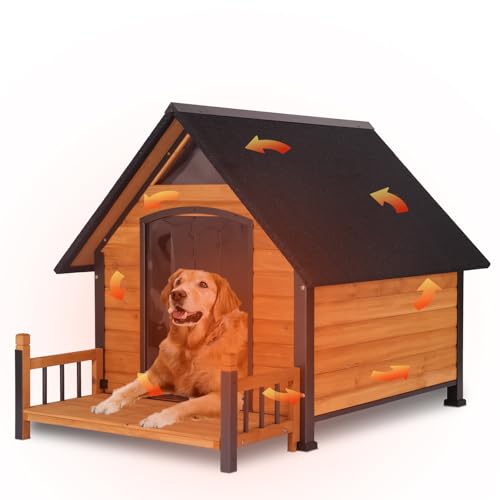
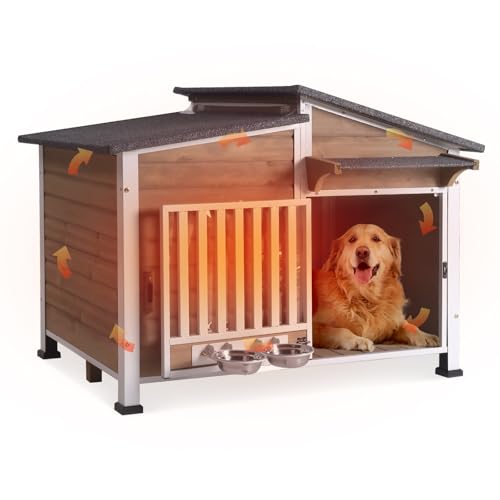
Three selected products include heating systems: the GUTINNEEN Extra Large Heated Dog House, the GUTINNEEN Extra Large Heated Dog House with Bowl, and the Aivituvin Heated Insulated Dog House. The first two describe thermostat control, overheat protection, and chew-resistant cords. Aivituvin specifies a 12-volt system and a removable liner. These features distinguish heated shelters from passive insulated houses.
Heating introduces requirements that passive houses do not have. The cord needs a suitable route and protection from chewing, and the electrical connection should match the product instructions and the outdoor environment. The supplied evidence describes safety-related features, but it does not establish performance in a particular climate or guarantee a specific indoor temperature. Owners should treat a heater as one component of a shelter setup rather than a replacement for weather-conscious placement and supervision.
If built-in heat is unnecessary, passive models offer fewer electrical considerations. The GUTINNEEN Extra Large Insulated Dog House, Lovinhut, BuddyManor, Aivituvin, RUNSHED, and Deblue rely on insulation, curtains, roofs, elevation, or material design instead. Select the approach that fits the dog’s needs and the intended location.
Prioritize weather and ground protection
A sloped or asphalt roof helps shed rain and snow. Raised feet or an elevated floor create separation from wet ground, which is documented on the GUTINNEEN, Aivituvin, RUNSHED, Lovinhut, and Deblue designs. BuddyManor describes weather-tight walls and a sloped roof, while the heated GUTINNEEN models describe resistance to rain, snow, and wind.
Elevation is particularly important on patios, decks, and yards where runoff or damp soil may reach the base. Waterproof feet do not eliminate the need for a level, sheltered location. Place the entrance away from prevailing wind where possible, and inspect the roof, curtain, floor, and connection points periodically. No supplied listing supports an absolute claim that any model is suitable for every storm or climate.
Material choice also affects maintenance. Wood shelters such as RUNSHED, Aivituvin, Lovinhut, and the GUTINNEEN models provide a traditional structure but should be checked for moisture exposure and surface wear. Deblue’s HDPE construction is washable and described as resistant to corrosion and odor retention, offering a different care routine. These are design differences, not guarantees of longer life.
Look for cleaning access
Cleaning access is easy to overlook when comparing the best insulated dog houses. Removable floors appear on the GUTINNEEN Extra Large Insulated Dog House, the GUTINNEEN Large Insulated Dog House with Bowls, Aivituvin, RUNSHED, Lovinhut, and Deblue. Openable roofs are documented for BuddyManor and Lovinhut, while the GUTINNEEN large model also provides roof access. These features can make it easier to remove bedding, hair, dirt, and moisture.
A removable liner is another practical detail. Aivituvin’s heated model specifies a removable liner that can be machine washed. The Deblue shelter has detachable components, and its roof is removable. Before assembly, check whether the selected location leaves enough clearance to open a roof or remove a floor. A house that is easy to clean in a product listing may still be awkward if placed directly against a wall or under a low overhang.
Final recommendation
GUTINNEEN Extra Large Heated Dog House ranks first overall in this specification-based comparison under the published weighted criteria.
The GUTINNEEN Extra Large Heated Dog House is the first overall specification-based choice among these best insulated dog houses. It combines six-sided 0.78-inch insulation, controlled heating, overheat protection, a chew-resistant cord, weather-resistant construction, and generous large-dog dimensions. The GUTINNEEN Extra Large Heated Dog House with Bowl is a close alternative if integrated feeding matters, while the Aivituvin Heated Insulated Dog House is the more compact low-voltage heated option.
For passive shelter, the GUTINNEEN Extra Large Insulated Dog House offers the most specification-aligned balance of insulation, weather protection, durability, and cleaning access. The GUTINNEEN Large Insulated Dog House with Bowls is more compact and adds feeding convenience. RUNSHED is a sensible fit-focused choice for dogs in its documented 40–65-pound range, and Deblue is worth considering when washable plastic construction is a priority. These top insulated dog houses differ substantially in size and heating approach, so verify fit and placement before ordering.
Practical pre-purchase checklist
Measure the dog’s body length and shoulder height, then compare those measurements with the listed interior or size guidance. Confirm whether the entrance is large enough and whether the dog can turn comfortably. Decide whether passive insulation is sufficient or whether a heater is appropriate. Check that the intended location can accommodate the house footprint, roof access, cord route if applicable, and drainage around the elevated base.
Also plan for bedding, cleaning, and seasonal inspection. A curtain can help reduce drafts, but it should remain usable for the dog. A removable floor or roof can simplify care, but only if there is enough surrounding clearance. Finally, treat every capacity statement as product guidance rather than a promise of comfort for every breed or body shape.
Frequently Asked Questions
What should I compare first when choosing the best insulated dog houses?
Start with interior fit and the dog’s measurements, then compare where insulation is placed. Six-sided liners, insulated floors, roof insulation, curtains, raised feet, and weather-resistant roofs are all useful specification details. After that, consider cleaning access, durability, and whether built-in heat is actually needed.
Are heated dog houses better than passive insulated houses?
Not automatically. Heated models such as the GUTINNEEN heated houses and the Aivituvin Heated Insulated Dog House add controlled warmth, but they also require electrical planning and cord management. Passive options use insulation, curtains, elevation, and weather-resistant materials without a heating system. The better choice depends on the dog’s needs, climate, placement, and safe access to power.
Which selected house is easiest to clean?
The BuddyManor 59-Inch Insulated Dog House has an openable roof for top-down access. Several others, including the GUTINNEEN Extra Large Insulated Dog House, the GUTINNEEN Large Insulated Dog House with Bowls, RUNSHED, Lovinhut, Aivituvin, and Deblue, document removable floors or components. Confirm that the surrounding space allows the relevant parts to be removed.
Can an insulated dog house stay outdoors year-round?
The selected listings document features such as asphalt roofs, waterproof feet, weatherproof roofing, curtains, and weather-resistant materials, but they do not guarantee performance in every season or location. Outdoor placement should still provide drainage and reasonable wind protection. Inspect the roof, base, fasteners, curtain, and electrical components when applicable, and follow the product’s care instructions.
How much space should a dog house have?
Use the dog’s body length, shoulder height, and sleeping posture rather than relying only on labels such as large or extra large. The dog should be able to enter, turn around, lie down, and reposition without excessive unused space. The RUNSHED listing provides an approximately 37-by-22-inch interior for dogs weighing 40–the current price, while larger selected models document substantially broader exterior dimensions. Verify the actual interior and entrance measurements before purchase.