Buying Guide
The best indoor dog houses should be chosen by fit and construction first, then by the cleaning and comfort details that matter in your home. The supplied models vary substantially: some are rigid wood furniture pieces, while others use PVC or metal frames with fabric covers. A good comparison begins with the dog’s size, preferred sleeping posture, and tolerance for enclosed spaces.
Start with interior dimensions
Measure your dog while standing, then consider how the dog sleeps. A house should allow the pet to enter, turn, lie down, and change position without pressing against every wall. The PETMAKER Indoor Dog House Bed provides the clearest broad-capacity specification, with a 28.5-by-25.75-by-23-inch interior and an 80-pound listed capacity. Hovicaed Extra-Large Indoor Dog Tent lists a 42-by-30-by-30-inch size, while Jiupety Large Indoor Dog Cave House lists a 38-by-30-by-28-inch interior for larger dogs.
For smaller pets, the ALBAD RYpetmia Wooden Indoor Dog House and Lumicedar Natural Solid Wood Dog House offer compact wooden formats. Ipixune Pink Princess Pet Tent Bed is specifically listed for pets under the current price, so its smaller interior should not be treated as a large-dog option. Always compare internal rather than external dimensions when both are available.
Choose wood, fabric, or a framed cave
Wood houses can look more like furniture and may provide a defined, enclosed structure. PETMAKER uses wood with canvas fabric, while Lumicedar specifies natural solid cedar. ALBAD RYpetmia uses an interlocking wooden structure with a detachable roof. These models may be a better visual fit for living rooms or bedrooms, but they generally need a permanent floor position.
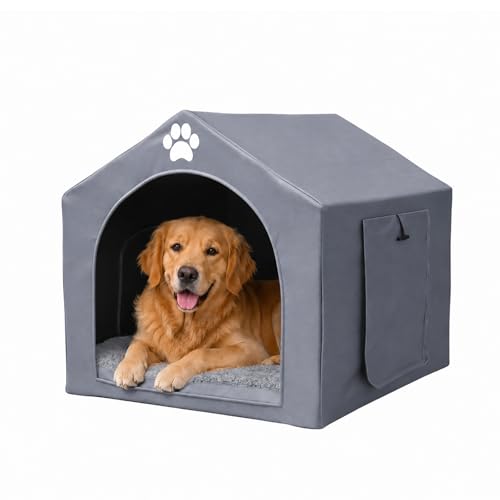
Fabric tents and cave beds are easier to move or fold. SKTREVAN uses a PVC frame and foldable design, and both Pelemee and Jiupety’s pink framed tent describe portable or foldable construction. Hovicaed uses a metal frame and weighted design, which may appeal to owners who want a soft house with more stated support. The right material depends on whether your priority is furniture styling, storage, portability, or a more structured enclosure.
Look for useful airflow features
Enclosed houses should not be judged by privacy alone. Windows, mesh, open entrances, curtains, and door flaps can help adjust how closed the retreat feels. PETMAKER lists roof air holes and open side windows. ALBAD RYpetmia lists side windows and an open entrance. Pelemee includes curtains and a door flap, while Ipixune and Jiupety’s pink tent describe 360-degree ventilation.
Some houses in this comparison emphasize warmth or insulation but do not specify a dedicated ventilation system. Hovicaed, for example, describes a semi-enclosed form and foam walls without giving a detailed airflow layout. That does not establish poor performance; it simply means the documented evidence is narrower. If your dog tends to become warm or prefers visibility, prioritize models with explicit airflow features.
Check the cushion and fabric details
A removable or reversible cushion can make a house more adaptable. PETMAKER includes a cushion with a removable canvas cover. SKTREVAN, Pelemee, and Jiupety’s pink tent describe reversible cushions for different seasonal surfaces. Jiupety Large Indoor Dog Cave House includes a double-sided sponge mat, while LOOBMBNS Large Soft Indoor Dog House includes a removable cushion with a soft velvet surface.
Soft walls and flannel or fleece linings may create a more den-like feel, but the listing evidence does not show how any individual dog will respond. Consider your dog’s habits: a burrowing dog may prefer a covered cave, while a dog that likes to watch the room may do better with windows, an open entrance, or a roll-up section.
Plan for cleaning and storage
For everyday maintenance, look for removable cushions, machine-washable covers, wipe-clean shells, or access panels. Ipixune and Jiupety’s pink tent specifically describe machine-washable covers and pads. LOOBMBNS uses Oxford cloth with an internal PVC coating and says the interior is easy to wipe. ALBAD RYpetmia’s detachable roof gives access for cleaning, while PETMAKER’s removable cushion cover supports regular washing.
Storage is another key difference. Foldable framed designs such as SKTREVAN, Pelemee, and Ipixune can be more practical in apartments or rooms that serve multiple purposes. Wooden houses are better treated as fixed pet furniture. Before selecting a model, measure the intended spot, the doorway clearance, and any space needed to remove the cushion or access the interior.
Match the house to the room
The best indoor dog houses should sit on a stable, suitable surface and leave enough room around the entrance. Non-slip features are documented on SKTREVAN and Ipixune, while soft framed houses may be lighter and easier to reposition. Keep the retreat away from blocked heating vents and choose a location where the dog can rest without being disturbed.
Final Recommendation
PETMAKER Indoor Dog House Bed ranks first overall in this specification-based comparison under the published weighted criteria.
PETMAKER Indoor Dog House Bed is the first overall specification-based choice among these best indoor dog houses. Its documented 80-pound capacity, spacious interior, wood construction, roof vents, side windows, removable cushion cover, and neutral design give it a broad combination of fit and practical features.
For a furniture-oriented small-dog house, Lumicedar Natural Solid Wood Dog House is a strong alternative because it specifies solid cedar, a compact footprint, and an included removable cushion. Larger dogs may prefer Hovicaed Extra-Large Indoor Dog Tent or Jiupety Large Indoor Dog Cave House, both of which document generous dimensions and framed support. Among the top indoor dog houses for smaller pets, Ipixune offers especially clear ventilation and washability information, while Pelemee balances privacy, airflow, and portability.
Frequently Asked Questions
How do I choose among the best indoor dog houses for my dog’s size?
Use the listed interior dimensions and weight guidance together. Measure your dog standing and lying down, then confirm the dog can turn around and enter comfortably. PETMAKER provides an 80-pound capacity, while Ipixune is intended for pets under the current price, showing why size claims should not be generalized across models.
Are wooden indoor dog houses better than fabric tents?
Neither construction is universally better. Wooden models such as Lumicedar, ALBAD RYpetmia, and PETMAKER are more furniture-like and intended for a stable location. Fabric tents such as SKTREVAN, Pelemee, and Jiupety’s pink tent are easier to fold or move. Choose based on room placement, storage needs, and the dog’s preference for a rigid or soft retreat.
Which best indoor dog houses have the clearest ventilation features?
PETMAKER lists roof air holes and side windows. Ipixune and Jiupety’s pink framed tent describe 360-degree ventilation, while Pelemee uses curtains and a door flap to adjust privacy and airflow. These documented features make them useful starting points for dogs that prefer a less enclosed resting space.
What should I look for if cleaning is a priority?
Prioritize machine-washable covers and removable cushions. Ipixune, Jiupety’s pink tent, and Pelemee describe washable fabric components. LOOBMBNS uses wipe-clean Oxford cloth, and ALBAD RYpetmia has a detachable roof for interior access. Confirm which components can be removed before purchase rather than assuming every fabric or cushion is washable.
Do indoor dog houses replace a crate?
The selected products are described primarily as resting houses, caves, beds, or tents. Do not assume an indoor dog house provides the containment, security, or training function of a crate unless those features are explicitly documented.