Buying Guide
The best oval measuring spoons are defined by more than the word “oval” in a product title. A useful comparison should consider whether the bowl can reach a narrow container, whether the set covers the measures your recipes use, and whether the markings and storage system remain practical. The products above are ranked from public listing specifications. They were not hands-on tested, and this guide does not summarize customer opinions.
Start with the bowl shape and reach
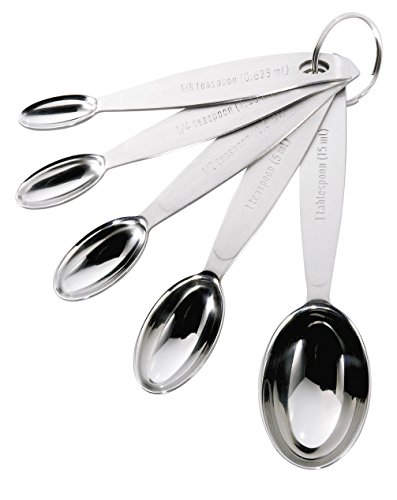
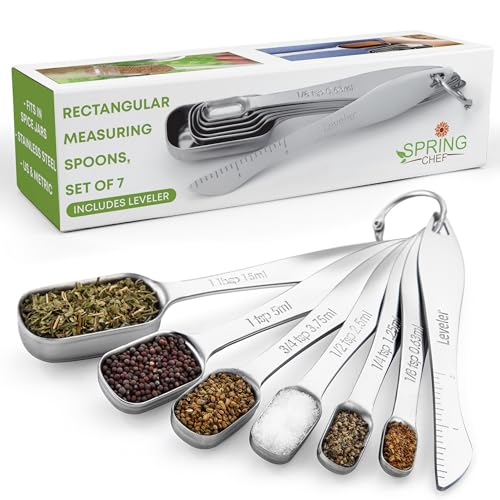
Oval or narrow spoon bowls are useful when a spice jar opening is smaller than a conventional round spoon. Chef Craft, Vollrath, both Cuisipro sets, Spring Chef, Lucksury, ChefAide, and the RSVP scoop specifically document oval or narrow access. The YUNNKEEY set is a related narrow option, but its listing calls the spoon heads rectangular, so it should not be treated as an oval design in the strictest sense.
A narrow head is only one part of reach. Handle length also matters when ingredients sit low in a tall container. These are substantially different tools from teaspoon sets: they are aimed at bulk dry ingredients and portioning rather than small recipe increments. If you regularly scoop flour, granola, coffee, or pet food, a large oval scoop can complement a standard set.
Match the capacity lineup to your recipes
For everyday cooking, a core set usually includes 1/4 teaspoon, 1/2 teaspoon, 1 teaspoon, and 1 tablespoon. Vollrath also includes 2 teaspoons, giving it a little more range without becoming a large specialty collection.
Seven-piece sets go further. Spring Chef lists 1/8, 1/4, 1/2, and 3/4 teaspoon, 1 teaspoon, 1/2 tablespoon, and 1 tablespoon. That lineup is useful when a recipe calls for intermediate quantities. The Lucksury set covers a similar standard range and adds a leveler plus five mini measures. ChefAide and the Spring Chef magnetic set also list seven spoon sizes and a leveler, with dual-sided designs for dry and liquid ingredients.
Odd-size collections serve a different need. Cuisipro’s odd-size set includes pinch, 2/3 teaspoon, 1 1/2 teaspoons, and 2 teaspoons. YUNNKEEY lists eight narrow spoons plus Tad, Dash, Pinch, Smidgen, and Drop mini measures. These sets can be especially helpful for detailed baking or recipes that use specialty quantities, but they may be unnecessary if your cooking relies only on conventional measures.
Check how markings are applied
Permanent or engraved markings are preferable on paper because they are documented to remain identifiable over time. Chef Craft describes permanently stamped measurements, while Vollrath says capacities are clearly stamped on the product. Cuisipro’s standard and odd-size sets list stamped or engraved measurements, and Spring Chef lists engraved US and metric markings.
Lucksury, ChefAide, and YUNNKEEY also document engraved or easy-to-read US and metric measurements. When comparing any unlisted alternative, verify both the marking method and the actual bowl shape rather than relying on a generic measuring-spoon title.
Decide between rings, nesting, and magnets
A ring keeps a set together, but it can make one spoon harder to remove. Cuisipro’s sets list removable rings, and Spring Chef describes a ring that opens and closes. Vollrath lists a stainless steel ring, while Lucksury combines nesting with a removable ring. These formats work well when drawer storage is the priority.
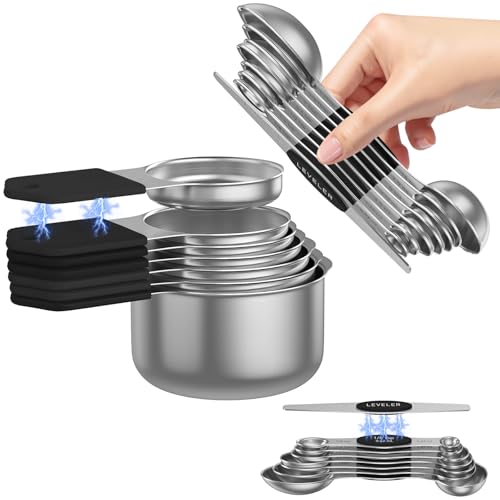
Magnetic sets use a different approach. ChefAide and Spring Chef list magnetic handles that let the pieces nest and separate individually. ChefAide also describes flat placement on a counter. Magnets can simplify access, but the set’s dual-sided construction may take a little more room than a thin, single-bowl design. Choose a ring system for a compact bundled set, or magnetic storage when quick individual access matters more.
Stainless steel is the dominant material in this selection. Lucksury specifies food-grade 18/8 stainless steel, ChefAide specifies food-grade stainless steel, Cuisipro lists 304 stainless steel, and RSVP International lists 18/8 stainless steel. Several listings describe resistance to rust or corrosion, but those claims are product-specific and should not be generalized to every unlisted spoon.
Dishwasher-safe care is documented for Chef Craft, Spring Chef, RSVP International, and YUNNKEEY. Other listings identify stainless steel without providing the same care instruction. If dishwasher cleaning is important, favor a product whose listing explicitly states it.
A compact four- or five-piece set is sensible for a small drawer and ordinary recipes. Chef Craft and standard Cuisipro fit that role. A seven-piece set is better when 3/4 teaspoon and 1/2 tablespoon measures would be useful. Lucksury, ChefAide, Spring Chef, and YUNNKEEY are stronger candidates when specialty capacities or a leveler matter.
Large scoops should be considered separately. RSVP International lists a 1-cup scoop with an 11.5-inch length, hanging loop, polished finish, and dishwasher-safe care. Those choices are appropriate for bulk ingredients, but neither replaces a full teaspoon-and-tablespoon set.
Final Recommendation
Lucksury 13-Piece Oval Stainless Steel Set ranks first overall in this specification-based comparison under the published weighted criteria.
The final choice among the best oval measuring spoons depends on the documented features that match your intended use.
Lucksury 13-Piece Oval Stainless Steel Set is the highest-scoring returned product and the first overall specification-based choice. Its seven oval spoons, leveler, five mini measures, engraved markings, nesting design, removable ring, and food-grade 18/8 stainless steel give it the broadest documented coverage in this comparison.
For a magnetic alternative, ChefAide is the most specification-aligned fit because it combines narrow oval ends, round liquid ends, US and metric markings, a leveler, and magnetic storage. Spring Chef’s seven-piece nonmagnetic set is a simpler choice when standard size coverage and engraved markings matter more than dual-ended construction. Cuisipro’s odd-size set is the specialist pick for recipes using 2/3 teaspoon or 1 1/2 teaspoons.
Among the top oval measuring spoons, the right choice depends on capacity needs as much as bowl shape. These recommendations reflect supplied specifications, not hands-on performance.
Frequently Asked Questions
What should I look for in the best oval measuring spoons?
Look for a clearly documented oval or narrow bowl, capacities that match your recipes, permanent or engraved markings, and a storage method suited to your drawer. Stainless steel construction and dishwasher-safe care can also be useful when those details are explicitly listed. A leveler is helpful if you want a more defined way to level dry ingredients.
Are magnetic measuring spoons better than ring-bound sets?
Neither format is universally better. Magnetic sets such as ChefAide and Spring Chef are designed to separate individually while nesting together. Ring-bound sets keep the pieces physically connected, and some Cuisipro and Spring Chef models list removable or openable rings. Choose magnets for quick access or a ring when keeping the set together is the priority.
Which selected set has the most unusual capacities?
Cuisipro’s odd-size set lists pinch, 1/8 teaspoon, 2/3 teaspoon, 1 1/2 teaspoons, and 2 teaspoons. YUNNKEEY also lists mini measures including Tad, Dash, Pinch, Smidgen, and Drop. These are specialty collections, so check whether your recipes use those quantities before choosing them over a conventional set.
Do oval measuring spoons work for liquids?
The supplied evidence supports liquid use most directly for dual-sided sets. ChefAide and Spring Chef’s magnetic set describe round ends for liquids and narrow oval ends for spice jars. A product listing that only describes an oval dry-ingredient spoon should not automatically be assumed to provide the same liquid-measuring design.
When is a large oval scoop more useful than a spoon set?
A large oval scoop is more appropriate for bulk ingredients or portioning. These tools can complement a small measuring-spoon set, but their single large capacity does not cover the teaspoon measures used in most recipes.