Buying Guide
The best over-the-door hanging shelves use unused vertical space, but the right format depends on what the door must carry. Metal basket systems are better suited to pantry jars, cans, toiletries, and cleaning supplies. Fabric compartment organizers are generally more appropriate for diapers, towels, clothing, toys, and other soft or lightweight household goods. Start by identifying the item types, then compare the rack’s depth, width, height, support method, and access design.
Metal racks such as the Moforoco 9-Tier Over-the-Door Pantry Organizer, Eastherry 9-Tier Adjustable Basket Organizer, and Delamu 6-Tier Adjustable Pantry Organizer document basket construction and adjustable or varied layouts. This type of shelf leaves items visible from the front and can accommodate jars or bottles more naturally than fabric pockets. Delamu lists six baskets, a 60-pound total capacity, and the current price per tier. Eastherry lists nine adjustable baskets and a weighted support rod. Moforoco specifies three large, three medium, and three small shelves.
Capacity figures are listing specifications, not independent load tests. Treat them as reference points, and distribute heavy items rather than concentrating them on one basket. Also check whether the supplied stabilizers use adhesive, screws, or both before installing on a painted or delicate surface.
Choose fabric compartments for soft goods
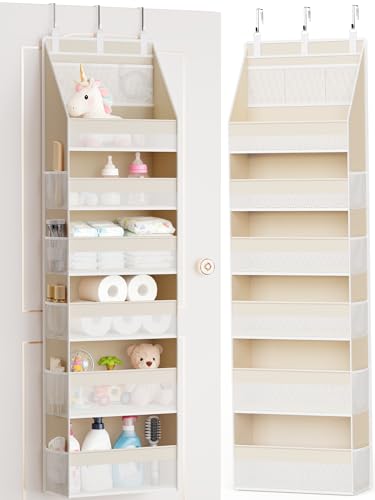
Fabric designs create enclosed bins that work well for nurseries, closets, bedrooms, dorms, and bathrooms. The JARLINK organizer has five large pockets and five mesh pockets on each side. Criusia has six main compartments and 13 mesh side pockets. Lifewit uses five clear-view pockets plus four side pockets, while Ofiray-home divides five tiers into ten compartments and adds ten mesh side pockets.
These layouts are useful when the main challenge is sorting many small items. Clear windows or mesh fronts can reduce searching, while side pockets are convenient for chargers, keys, cosmetics, wipes, or other small essentials. Fabric organizers may be less suitable for heavy cans and glass jars unless the listing specifically supports that use.
Measure the door and the space behind it
Door fit is not just about width. Measure the door panel, thickness, available space between the door and wall, and any trim, handle, hinge, shelf, or cabinet obstruction. Tall products such as Moforoco and Eastherry require particular attention because their listed heights approach or exceed six feet. Wide models such as Ofiray-home and ElegantArray may need more side clearance than narrower organizers.
The listings provide several useful fit examples. JARLINK states that its hooks fit doors up to 1.98 inches thick. Lifewit specifies a 1.4-to-1.8-inch door range. Ofiray-home lists a 1.4-to-1.73-inch range. ElegantArray calls for a door wider than 17 inches and more than 6.3 inches behind the door. Delamu lists required door width, pantry depth, and door gap. Use the most restrictive published measurement as a planning checkpoint, not as a guarantee for every door configuration.
Compare fixed and adjustable layouts
A fixed pocket organizer is simple when you already know the items you want to store. An adjustable basket system is more useful when containers vary in height. Eastherry allows basket height and order changes, Delamu provides adjustable baskets, and Hongtamoya offers adjustable spacing between five baskets. Hongtamoya also documents separate use and wall mounting, making it the most modular design in this selection.
Adjustability can add setup decisions. Before loading, place taller items where they will not block shorter baskets, and verify that the door can still open without contact. A layout that looks spacious when empty may become difficult to access if deep containers are placed in every tier.
Check installation and movement control
Most selected products describe no-drill or tool-free hanging, but the support details differ. JARLINK, Criusia, Lifewit, and Ofiray-home use hanging hooks with reinforced fabric structures. Metal models may include adhesive stickers, snap-on baskets, fasteners, or wall-mount hardware. Hongtamoya includes door hooks, pre-drilled holes, and screws for wall installation.
Movement control matters because a loaded organizer adds weight to the door and can swing as the door opens. Look for reinforced bottoms, multiple hooks, anti-slip stickers, weighted support rods, or other stated stabilizing features. Do not assume that a stated capacity eliminates movement or guarantees compatibility with a particular door.
Match visibility to daily use
Open wire baskets make contents easy to see from the front. Clear windows help with fabric pockets, especially for toiletries, baby supplies, and accessories. Enclosed fabric compartments can hide clutter but may require labels if several pockets contain similar items. For frequently used items, place everyday essentials in the upper or easiest-to-reach section and reserve lower tiers for less frequently accessed supplies.
Final Recommendation
Ofiray-home Extra-Large 5-Tier Organizer ranks first overall in this specification-based comparison under the published weighted criteria.
The final choice among the best over-the-door hanging shelves depends on the documented features that match your intended use.
Moforoco 9-Tier Over-the-Door Pantry Organizer is the first overall specification-based choice among these top over-the-door hanging shelves because it combines nine tiers, mixed shelf sizes, metal construction, broad utility, and documented installation guidance. It is best for shoppers who need substantial pantry or household capacity and have enough vertical and rear-door clearance.
Choose Eastherry if adjustable basket order is more important than a mixed fixed-size layout. Delamu is a practical alternative for shoppers who want unusually clear measurements for door width, depth, and gap. Hongtamoya stands out when modularity or wall mounting matters. For fabric storage, JARLINK, Criusia, Lifewit, and Ofiray-home provide different combinations of clear visibility, side pockets, reinforced structure, and compartment count.
Before ordering, measure twice: door width, thickness, height, rear clearance, and nearby obstructions. Then compare the organizer’s material and documented capacity with the items you actually plan to store. This approach is more reliable than choosing solely by tier count.
Frequently Asked Questions
What are the best over-the-door hanging shelves for a pantry?
Metal basket systems are the most directly aligned with pantry storage. Moforoco, Eastherry, Delamu, ElegantArray, VyGrow, and Hongtamoya all document metal baskets or wire shelves. Compare the stated width, depth, height, basket spacing, and door-clearance requirements before choosing. Delamu and Eastherry provide especially useful adjustment details for mixed-size pantry items.
Fabric organizers may be more suitable for diapers, wipes, clothing, toys, and towels because they provide soft compartments and side pockets. JARLINK, Criusia, Lifewit, and Ofiray-home document fabric construction, visibility features, and multiple compartments. Metal baskets can also hold nursery supplies, but their open structure and rigid surfaces may be less convenient for soft goods.
How do I know whether a door can support an organizer?
Check the product’s door-thickness range, width, height, and rear clearance against your door. Also inspect the handle, trim, hinges, and wall space. Lifewit, JARLINK, and Ofiray-home publish door-thickness information, while ElegantArray and Delamu provide important width or clearance requirements. A stated load figure is product-listing information and does not replace checking the door and mounting surface.
Can over-the-door shelves be used without drilling?
Several selected products describe tool-free or no-drill installation, including Moforoco, Delamu, VyGrow, Lifewit, and the fabric organizers. Some metal systems also include adhesive stabilizers or optional wall-mount hardware. Follow the specific installation method and verify that the hooks sit fully over the door before adding items.
How much clearance should I leave behind the door?
Use the manufacturer’s published requirement when one is available. ElegantArray specifies more than 6.3 inches behind the door, while Eastherry specifies more than 5.6 inches. If no clearance is stated, measure the organizer’s depth and account for the handle, wall, trim, and any item that may project beyond the shelf. Leave enough room for the door to open without striking nearby surfaces.