Buying Guide
The best over-the-door hat racks should be selected by matching the storage format to the collection, the door, and the types of hats being stored. The supplied products fall into four practical designs: deep-pocket organizers, open hook frames, clip-and-strap systems, and mixed basket or hook layouts. Each design solves a slightly different problem.
Start with collection size
Capacity is the clearest dividing line. The Lifewit organizer lists space for up to 84 hats, while the Simple Trending and AOODA pouch systems each list approximately 72. These tall organizers are appropriate when a large cap collection should remain in one location. Their deep pockets also create separate compartments, which can be useful when hats need more support than a single hook provides.
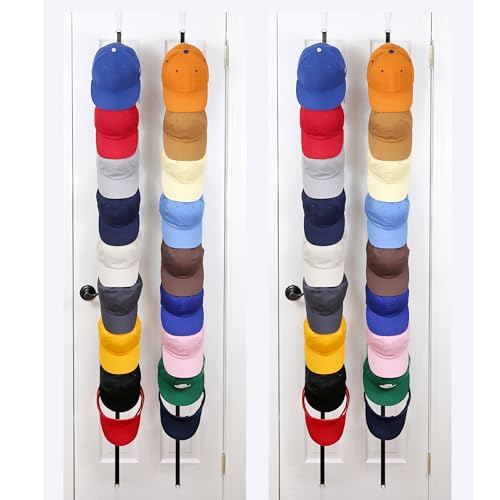
The Perfect Curve two-pack also lists up to 72 caps, but it reaches that figure through four straps and movable clips rather than pockets. That makes it better suited to adjustable caps and visors; the listing specifically says it is not suitable for fitted caps. By contrast, the Perfect Curve CapRack FAV lists support for fitted caps, adjustable caps, and visors, making it the more appropriate strap-based choice for mixed cap styles.
For smaller collections, the SWTYMIKI three-tier metal rack lists up to 27 caps. Choosing a smaller rack can leave more of the door available for other storage and avoid installing a tall organizer when only a few hats need to be kept accessible.
Choose pockets, hooks, clips, or baskets
Deep pockets are the most structured format in this selection. Lifewit, AOODA, and Simple Trending use transparent or clear pocket concepts that make hats visible. Pocket depth and reinforced bases may help keep caps separated, but the evidence does not establish performance beyond the listed construction features. These systems are a practical choice when display and compartmentalization matter.
Open hook racks expose each hat and usually make removal quick. SWTYMIKI’s three-tier metal rack and the three-pack metal organizer use hooks, while HapiRm combines hooks with movable clips. Open designs can also hold related items such as scarves, bags, keys, or ties when the listing explicitly documents that use. They generally offer more adaptable everyday storage, but they do not provide the same enclosed pocket format.
Clip-and-strap systems are narrow and adjustable. Aitsuremoom includes movable ABS clips, the Perfect Curve products use adjustable or fixed hooks, and the CapRack FAV uses adjustable hooks on flexible straps. These designs can spread hats vertically without creating a deep organizer behind the door. Check the hat-style guidance carefully: the Perfect Curve four-strap product excludes fitted caps, while the CapRack FAV explicitly includes them.
Basket systems add another option. The SWTYMIKI five-tier organizer documents adjustable basket heights, which can help accommodate different item sizes. It also supports wall or over-door installation and includes three hooks. Because its listing provides conflicting capacity statements, shoppers should treat the adjustable layout as the stronger documented reason to choose it rather than relying on one exact capacity figure.
Confirm door fit before buying
Door compatibility is not universal. Lifewit lists doors from 1.4 to 1.8 inches thick, AOODA lists 1.42 to 1.77 inches, and Aitsuremoom lists 1.2 to 1.9 inches. The latter is the broadest documented range among these products. Perfect Curve’s strap systems are specified for typical residential doors up to 1 3/8 inches thick.
Measure the door thickness, and consider whether the door has trim or limited clearance at the top. A rack that hangs over the door may need enough space for its hooks to sit flat. The supplied evidence cannot confirm compatibility with every door design, so an exact measurement is more reliable than assuming that any standard-door claim will apply.
Compare installation methods
Tool-free installation is common among the pocket organizers and strap systems. Lifewit uses two metal hooks, AOODA uses three, and Aitsuremoom uses two. These formats are easy to remove or relocate, which may suit renters, dorm rooms, or changing storage needs.
Some metal organizers document both over-door and wall-mounted installation. HapiRm, the SWTYMIKI five-tier organizer, and the SWTYMIKI three-tier rack provide that flexibility in their listings. Wall mounting can be useful when a door cannot accept hooks, but it requires a suitable wall surface and, depending on the product, hardware or stabilizers. The buying decision should therefore account for whether no-drill installation or a more permanent layout is the priority.
Look for stability and hat support
Stability features vary by design. The SWTYMIKI products and HapiRm list anti-swing or anti-sway patches. Aitsuremoom lists anti-slip grooves in its clips, while AOODA lists cardboard bottoms and fiberglass strips intended to keep hats fixed in the pockets. Lifewit uses a protective cover and deep clear pouches, and Simple Trending lists reinforced cardboard bases.
These are specification-level indicators, not proof of hands-on performance. Still, they help identify the intended use. If the door moves frequently, a listed stabilizer or anti-swing feature may be worth prioritizing. If dust protection matters, Lifewit’s full cover is more directly relevant than an open hook rack. If quick visual selection matters, transparent pockets or exposed hooks may be preferable.
Final recommendation
Lifewit 6 Tier Clear Over-the-Door Hat Rack ranks first overall in this specification-based comparison under the published weighted criteria.
Lifewit 6 Tier Clear Over-the-Door Hat Rack is the highest-scoring returned product and the first overall specification-based choice. Its listed 84-hat capacity, clear deep pouches, full protective cover, reinforced access design, and documented door range make it the most specification-aligned match for a large collection.
Among the top over-the-door hat racks, Simple Trending and AOODA are close alternatives for high-capacity clear-pocket storage. Choose Perfect Curve’s CapRack FAV when fitted-cap compatibility is more important than maximum capacity, or choose Aitsuremoom when a broad door-thickness range and no-drill setup matter most. For a compact collection, the SWTYMIKI three-tier rack avoids the footprint of a tall pouch organizer. The best over-the-door hat racks are therefore not interchangeable: capacity, hat style, door measurements, and installation preference should determine the final pick.
Frequently Asked Questions
How do I choose among the best over-the-door hat racks for fitted caps?
Start with the product’s stated hat compatibility. Perfect Curve’s CapRack FAV explicitly supports fitted caps, while the Perfect Curve four-strap organizer specifically says it is not suitable for fitted caps. Deep-pocket models such as Lifewit, AOODA, and Simple Trending list compatibility with several cap styles, including fitted caps, but shoppers should still compare pocket dimensions with their collection.
Do these racks work on doors of every thickness?
No. Door ranges differ. Aitsuremoom lists 1.2 to 1.9 inches, Lifewit lists 1.4 to 1.8 inches, and AOODA lists 1.42 to 1.77 inches. Perfect Curve’s products are listed for typical residential doors up to 1 3/8 inches. Measure before ordering and account for top-door clearance or trim.
Neither format is universally better. Pocket organizers provide separated, visible storage and may offer more support for individual hats. Metal hook racks expose hats for quick access and can be more adaptable for scarves, bags, or other accessories when the listing documents those uses. Select pockets for structured collection storage and hooks for open, flexible access.
Can an over-door hat rack be wall mounted?
Some selected products document dual installation. HapiRm, the SWTYMIKI five-tier organizer, and the SWTYMIKI three-tier rack list over-door and wall-mounted options. Other products are described primarily as over-door systems. Check whether the specific package includes wall hardware, screws, or stabilizers before planning a wall installation.
What capacity should I choose for a growing collection?
Use the listed capacity as a planning reference rather than packing every space tightly. Lifewit lists up to 84 hats, while AOODA and Simple Trending list approximately 72. A 27-cap rack such as the SWTYMIKI three-tier model may be enough for a smaller collection. Leave room for different hat shapes and choose a layout that keeps the hats easy to retrieve.