Buying Guide
The best plastic over-the-door shoe organizers are useful when floor space is limited, but the right choice depends on more than pocket count. Public listings describe different layouts, materials, door clearances, and sizes. Because this comparison is specification-based, treat every stated capacity as a listing claim and verify the dimensions against your own door.
Start with the door measurements
Measure door thickness, available height, width, and the gap between the top of the door and its frame. Simple Houseware documents compatibility with doors up to 1 3/8 inches thick, while TidyMaster specifies doors under 1 3/4 inches and a minimum top gap. UVIAHOMI lists a broader 1.37-to-1.98-inch range. These differences can determine whether hooks sit correctly and whether the door can close.
Width also matters. The Simple Houseware organizer is 22.5 inches wide, GOMAJI’s 24-pocket model is 22.5 inches wide, and MISSLO reaches 24.5 inches. GOMAJI’s 35-pocket version is listed at 26.25 inches wide. A wide organizer can offer more capacity, but it may interfere with trim, adjacent walls, or a narrow door opening.
Choose pockets or shelf sections
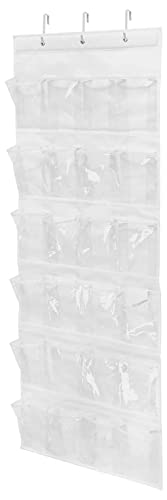
Pocket organizers divide storage into individual compartments. The VOPTON model lists 28 large pockets, while MISSLO and GOMAJI each list 35 pockets. This arrangement works well when you want one shoe or one small item per compartment. Pocket size is especially important for adult shoes: VOPTON lists pockets about 7.88 by 6 inches, and Simple Houseware lists pockets measuring 5 by 9 inches.
A shelf-style design can be more suitable for bulkier footwear or items that are easier to grab from an open section. Whitmor’s 26-section model documents side-by-side compartments with a clear vinyl front. It is not the same layout as a clear-pocket bag, so compare the organizer’s depth and the amount of door clearance available.
Prioritize visibility where it saves time
Clear PVC, transparent windows, mesh, and clear vinyl are not identical materials, but each can help identify stored contents. Bofoho specifically lists crystal-clear PVC pockets. UVIAHOMI documents transparent PVC windows, and Whitmor lists a protective clear vinyl front. These details are more useful than a generic claim that an organizer is “clear,” because they identify where the transparent material appears.
Visibility is valuable for shoes, toiletries, cleaning supplies, and pantry items. It can also reduce the need to remove several items while searching. If the listing does not provide individual pocket dimensions or a clear material description, avoid assuming that every compartment is equally transparent or large enough for adult footwear.
Consider structure and load documentation
Construction details vary across the selected products. Bofoho lists thick PVC with reinforced stitching, Simple Houseware lists a sturdy base and a 40-pound capacity, and Whitmor lists strong fabric, reinforced seams, and a clear vinyl front. UVIAHOMI documents reinforced rings and an 80-pound total hook capacity. These statements describe listing specifications, not independent testing.
Hook count and design are also relevant. Four-point hanging appears on Simple Houseware, TidyMaster, UVIAHOMI, MISSLO, and Whitmor’s shelf-style model. Some products add adhesive strips or non-scratch features. Those additions may help with positioning, but they do not remove the need to confirm door clearance and avoid overloading beyond the documented limit.
Match capacity to the intended contents
A 12- or 24-pocket organizer may be easier to fit in a smaller room, while 28 or 35 pockets may suit a family or a large collection. UVIAHOMI is listed for 20 to 30 pairs and has 20 extra-large pockets, whereas VOPTON lists 28 pockets for up to 14 pairs. Pocket count does not always equal pair capacity, so read the stated layout carefully.
Also decide whether the organizer will hold only footwear. Bofoho, Simple Houseware, TidyMaster, GOMAJI, and other selected products list alternative uses such as toiletries, toys, accessories, cleaning supplies, or pantry goods. A mixed-use organizer may be a better fit for a dorm, laundry room, or entryway than a shoe-only setup.
Think about storage when it is not hanging
Several fabric-based models are described as foldable, including Bofoho, MISSLO, and GOMAJI. Foldability can help when moving, traveling, or changing seasonal storage. Whitmor’s shelf-style structure may offer a more defined shape but is listed at the current price, heavier than many pocket bags. Consider whether you need a collapsible organizer or a more structured one that stays assembled.
Final Recommendation
UVIAHOMI 20-Pocket Clear-Window Organizer ranks first overall in this specification-based comparison under the published weighted criteria.
Simple Houseware 24-Pocket Clear Organizer is the highest-scoring returned product and the first overall specification-based choice. Its combination of 24 extra-wide clear pockets, four metal hooks, stated capacity, and documented dimensions makes it the most balanced option for many standard doors.
Among the top plastic over-the-door shoe organizers, Bofoho is a strong visibility-focused alternative because its PVC pockets are explicitly described as crystal clear. Choose UVIAHOMI when the priority is family-scale capacity and your door can accommodate its 73-inch height. VOPTON is better for shoppers who want many individual compartments, while MISSLO provides the highest listed pocket count in this selection but needs a wide door area.
Whitmor is the clearest choice for a shelf-style layout rather than a conventional hanging pocket bag. TidyMaster is useful when a combination of large and standard pockets is more practical than identical compartments. For compact-height storage, GOMAJI’s 24-pocket model measures 56 inches high. Before ordering any of the best plastic over-the-door shoe organizers, confirm the door thickness, top gap, organizer width, and the dimensions of the footwear or items you plan to store.
Frequently Asked Questions
Among the best plastic over-the-door shoe organizers, are plastic over-the-door shoe organizers suitable for items besides shoes?
Yes. The selected listings describe uses including toiletries, cleaning supplies, toys, pantry goods, scarves, belts, and school or craft items. Bofoho, Simple Houseware, TidyMaster, and GOMAJI specifically present their organizers as multipurpose storage. Check each pocket’s dimensions before placing bulky objects inside.
How many pairs can a 24-pocket organizer hold?
The answer depends on pocket size and whether each compartment holds one shoe or a pair. SciencePurchase lists a 12-pair capacity for its 24-pocket model, while Amazon-style pocket layouts may be intended for one shoe per pocket. Read the manufacturer’s stated capacity rather than dividing pocket count automatically.
Do clear pockets mean the whole organizer is plastic?
No. Several listings describe a combination of materials. Bofoho lists PVC pockets with reinforced stitching, UVIAHOMI lists transparent PVC windows and breathable non-woven fabric, and Whitmor lists a clear vinyl front with fabric backing. Buyers seeking the best plastic over-the-door shoe organizers should check whether plastic is used for the pockets, windows, front, or the entire body.
Will an over-door organizer work on every standard door?
Not necessarily. Hook thickness, door thickness, top clearance, width, and trim can affect fit. TidyMaster and UVIAHOMI provide specific compatibility ranges, while other listings use broader language such as “standard doors.” Measure first, especially for wide or tall models.
Which layout is better for boots or larger shoes?
Large pockets or shelf sections may be more suitable than narrow compartments. Compare the listed pocket or section dimensions with your largest footwear before choosing.