Buying Guide
This guide compares the best plastic contact cements using documented substrate compatibility, chemical and environmental resistance, cure profile and open time, application format and spread, container sizing for project scale, and flexibility and long-term durability.
Contact adhesives create an instant bond when two coated surfaces are pressed together, which makes substrate coverage, open time, and cured chemical resistance the three specification areas that matter most. The best plastic contact cements pair a documented plastic-friendly substrate list with a clear cure profile so you can align panels before the bond sets. Without these two data points, a product listing cannot be compared against alternatives.
Different plastics behave very differently with solvent-based contact cements. High pressure laminates, ABS, and rigid PVC generally accept neoprene formulas such as the DAP Weldwood Original line, which lists high pressure laminates and plastic veneers as primary substrates. Spray adhesives in the Weldwood line add plastic, foam, and upholstery coverage for contoured parts. Polyethylene and polypropylene are far more difficult to bond and usually require specialty plastic primers or specific adhesive lines, so always confirm a substrate match before purchase.
Open time and working speed
Open time is the window after the adhesive becomes tack-free but before the bond loses grab. The DAP Weldwood Original contact cement listings document a 2 hour open time, which is generous for aligning large laminate sheets. Spray formulas typically have shorter open times, with the Weldwood spray adhesive listing a 1 to 3 minute ready window and 24 hour full cure. Faster cure speeds are useful for small parts, while longer open times help when bonding full countertops.
Liquid contact cements applied with a brush, roller, or notched spreader give controlled film thickness on flat panels. Spray contact cements, such as the 14 oz DAP Weldwood Spray Adhesive, cover up to 79 square feet per can and suit curves, door panels, and upholstery where a brush would be slow. Choose liquid for controlled laminate work and spray for large, contoured, or repetitive jobs.
Container size and project scale
Small 1.5 oz and 3 oz tubes like the Permatex 25905 and the DAP Weldwood 3 oz options are sized for repair kits and single-piece fixes. Pint and quart cans (16 oz and 32 oz) suit mid-size countertop and paneling projects. The 1 gallon Weldwood Original can is built for shop-scale fabrication. Matching the container to the project reduces waste and avoids running out mid-bond.
Chemical, heat, and water resistance
A contact bond is only as good as its environmental resistance. The Weldwood Original line documents cured resistance to heat, water, weather, grease, oil, and household chemicals, while the Barge All Purpose listing calls out waterproof and flexible bonds for leather work. The nonflammable DAP contact cement listing addresses shops concerned about solvent flammability. Check the resistance list against the environment the bonded assembly will live in.
Final recommendation
DAP Weldwood Original Contact Cement, 1 Gallon ranks first overall in this specification-based comparison under the published weighted criteria.
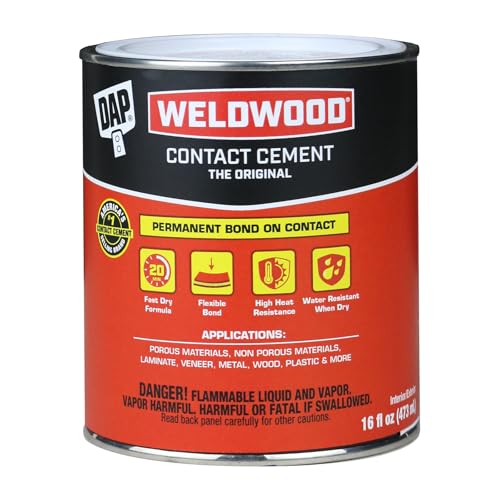
After comparing substrate range, cure profile, application format, container scale, and resistance, the DAP Weldwood Original Contact Cement, 16 oz stands out as the first overall specification-based choice among the best plastic contact cements, combining a documented plastic-friendly substrate list with a 2 hour open time and full chemical and water resistance in a versatile mid-size container. For shops that need scale, the 1 gallon Weldwood Original can keeps the same specification set, while the Weldwood spray adhesive is the right pick for contoured or large surfaces. Together these three Weldwood options also make up the most complete set of top plastic contact cements on the US market for plastic laminate and trim work.
Frequently Asked Questions
The DAP Weldwood Original line, including the 3 oz, 16 oz, 32 oz, and 1 gallon cans, lists high pressure laminates and plastic veneers as primary substrates. For smaller repairs, the Permatex 25905 and the 3 oz Weldwood tube are also designed for contact bonds on multiple materials.
Liquid contact cements applied with a roller or brush give more controlled film thickness on flat plastic laminates. Spray contact cements such as the DAP Weldwood Spray Adhesive cover contoured parts, upholstery, and large surfaces faster, with documented plastic and foam compatibility.
A documented open time of 1 to 3 minutes suits small or curved parts, while 2 hour open times like the Weldwood Original line’s specification help when aligning full laminate sheets. Longer open times are usually better for large countertop or panel builds.
The Weldwood Original listings explicitly state cured resistance to heat, water, weather, grease, oil, and household chemicals. The Barge All Purpose listing emphasizes waterproof flexibility for leather assemblies, and the Weldwood spray adhesive also lists high heat and water resistance after full cure.
Yes. The DAP 7079825332 Nonflammable Contact Cement is documented as a nonflammable quart option for shops that prefer to avoid high-flash-point solvents. Confirm substrate compatibility with the manufacturer before relying on it for specialty plastics.