Buying Guide
This guide compares the best pour spout mixing bowls using documented pouring control, mixing stability, capacity and size range, storage efficiency, material durability, and care and use versatility.
Pour spout mixing bowls are most useful when the bowl’s shape, grip, and base work together. A spout alone does not describe the full buying decision. Consider how much you prepare, whether you prefer plastic, melamine, glass, or stainless steel, and whether the bowls need to nest or include lids.
Match the capacity to your recipes
A single large bowl can be convenient for batters, while a set gives you more flexibility for separating ingredients. The UP bowl provides a documented 4.3-quart capacity for larger preparations. By contrast, the Glad four-piece set starts at 1.2 quarts and adds smaller increments through 3 quarts, which may suit sauces, eggs, and modest baking tasks.
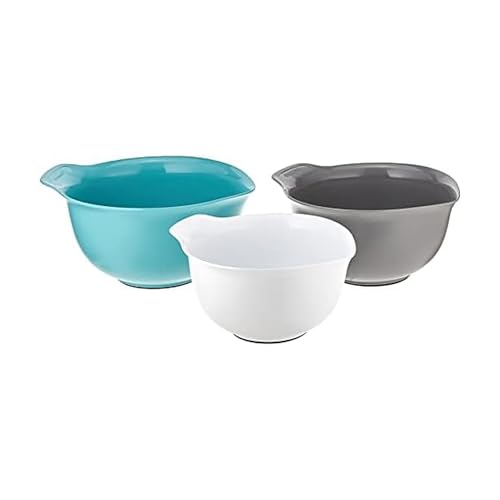
Four-piece sets can provide more steps between small and large prep jobs. Glad lists 1.2, 1.9, 2.8, and 3 quarts, while Cheeren lists 1, 1.5, 2.1, and 2.6 quarts. COOK WITH COLOR also supplies four bowls, but the supplied evidence does not identify each capacity. If exact size planning matters, prioritize sets with explicit measurements.
Look for a complete pouring design
A useful pouring setup usually includes three elements: a shaped spout, a handle or grip area, and a base that resists movement. AVACRAFT, UP, Glad, ZAROCRUS, and Norpro document these combinations in different forms. Norpro specifically describes a contoured dripless pour spout, while the Glad set lists embedded spouts on every bowl.
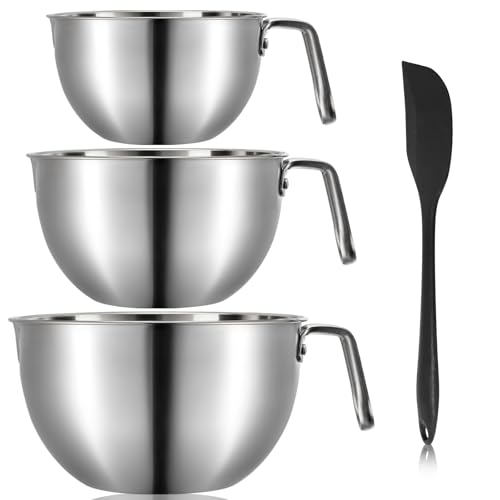
Handle coverage matters in multi-piece sets. Glad describes handle lips on three bowls and a full handle on the largest. Other selected sets, including UP, ZAROCRUS, Cheeren, Suwimut, and AVACRAFT, document handles as part of their designs. A handle can be especially useful when transferring liquid from a deeper or fuller bowl, but the supplied listings do not establish a measured grip strength or spill rate.
Choose the right base material
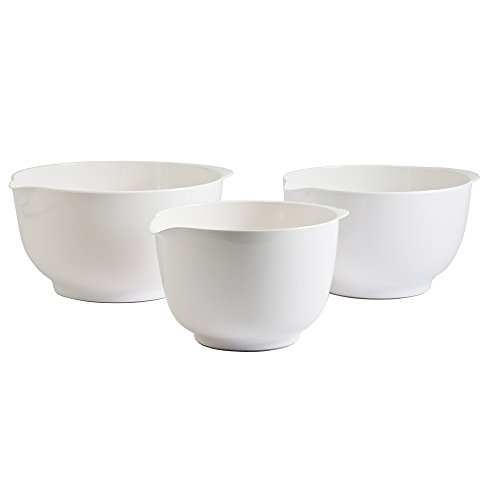
Plastic and melamine bowls are generally presented in the listings as lightweight options. The UP bowl uses BPA-free melamine and is described as shatter-resistant. ZAROCRUS also uses BPA-free melamine and adds silicone bases. Glad and the other plastic sets emphasize non-slip rings or bottoms rather than heavy construction.
Stainless steel offers a different specification profile. AVACRAFT uses 18/10 stainless steel, while Suwimut and WAGENSTEIGER specify stainless steel construction. The AVACRAFT listing also describes resistance to rust, cracks, stains, and corrosion, and Suwimut identifies 304 stainless steel. These statements describe the listed material characteristics; they are not independent durability tests.
Glass and ceramic are documented design types in the wider candidate pool, but the selected products here focus on plastic, melamine, and stainless steel because they provide stronger evidence for multi-size mixing, handles, bases, or storage. For a single compact bowl, a ceramic or glass design may still be relevant, but it offers less capacity flexibility than the selected sets.
Consider markings and lids
Interior measurement marks can reduce the need for a separate measuring vessel. AVACRAFT, Suwimut, WAGENSTEIGER, and COOK WITH COLOR document markings, with Suwimut specifying quart and liter markings. These features are useful when a recipe calls for volume-based additions, although the listings do not state marking precision.
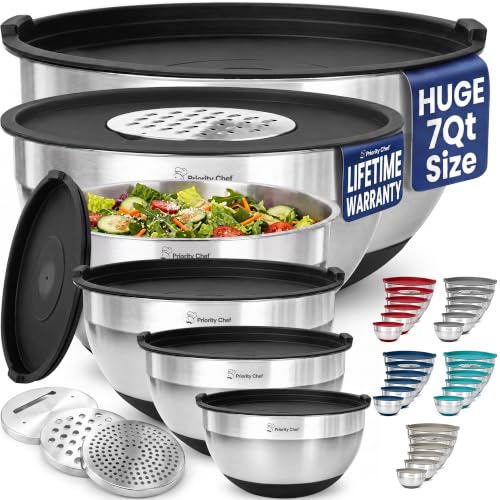
Lids expand a set beyond mixing. AVACRAFT includes lids for its three bowls, allowing the same containers to be used for covered storage. The supplied evidence supports dishwasher, freezer, and refrigerator use for AVACRAFT. If storage is a priority, compare covered sets with open nesting sets rather than assuming every pour bowl includes a lid.
Check care instructions before buying
Care guidance varies. Norpro lists dishwasher, microwave, and freezer safety. AVACRAFT lists dishwasher, freezer, and refrigerator safety. UP describes a melamine bowl intended for regular kitchen tasks, while Glad, KitchenAid, Cheeren, ZAROCRUS, and WAGENSTEIGER document dishwasher-safe care in their listings. COOK WITH COLOR specifies top-rack dishwasher and freezer-safe use.
Stainless steel is often straightforward to wash, but Suwimut’s listing advises drying the interior after cleaning to prevent corrosion from remaining water. That instruction is a useful reminder to follow the manufacturer’s care guidance rather than generalizing across materials.
Prioritize storage realistically
Nesting is one of the clearest space-saving features in this category. KitchenAid, Glad, COOK WITH COLOR, Cheeren, Suwimut, AVACRAFT, ZAROCRUS, WAGENSTEIGER, and Norpro all document nesting or compact stacking. Before choosing a large set, check whether your cabinet can accommodate the largest bowl’s listed dimensions and whether handles protrude when nested. A single bowl such as UP may be simpler when you already own smaller prep containers.
Final Recommendation
AVACRAFT 18/10 Stainless Steel Bowls with Lids ranks first overall in this specification-based comparison under the published weighted criteria.
AVACRAFT 18/10 Stainless Steel Bowls with Lids is the highest-scoring first overall specification-based choice among these best pour spout mixing bowls. Its combination of three capacities, spouts, handles, measurement marks, non-slip bases, lids, and stainless steel construction gives it the broadest documented utility.
KitchenAid is a strong alternative for a three-piece plastic set, while Glad’s four-piece collection is better suited to smaller graduated tasks and compact storage. Choose UP when one large batter bowl is enough. Select Suwimut or WAGENSTEIGER if stainless steel and interior markings matter, and Norpro if microwave and freezer compatibility are central requirements. Together, these top pour spout mixing bowls cover single-bowl, nesting plastic, melamine, and stainless steel designs without treating marketplace metrics as evidence of product performance.
Frequently Asked Questions
What makes the best pour spout mixing bowls different from ordinary mixing bowls?
The selected designs add a pouring feature to a bowl intended for ingredient preparation. The most complete examples also document a handle or grip, a non-slip base, and sometimes measurement marks, nesting, or lids. A spout’s presence alone does not establish how well it performs, so compare the complete specification set.
Are stainless steel or plastic bowls better for baking?
The choice depends on the features you need. Stainless steel models such as AVACRAFT, Suwimut, and WAGENSTEIGER document steel construction, while plastic and melamine models emphasize lightweight handling, nesting, and non-slip bases. The supplied evidence does not provide hands-on performance comparisons, so material preference, capacity, markings, and care instructions should guide the decision.
Do all pour spout mixing bowls come with lids?
No. AVACRAFT explicitly includes lids, but most selected products describe open bowls and nesting rather than covered storage. If leftovers or prepared ingredients need to be covered in the same container, verify that lids are included rather than assuming they are part of the set.
Which selected set has the smallest graduated sizes?
Cheeren lists 1-, 1.5-, 2.1-, and 2.6-quart bowls, while Glad lists 1.2-, 1.9-, 2.8-, and 3-quart bowls. These documented ranges are useful for cooks who want several smaller preparation sizes instead of one very large bowl.
Are these products hands-on tested?
No. This is a specification-based comparison using supplied public listing data. The rankings reflect documented features such as spouts, handles, bases, materials, capacities, nesting, markings, lids, and care guidance, not independent testing or customer sentiment.