Buying Guide
The best rechargeable 3d glasses are not universal. Before comparing frame design or battery claims, identify whether your display sends a DLP-Link or RF synchronization signal. DLP-Link models in this guide include the AWOL VISION DG-002, NexiGo DLP Link glasses, Valerion glasses, ELEPHAS GL2100, Sintron ST08-DLP, and TOUMEI JX30. RF models include the Sintron ST08-BT, Epson V12H548006, and Cocar RF glasses. A listing that names your projector or television family is more useful than a general compatibility statement.
Match the synchronization method
DLP-Link glasses synchronize through the projector’s DLP-Link system and generally do not require a separate emitter. The AWOL VISION model names AWOL LTV projectors, Vanish TV, and other DLP-Link projectors. NexiGo identifies Aurora Pro, TriVision Ultra, and Nova Mini compatibility, while ELEPHAS lists Acer, ViewSonic, BenQ, Optoma, Panasonic, Dell, and Vivitek among compatible brands. Sintron ST08-DLP specifically excludes Epson, so that model should not be treated as a general replacement for Epson RF eyewear.
RF glasses are intended for RF-enabled televisions or projectors. Epson’s V12H548006 is more narrowly focused on named PowerLite Home Cinema and Pro Cinema models. Cocar’s RF two-pack lists replacement references such as TDG-BT500A, SSG-5100GB, TY-ER3D4MU, and AN3DG40. Check the exact display model because RF standards and pairing procedures can vary.
Compare rechargeable runtime
Documented runtime ranges from 30 hours for ELEPHAS GL2100 to 60 hours for Sintron ST08-BT and XGIMI. AWOL VISION and Valerion each list up to 50 hours, while TOUMEI specifies up to 45 hours and NexiGo specifies more than 40 hours. Epson lists up to 40 hours and also mentions a three-minute quick-charge feature. These are listing claims, not independently verified measurements, so use them for relative specification comparison rather than as a guarantee of actual operating time.
A precise runtime is not supplied for every model. Sintron ST08-DLP describes rechargeable operation and low-energy features without stating a continuous-hour figure. Cocar’s selected RF two-pack similarly explains charging, standby, and shutoff behavior without a specific runtime. That missing figure is an important distinction when planning long viewing sessions.
Understand refresh-rate and image details
The selected products with 144Hz claims are intended to support smoother active-shutter operation according to their listings. Valerion documents 120Hz LCD refresh, while AWOL VISION documents less than 1.5 ms response and 38% transmittance. XGIMI lists less than 2.0 ms response and a 178-degree viewing angle.
Refresh rate alone does not establish compatibility. The projector must support the same synchronization method and a compatible 3D signal. Also pay attention to features that affect setup: NexiGo and TOUMEI document left/right eye switching, which may help when the perceived depth sequence is reversed. AWOL VISION, ELEPHAS, and XGIMI list wide 178-degree viewing angles, while other models provide fewer viewing-angle details.
Consider fit and wearing comfort
The supplied evidence points to several different fit approaches. AWOL VISION and Valerion list 28-gram frames, and both describe designs suitable for users wearing myopic glasses. Epson specifies an adjustable fit over most eyeglasses. ELEPHAS mentions a lightweight frame with soft nose pads, while Sintron ST08-DLP describes detachable earhooks. Cocar’s RF listing also says it can be worn in front of regular glasses.
These details can help narrow the field, but they do not replace checking frame dimensions or personal fit. The listings do not provide a common standardized measurement for bridge width, lens height, or temple length. A wide viewing-angle claim also describes the optical field, not necessarily the physical size of the frame.
Review controls and charging details
Simple controls can matter during setup. XGIMI describes a chip that activates when it detects a DLP-Link signal. NexiGo provides a power-button eye-rotation control. TOUMEI lists one-button operation, automatic standby, and five-minute shutoff. RF Cocar glasses document a close-range pairing process, while Sintron ST08-BT lists automatic power-off. These features may reduce repeated trips to the projector, but only when the display and glasses are correctly matched.
Charging connectors and included accessories also differ. ELEPHAS lists a battery indicator. Product packaging and connector details should be confirmed from the current listing before relying on them.
How this comparison was scored
The editorial score uses five category-specific criteria: sync compatibility at 30%, rechargeable runtime at 20%, visual specifications at 20%, comfort and fit at 15%, and controls and convenience at 15%. Every selected model reached at least 7.0 on the weighted editorial calculation using only supplied product features and specifications. This is a public-listing comparison, not a hands-on test, and it does not assess unprovided measurements or personal comfort.
Final Recommendation
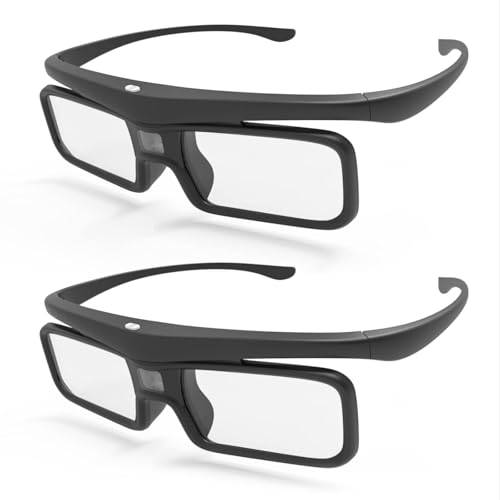
AWOL VISION DG-002 3D Glasses, 2-Pack ranks first overall in this specification-based comparison under the published weighted criteria.
The final choice among the best rechargeable 3d glasses depends on the documented features that match your intended use.
AWOL VISION DG-002 is the highest-scoring returned product and the first overall specification-based choice. Its documented 50-hour runtime, 178-degree viewing angle, 1.5 ms response, lightweight 28-gram frame, and compatibility with AWOL VISION and other DLP-Link projectors make it the best-documented match in this comparison. Choose it only when your equipment uses the supported DLP-Link method.
The top rechargeable 3d glasses for other setups depend on the display. Choose NexiGo for named NexiGo projector compatibility, 144Hz support, and eye-sequence control. Valerion is a suitable fit for VisionMaster and StreamMaster systems, while XGIMI is the focused choice for XGIMI projector families. For RF equipment, Sintron ST08-BT offers broad named TV and projector references, and Epson V12H548006 is the more targeted option for compatible Epson RF projectors.
If shared viewing is important, the AWOL VISION, Valerion, Sintron ST08-BT, TOUMEI, and Cocar entries are supplied in two-pair packages. If you need one pair, ELEPHAS and Epson document single-unit formats. Always verify the exact model and signal type before selecting eyewear.
Frequently Asked Questions
Are the best rechargeable 3d glasses compatible with every 3D projector?
No. Compatibility depends mainly on the synchronization method and the projector’s supported signal. DLP-Link glasses are not a substitute for RF glasses, and the Sintron ST08-DLP listing specifically excludes Epson. Check the projector model and 3D instructions before choosing.
What is the difference between DLP-Link and RF 3D glasses?
DLP-Link glasses synchronize with a compatible DLP-Link projector, generally without a separate emitter. RF glasses pair with RF-enabled televisions or projectors. The Sintron ST08-BT, Epson V12H548006, and Cocar RF models are documented for RF equipment, while AWOL VISION, NexiGo, Valerion, ELEPHAS, Sintron ST08-DLP, and TOUMEI document DLP-Link use.
Which selected model has the longest documented battery runtime?
Sintron ST08-BT and XGIMI each list up to 60 hours of continuous operation. AWOL VISION and Valerion list up to 50 hours. These figures come from public product listings and have not been independently tested in this comparison.
Can these glasses fit over prescription eyewear?
Some listings explicitly address this use. AWOL VISION and Valerion describe large frames suitable for myopic glasses, Epson says its model fits over most eyeglasses, and Cocar describes wearing its RF glasses in front of regular glasses. Other models may fit differently, so frame dimensions and personal fit should be checked.
Do refresh rates determine whether the glasses will work?
No. Refresh-rate support is only one specification. The glasses must also use the correct synchronization method and match the projector or television’s supported 3D format. A 144Hz DLP-Link claim does not make a pair compatible with an RF television.