Buying Guide
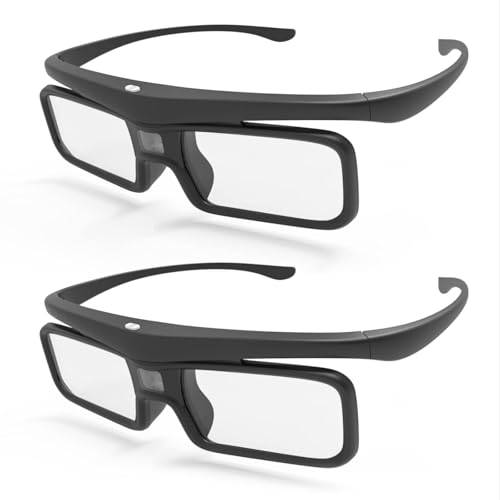
Choosing the best shutter 3d glasses is primarily a compatibility exercise. Active shutter eyewear does not use one universal communication standard: the selected listings document either DLP-Link synchronization or RF communication. Before comparing frame design or battery claims, identify the 3D mode supported by your projector or television and check the manufacturer’s compatibility information.
Match the synchronization method
Most selected models are intended for DLP-Link projectors. XGIMI, AWOL VISION, NexiGo, ELEPHAS, TOUMEI, EKYLIN, Valerion, Sintron, and Sanpyl all describe DLP-Link use in their supplied evidence. DLP-Link glasses synchronize with compatible projector signals, so a television, Bluetooth 3D system, or infrared setup may not work even when the glasses are described as universal within the DLP-Link category.
Cocar is the RF-focused exception in this selection. Its listing names RF 3D televisions and compatible RF projectors from Sony, Epson, Toshiba, and Sharp, and says an emitter is not required. That makes it a different design type rather than a direct substitute for DLP-Link eyewear. Confirm the exact television or projector model before selecting RF glasses.
Compare refresh-rate documentation
A higher stated refresh rate can matter when your source and projector support it, but the glasses must match the equipment’s supported mode. NexiGo, ELEPHAS, TOUMEI, EKYLIN, Sintron, and Cocar list 144Hz operation. Valerion gives the most detailed frequency range, listing support for 96, 100, 120, and 144Hz synchronization frequencies.
Refresh-rate claims should not be read as a guarantee of picture quality. The supplied evidence can establish what each listing says it supports, but it cannot establish how a particular projector, source, room, or viewer will look in practice. Check whether your projector outputs the relevant 3D frequency before treating 144Hz support as useful.
Consider battery and charging details
Rechargeable designs are common across this category, but stated runtimes vary. XGIMI lists up to 60 hours, while AWOL VISION, Valerion, and Sanpyl list up to 50 hours. TOUMEI and EKYLIN list up to 45 hours, and NexiGo lists more than 40 hours. ELEPHAS lists up to 30 hours per charge. These are supplied listing figures, not independent measurements.
Power-management details can be helpful for occasional use. XGIMI describes activation when a DLP-Link signal is received. EKYLIN documents five-second standby and five-minute shutoff, while Sintron lists automatic power-off and a low-power alarm. Cocar describes automatic standby and shutdown behavior. If glasses will be stored for long periods, also check the charging connector and instructions, since the supplied evidence does not provide a common charging standard across every model.
Check frame fit and viewing geometry
Viewers who wear prescription glasses should focus on frame dimensions and the listing’s fit language. AWOL VISION and Valerion describe large frames suitable for myopic glasses. Sanpyl specifically says it can be worn with various myopia glasses. Cocar says it can be worn in front of regular glasses. Those statements are more useful than assuming every active shutter frame will fit over prescription eyewear.
Viewing angle claims also differ. XGIMI and AWOL VISION list 178 degrees, while Sanpyl lists 150 degrees. Wider stated angles may be relevant for group seating, but the evidence does not show how those figures were measured or how they translate to a particular room. Sintron’s detachable earhooks provide a distinct fit option, whereas several other models emphasize lightweight or ergonomic frames without giving a measured weight.
Decide how many pairs you need
Pack size can change the practical fit of a model for a household. NexiGo, ELEPHAS, TOUMEI, EKYLIN, and Valerion are listed as two-pair configurations. A two-pack supports simultaneous viewing without requiring a second listing. XGIMI, AWOL VISION, Sintron, Cocar, and Sanpyl are presented as individual-pair products in the supplied evidence.
Do not assume that similarly named listings share the same parent product. This comparison treats each selected ASIN and its distinct parent grouping as a separate product, while avoiding duplicate parent groups. Also verify whether charging cables, manuals, or other included items matter to your setup; only documented inclusions should influence the decision.
Final Recommendation
Valerion DLP-Link 3D Glasses, 2-Pack ranks first overall in this specification-based comparison under the published weighted criteria.
The final choice among the best shutter 3d glasses depends on the documented features that match your intended use.
XGIMI Active Shutter 3D Glasses are the first overall specification-based choice among these selected products, combining DLP-Link compatibility, a documented 60-hour runtime, a 178-degree viewing angle, and signal-based activation. They are especially well matched to XGIMI projector owners, while the listing also identifies compatibility with other DLP-Link projectors.
AWOL VISION is the better fit-oriented alternative for viewers who need a large frame over prescription glasses, and Valerion is notable when multiple DLP-Link frequency options matter. NexiGo and ELEPHAS make practical choices for two-person viewing, with 144Hz support documented for both. TOUMEI and EKYLIN add useful left-right eye controls, while Sintron offers detachable earhooks.
For RF televisions or RF projectors, Cocar belongs on a separate shortlist because its synchronization method differs from DLP-Link. Sanpyl is worth considering when prescription-glasses accommodation, a 150-degree viewing angle, and a documented 50-hour battery are priorities. The top shutter 3d glasses therefore depend on the equipment standard first, then on runtime, fit, controls, and number of pairs.
Frequently Asked Questions
Are the best shutter 3d glasses compatible with every projector?
No. The selected products mainly document DLP-Link compatibility, while Cocar documents RF communication. A DLP-Link pair should not be assumed to work with an RF, infrared, Bluetooth, or ordinary projector. Review the projector’s 3D specifications and compare them with the glasses’ stated sync method before choosing.
Can these shutter 3d glasses work with a 3D television?
Only some of the selected evidence addresses televisions. Cocar is listed for RF 3D televisions from named brands, while several DLP-Link listings specifically exclude televisions. Confirm the television model and communication standard.
Which selected model is documented for the longest battery runtime?
XGIMI lists up to 60 hours of continuous operation. AWOL VISION, Valerion, and Sanpyl list up to 50 hours, while TOUMEI and EKYLIN list up to 45 hours. These figures come from public listing evidence and were not independently tested, so actual operation may depend on use and charging conditions.
What should prescription-glasses wearers check?
Look for explicit fit language rather than relying on the word universal. AWOL VISION and Valerion describe large frames for myopic glasses, Sanpyl addresses wearing the glasses with myopia eyewear, and Cocar says it can be worn in front of regular glasses. Frame fit can still vary by prescription lens size and face shape.
Do all selected models support 144Hz?
No. NexiGo, ELEPHAS, TOUMEI, EKYLIN, Sintron, and Cocar list 144Hz support. Valerion lists several supported synchronization frequencies, including 144Hz, while XGIMI, AWOL VISION, and Sanpyl provide other optical or response specifications without the same explicit 144Hz claim. Match the glasses to the projector’s actual output.