Buying Guide
The best rechargeable table fans are easier to compare when you separate personal cooling needs from whole-room expectations. These are portable, surface-friendly fans, so the useful question is whether a model can direct air where you sit, sleep, work, or camp. Battery capacity, runtime claims, controls, placement, noise information, and charging features matter more than promotional wording.
Start with the intended location
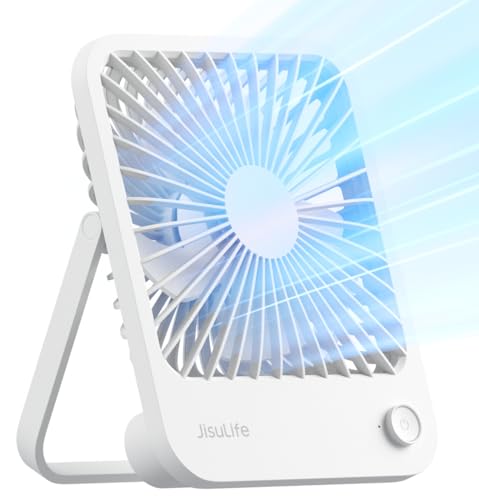
For an office desk or small nightstand, look first at footprint, weight, and stand design. JISULIFE FA26 folds through 180°, making it suitable for travel. Tevelecin F5 also folds and can stand or hang, while DoHome do-dfan01 emphasizes a compact personal format. These designs are convenient when the fan must move between a desk, bedroom, and bag.
A larger battery can increase flexibility but may also add bulk. BIVBTP F16 is listed as 1.65 inches thick, yet its 8000mAh battery and 7-inch format make it more substantial than a tiny personal fan. Roshopi P20 is more specialized: its 20000mAh battery, hook, light, and power-bank output suit tents, outdoor tables, and outages, but those features may be unnecessary for a laptop desk.
Compare runtime carefully
Battery capacity is useful, but the stated runtime range tells you more about how a fan may fit your routine. Otlonpe lists 5 to 23 hours, WNXQGZ lists up to 12 hours on its lowest setting, and TriPole lists 5 to 31 hours depending on use. DIGIX lists up to 17 hours on low speed. These figures should not be treated as directly comparable laboratory results because the supplied listings do not establish a common test method.
For overnight or workday use, prioritize a model whose low-speed claim matches the session you need. TriPole and BIVBTP emphasize long cordless operation, while JISULIFE and DoHome are better aligned with moderate personal use. Roshopi provides the largest stated battery capacity in this group and can also serve as a power source, which may help away from outlets.
Choose the right control range
Three or four speeds are often enough for personal cooling. Tevelecin F5 provides three speeds, JISULIFE FA26 provides four, and TriPole provides four. These controls are straightforward and can be convenient at a bedside table.
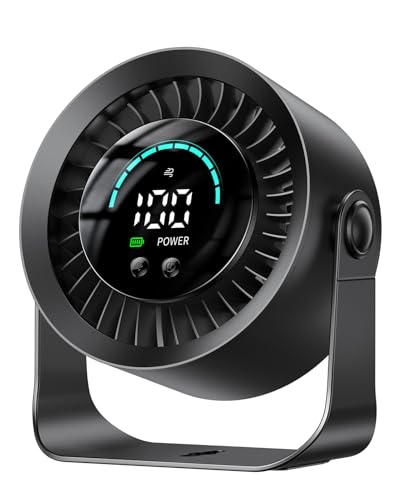
If you want smaller airflow adjustments, consider a model with more settings. DIGIX offers 100 speed settings and 360° rotation, while YOSHENMO adds memory for the last setting. A high number of speeds does not by itself establish stronger airflow or better comfort; it provides more adjustment points. For a desk shared with another person, or for a sleeper sensitive to airflow, more control may be useful.
Check positioning and mounting
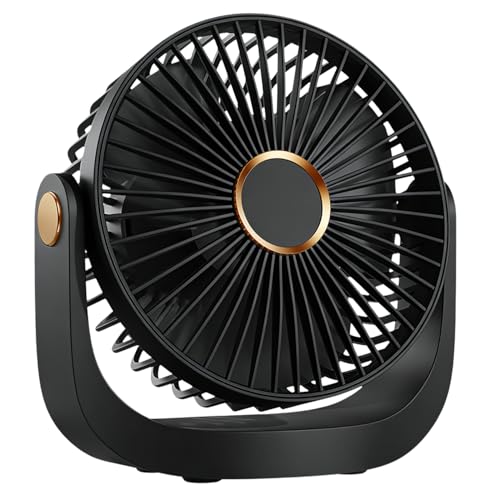
Direction matters when the fan is designed for personal airflow. Full rotation is documented for DIGIX, DoHome, and WNXQGZ. Otlonpe and JISULIFE use foldable or swiveling structures, while Tevelecin provides a 180° swivel stand. Roshopi adds a 270° adjustable head and a 360° swivel hook for hanging use.
Wall placement can free desk space. DIGIX documents wall mounting, and YOSHENMO describes no-hole wall hanging. BIVBTP is designed with travel storage in mind, while TriPole focuses on tabletop tilt. Before choosing a mounting model, check where you can safely place the included hook or mounting accessory and whether the airflow direction suits the room.
Treat noise claims as listing specifications
Several selected fans provide numerical noise information, including TriPole at below 25dB, WNXQGZ at 12 to 27dB, Roshopi below 30dB, DoHome at a 30dB minimum, and Tevelecin close to 25dB at minimum noise. JISULIFE lists noise below 40dB, while BIVBTP lists 42dB. These figures are supplied product claims, not independent measurements, and may vary by speed or environment.
For sleeping, a lower stated figure may be a useful starting point, but also consider whether the lowest setting supplies enough airflow. For office calls or study, a fan with a documented low-noise mode and precise speed control may be more useful than one that only advertises powerful airflow.
A battery display reduces guesswork. DIGIX, Otlonpe, TriPole, WNXQGZ, and BIVBTP document displays or battery-status indicators. USB-C or USB operation can also help when a wall outlet is nearby: DoHome documents Type-C charging, BIVBTP documents USB-C, and Otlonpe supports USB power in addition to its battery.
Lighting is useful beside a bed or in a tent, but it can be unnecessary on an office desk. TriPole has a night light, DoHome has a night-light mode, WNXQGZ offers gradient ambient lighting, and Roshopi includes a three-level LED lantern. Roshopi also provides USB-A output, while Otlonpe documents emergency phone charging. These features may justify a multifunctional design if you will use them.
Cleaning and storage are also worth checking. Otlonpe and DoHome document detachable front covers, and BIVBTP’s slim profile is aimed at packed travel. WNXQGZ describes an enclosed blade design, while Roshopi describes an outdoor-oriented body. These are listing-supported design details, not evidence of long-term durability.
Final recommendation
ROSHOPI P20 Camping Fan ranks first overall in this specification-based comparison under the published weighted criteria.
DIGIX NS-11 is the first overall specification-based choice among these best rechargeable table fans because it combines 100 speed levels, 360° rotation, up to 17 hours of low-speed runtime, a battery display, USB recharging, and wall-mounting flexibility. It is a balanced pick for a desk or bedroom when fine control matters.
The top rechargeable table fans are not identical, so the right alternative depends on your setting. Choose TriPole for a long stated runtime, low listed noise, and a bedside light. Choose Otlonpe if dual battery and USB operation, folding storage, and emergency phone charging are priorities. BIVBTP is a travel-oriented option when a thin body, high battery capacity, and lantern matter. JISULIFE is the lightweight choice, while DoHome suits a compact nightstand.
For camping, outages, or outdoor tables, Roshopi P20 is appropriate because its 20000mAh battery, hook, lantern, and USB output address needs that ordinary desk fans may not. YOSHENMO fits users who want 100 speed levels and memory, and WNXQGZ adds ambient lighting and full rotation to a desktop format. Tevelecin remains a practical simple option for work or study, especially if a low stated minimum-noise figure is important.
Frequently Asked Questions
How long do rechargeable table fans run?
The supplied listings show a wide range. DoHome lists up to eight hours, JISULIFE lists up to 13 hours, DIGIX lists up to 17 hours on low speed, and BIVBTP lists up to 28 hours. TriPole lists up to 31 hours, while Roshopi lists 8 to 30 hours. Actual use depends on speed, lighting, oscillation, and other functions, so treat these as product-listing estimates rather than a shared test result.
Which of the best rechargeable table fans is suitable for a bedside table?
TriPole is suitable for a bedside design because it documents a below-25dB noise claim, a night light, an LED battery display, and a 4000mAh battery. DoHome is another compact option with a night-light mode and 360° adjustment. WNXQGZ adds ambient lighting and a low stated noise range, while JISULIFE favors lightweight portability and a foldable stand.
Do these fans work while charging?
The supplied evidence confirms USB or dual-power operation for some models, including Otlonpe, Tevelecin, DoHome, and BIVBTP. Because the evidence is not uniform across all products, check the individual listing before assuming a selected fan can operate continuously while connected.
Are rechargeable table fans useful for camping?
Yes, but the choice depends on the outdoor functionality needed. Roshopi P20 documents a 20000mAh battery, a hanging hook, a 270° adjustable head, a lantern, and USB-A output. BIVBTP adds a large battery, a thin travel profile, a timer, and an emergency lantern. These designs are more suitable for tents and outdoor tables than a small desk-only model.
What should I prioritize if I need quiet operation?
Start with the supplied numerical noise claims, while remembering they are not independent measurements. TriPole lists below 25dB, WNXQGZ lists 12 to 27dB, Tevelecin lists a minimum close to 25dB, and Roshopi lists below 30dB. Then consider speed control and runtime, because the quietest setting may not provide the airflow you want. DIGIX and YOSHENMO offer many speed settings for finer adjustment, although neither supplies an exact decibel figure.