Buying Guide
Choosing among the best clip-on table fans starts with the mounting surface, power source, and amount of airflow control you actually need. A compact fan can save desk space, but the smallest models may have narrower clamps or shorter battery specifications. Larger fans can offer broader airflow or more stable mounting, while corded designs avoid recharge time when a USB port or wall outlet is nearby.
Match the fan to the mounting surface
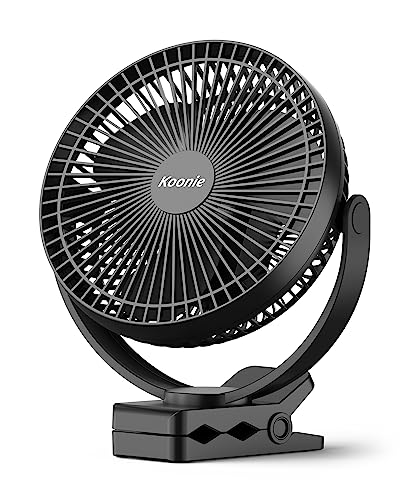
Check the documented clamp opening before choosing a model. Gaiatop lists a one-inch clamp, while Koonie’s 8-inch fan lists a three-inch clamp. Minthouz describes a non-slip clamp for surfaces such as treadmills, nightstands, golf carts, and strollers. A padded or rubberized interior is useful when the fan will be attached to finished furniture, because several listings specifically describe protective padding or rubber grips.
A tabletop base is valuable when the fan will move between locations. PureHome documents both a clamp and a non-slip base, while KIMMOO supports clip, stand, and wall-mount use. BananaDeer also documents clip, tabletop, and wall-mounted configurations. These convertible designs can be more practical than a clamp-only model, but additional parts or installation steps may make setup less immediate.
Decide between corded and rechargeable power
Corded USB models are a straightforward fit for a workstation with a laptop, USB adapter, power bank, or car charger nearby. HONYIN explicitly lists several compatible USB power sources and does not include a battery. This arrangement can provide continuous operation while leaving the fan body light, but it does not offer cordless placement.
Rechargeable models are more flexible for bedsides, strollers, camping, and travel. Minthouz documents an 8000mAh battery and a low-speed runtime claim of up to 37 hours. Koonie’s larger model lists a 10000mAh battery, while KIMMOO, duludulu, PureHome, Gaiatop, and NIFBANG also describe rechargeable operation. Runtime depends on speed and other functions, so treat low-speed figures as a specific operating scenario rather than a universal expectation.
Compare speed and directional control
Two or three speeds are enough for simple personal cooling, but more settings can make the transition between a light breeze and stronger airflow less abrupt. Vornado, Gaiatop, HONYIN, and PureHome list three speeds. BananaDeer lists three speeds plus oscillation, while Koonie’s 8-inch model adds an energy-saving setting.
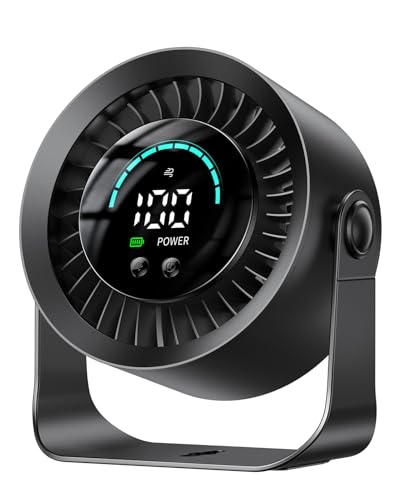
Digital models take control further. KIMMOO and duludulu both list 100-speed adjustment, with duludulu also providing preset levels and a display. This is useful when precise control or battery visibility matters, but it is not automatically better for every desk. The best clip-on table fans for a simple office setup may be easier to use with a physical speed control.
Directional range also matters. Many selected fans document 360-degree movement, and HONYIN and Minthouz describe 720-degree adjustment across horizontal and vertical axes. BananaDeer adds left-right oscillation, while the NIFBANG dual-head fan allows each head to move independently. Wider adjustment helps when the mounting position is fixed, but a stable clamp remains important because a broad range is only useful if the fan stays aimed where placed.
Consider noise claims carefully
Several listings provide useful noise information, but the claims are not presented under a common testing standard. Vornado lists specific low- and high-speed decibel figures; HONYIN states a 25 dB minimum; KIMMOO, duludulu, and NIFBANG also describe quiet operation with numerical claims in their listings. These figures can help narrow the field, but they should not be treated as directly comparable laboratory results.
For a bedroom or nursery-adjacent setup, also look at the grille and mounting design. Gaiatop and Koonie’s smaller fan describe narrow grille spacing, while KIMMOO documents a dual-barrier design. These are design features, not a substitute for supervision or general fan safety practices.
Look at size, weight, and extras
A small fan is easier to pack and may fit a crowded desk, but a larger fan can provide a different airflow format. Vornado is a compact personal circulator, while Koonie’s 8-inch and BananaDeer’s 9-inch models occupy a larger category. NIFBANG’s dual-head layout is also intended to cover a broader area than a single-head mini fan.
Extras should support your use case. KIMMOO’s display and multiple mounting modes suit users who want control and placement flexibility. BananaDeer’s remote and oscillation suit a fixed home or office location. Digital displays on KIMMOO and duludulu help track settings and battery status. If you only need a breeze beside a keyboard, those additions may matter less than a secure clamp and accessible controls.
Final Recommendation
KIMMOO 100-Speed Rechargeable Clip-on Fan ranks first overall in this specification-based comparison under the published weighted criteria.
KIMMOO is the highest-scoring returned product and the first overall specification-based choice among the best clip-on table fans. Its 100 speed settings, rechargeable design, three placement methods, two-axis rotation, quiet-operation claim, and dual-barrier safety design give it a strong documented feature mix.
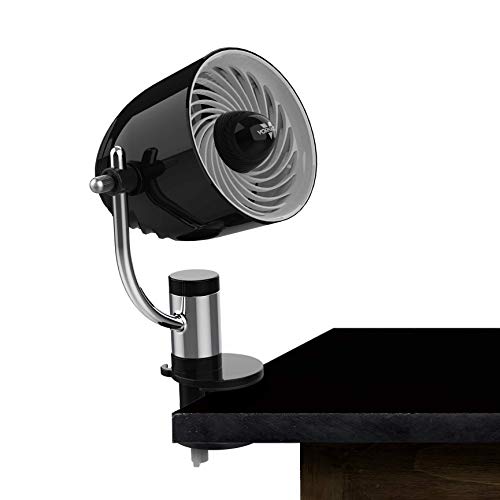
Choose Vornado if quiet operation, a multi-surface clip, and a stated three-year warranty matter more than cordless use. Minthouz is the stronger fit for extended runtime, while Koonie’s 8-inch model suits shoppers who prefer a larger cordless format. For camping, Gaiatop provides compact cordless operation and a padded clamp; for precise digital control, duludulu is a close alternative. HONYIN remains a practical USB choice when a power source is always available. These are the top clip-on table fans here because each serves a distinct documented need rather than relying on volatile marketplace signals.
Frequently Asked Questions
Are clip-on table fans better than regular desk fans?
They can be more space-efficient because the clamp attaches to a desk edge, shelf, bed frame, stroller, or other compatible surface. A regular desk fan may be simpler if you always have clear tabletop space. Convertible products such as PureHome and Vornado offer more than one placement method, which can reduce that trade-off.
Which of the best clip-on table fans is best for camping?
Gaiatop is a practical camping-oriented selection because its listing documents rechargeable power, a padded clamp, USB charging, and compact dimensions. KIMMOO, duludulu, and Minthouz also provide cordless operation and portable clip designs, but their listed feature sets focus more on control, runtime, or digital adjustment.
Do all clip-on fans work without an outlet?
No. HONYIN is described as USB-powered with no battery, so it needs a compatible USB power source. Rechargeable models such as KIMMOO, duludulu, Minthouz, and PureHome can operate without a connected cable after charging. Check whether the listing includes a charger or only a charging cable before buying.
How much speed control is enough?
Three speeds cover many everyday uses. More precise adjustment can help when a low setting feels too weak but the next fixed setting feels too strong. KIMMOO and duludulu list 100-speed adjustment, while Vornado, Gaiatop, HONYIN, and PureHome list three speeds. The best choice depends on whether fine control or simpler operation is more important.
What should I check before attaching a fan?
Confirm the clamp opening, surface thickness, and whether the interior has rubber or padded protection. Also consider the fan’s weight and whether the selected position leaves the grille unobstructed. Koonie’s 8-inch fan documents a three-inch clamp, while Gaiatop lists a one-inch clamp, illustrating why mounting compatibility should be checked before purchase.