Buying Guide
Choosing among the best wall/table fans starts with the location and the type of airflow you need. A compact rechargeable model may be ideal for a nightstand, dorm shelf, camper, or crowded kitchen counter. A larger air circulator is better suited to moving air across a room, while a dedicated wall fan can keep a vanity or closet area clear of tabletop clutter. The listings in this comparison document several different designs, so the most useful choice depends on placement, control range, power source, and intended coverage.
Decide between personal airflow and room circulation
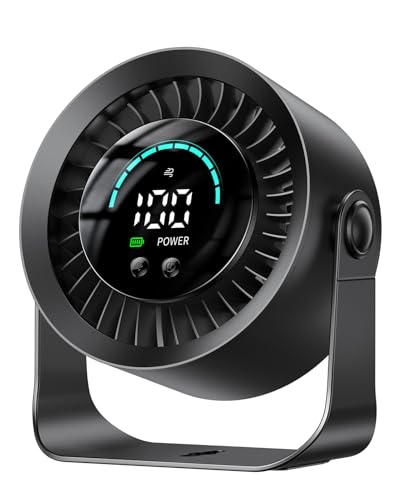
Small wall-and-table fans are generally personal-airflow products. The Coolhill ZH27, Coolhill ZH57, DIGIX, Dexmary, YOSHENMO, HAGEDAWN, and WNXQGZ models all emphasize compact placement, rechargeable use, or focused airflow. These formats are easier to move and can sit near a desk or bed, but their specifications do not establish whole-room performance.
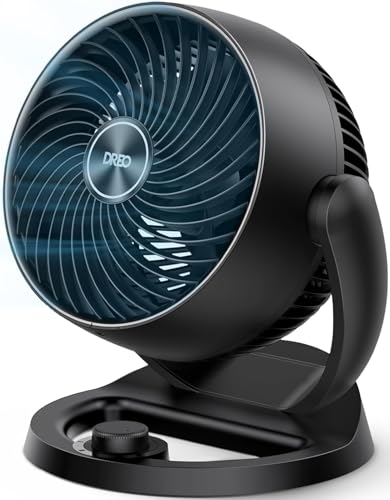
The DREO DR-HAF002 is the clearest room-circulation option in the selection. Its listing describes airflow reaching up to 70 feet, a 12-inch air-circulator format, and use on a table or wall. It is substantially heavier than the personal fans, so it makes more sense when coverage is more important than carrying the unit from place to place.
Check mounting and placement details
“Wall mountable” does not always mean the same thing. Some products use an adhesive hook, while others describe a wall-hanging or mounting design without giving detailed surface requirements. The DIGIX, Coolhill ZH57, Coolhill ZH27, Dexmary, YOSHENMO, HAGEDAWN, WNXQGZ, Morelax, and DREO listings all support a wall or tabletop use case in their supplied evidence.
The No-Drill Hook-Mounted Wall Fan is the most specific option for wall placement. It includes two adhesive hooks and is designed to hang in locations such as vanities, restrooms, and closets. Its listing also limits the product to dry indoor use and close-range airflow. Check the mounting surface and follow the product’s stated requirements before installation, especially when using adhesive hardware.
Match speed control to your comfort needs
Speed count is useful when you want more gradual adjustment, but it should not be treated as a direct measurement of airflow strength. A high count may help fine-tune a personal breeze, but a simple three- or four-speed control can be easier to operate.
The DREO uses three knob-controlled speeds, and the Morelax uses four speeds plus a natural-wind mode. The No-Drill model also uses four speeds, supplemented by motion-sensing operation. These simpler controls may be preferable if you want quick changes without navigating a digital interface.
Consider battery capacity and stated runtime
Rechargeable power is a major advantage when outlets are inconvenient. DIGIX lists up to 17 hours on low speed, WNXQGZ lists up to 12 hours on its lowest setting, and Dexmary lists up to nine hours. Coolhill ZH27 gives a three-to-10-hour range, while YOSHENMO provides a three-to-10-hour range as well. These figures depend on operating settings, and the longest claims generally apply to lower speeds.
The Coolhill ZH57 adds pass-through charging, allowing use while connected to power. The No-Drill model supports USB-C continuous power and also lists four AA batteries as backup, although the batteries are not included. If you need uninterrupted operation, prioritize a model with a documented wired-use option rather than relying only on a battery estimate.
Look at noise evidence carefully
Several selected products provide specific noise figures. Coolhill ZH27 lists 28dB on lower settings, Coolhill ZH57 lists 30dB, WNXQGZ lists 12dB at its lowest setting and 27dB at its highest listed gear, and DREO lists 25dB. These figures are listing claims, not independent measurements, and may apply only to particular settings.
Other products use qualitative terms such as “quiet” or “whisper-quiet” without a numeric specification. That language can still indicate intended bedroom or office use, but it provides less comparable evidence. If sound is a primary concern, favor models with a stated low-setting figure and use the lower speed range when sleeping or working.
Prioritize direction and cleaning features
A tilting or rotating head helps aim personal airflow without moving the base. DIGIX, Dexmary, and WNXQGZ document 360-degree adjustment or rotation. Coolhill ZH27 lists 120-degree vertical tilt, and YOSHENMO lists 105-degree adjustment. Morelax adds independently adjustable heads, multi-angle rotation, and oscillation for directing airflow toward different positions.
Cleaning information is more limited across compact models. The DREO specifically describes removable parts for cleaning, while the No-Drill model describes a removable front cover. Those details may be helpful for routine maintenance, especially if the fan will operate in a dusty area. Always use the supplied instructions for disassembly and cleaning.
Think about convenience features
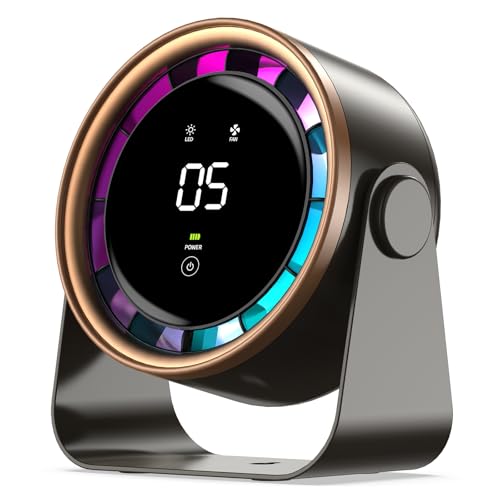
Digital displays can show speed and remaining battery information. DIGIX, Coolhill ZH27, Coolhill ZH57, YOSHENMO, HAGEDAWN, and WNXQGZ document some form of display. LED lighting appears on WNXQGZ, HAGEDAWN, Morelax, and the No-Drill model’s heat-index indicator. These additions can be useful at night, but they should not outweigh the fundamentals of placement, airflow direction, and power.
Final Recommendation
DIGIX Portable Desk Fan NS-11 ranks first overall in this specification-based comparison under the published weighted criteria.
The final choice among the best wall/table fans depends on the documented features that match your intended use.
DIGIX Portable Desk Fan NS-11 is the highest-scoring returned product and the first overall specification-based choice. Its combination of 100 speeds, 360-degree rotation, desk-and-wall placement, USB rechargeability, battery display, and stated 17-hour low-speed runtime gives it the broadest documented utility.
The DREO DR-HAF002 is the better fit for room circulation and a larger tabletop footprint, while the Coolhill ZH57 is a strong choice for compact quiet personal airflow with pass-through charging. Coolhill ZH27 and YOSHENMO offer especially fine speed adjustment, and WNXQGZ stands out for its stated runtime and ambient light. For a purpose-built wall installation, the No-Drill Hook-Mounted Wall Fan is the most targeted option. Together, these top wall/table fans cover personal desks, bedrooms, shared spaces, and dedicated wall locations without relying on customer sentiment or hands-on testing.
Frequently Asked Questions
Are the best wall/table fans suitable for whole-room cooling?
Not all of them. Most compact rechargeable models in this comparison are described for personal airflow around desks, beds, offices, dorms, kitchens, or travel. The DREO DR-HAF002 is the clearest whole-room circulation choice because its listing specifies a 70-foot airflow reach and an air-circulator design. A small fan can improve comfort in a nearby area, but the supplied evidence does not establish that every compact model can cool an entire room.
Which selected fan is easiest to use without a tabletop?
The No-Drill Hook-Mounted Wall Fan is the most specifically designed for that purpose because it includes adhesive hooks and is intended for close-range wall placement. DIGIX, Coolhill ZH57, Coolhill ZH27, Dexmary, YOSHENMO, HAGEDAWN, WNXQGZ, Morelax, and DREO also document wall or wall-hanging use. Confirm the mounting surface and installation instructions before hanging any model.
Do more speed settings guarantee stronger airflow?
No. A larger number of speed settings indicates finer adjustment, not necessarily greater airflow. Models such as DIGIX, Coolhill ZH27, Coolhill ZH57, YOSHENMO, and Dexmary list 100 levels, while DREO uses three speeds and is documented for broader air circulation. Compare the complete specification set, including fan format, stated airflow claims, direction controls, and intended use.
Which fan is the best option for overnight use?
The supplied evidence points to several bedroom-oriented choices. Coolhill ZH57 lists 30dB on low settings and up to eight hours of runtime, Coolhill ZH27 lists 28dB on lower settings and a three-to-10-hour range, and DIGIX lists up to 17 hours on low. These are listing specifications rather than independent measurements. For overnight use, also consider whether the display or LED light can be turned off and whether the fan can remain connected to power.
What should I check before buying a rechargeable wall fan?
Verify the stated runtime, charging connector, whether pass-through or continuous wired use is supported, mounting method, surface compatibility, and the available tilt or rotation. Battery claims commonly vary by speed, so read whether the maximum figure applies only to low operation. Also check whether the fan is intended for dry indoor use, close-range airflow, or wider circulation.