Buying Guide
Choosing among the best rolling utility carts starts with the job, not the number of tiers alone. A cart for craft supplies has different needs from one used for appliances, pantry goods, or garage tools. The selected products document several useful formats: open basket carts, wire utility carts, drawer carts, carts with tabletops, accessory-equipped organizers, slim carts for gaps, and a two-shelf service cart.
Match capacity to the load
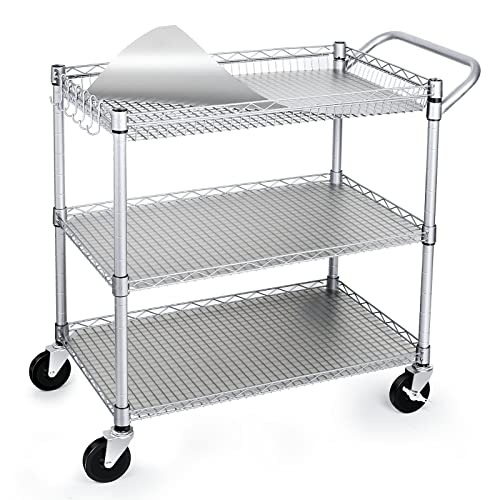
Capacity is the clearest dividing line in this group. MaxWorks documents a 500-pound capacity, ThreeHio lists a 198-pound total capacity, and Aokitsink documents a 150-pound capacity. EAGMAK states a 55-pound capacity per shelf, while TOOLF’s wooden-board cart lists a 132-pound capacity. These figures are not interchangeable: one listing may describe total capacity, another per-shelf capacity, and another may provide no load figure at all.
For heavy kitchen appliances, workshop supplies, or dense cleaning products, prioritize a cart with a stated limit and a suitable structure. MaxWorks uses commercial-duty polypropylene, deep trays, and 5-inch casters in a service-cart format. ThreeHio uses open wire shelves and adjustable feet, while EAGMAK uses deep metal mesh baskets. Spread weight across tiers rather than concentrating it on one basket, and follow the stated shelf or total limit.
For lighter items such as toiletries, craft materials, diapers, or office supplies, a drawer or accessory system may be more useful than maximum capacity. Aokitsink combines a metal frame with four mesh drawers, and Goovilla provides a removable drawer alongside four tiers. Goovilla’s listing separates the 24-pound top-layer allowance from the 50-pound allowance for each other layer, so loading should follow those individual limits.
Choose open tiers, drawers, or a work surface
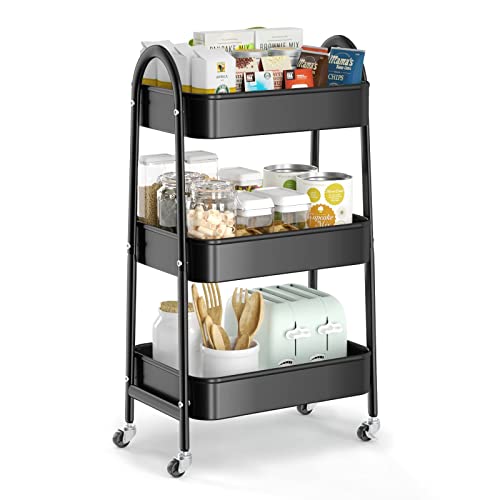
Open tiers make frequently used items visible and accessible. They work well for bottles, folded supplies, pantry containers, and craft materials that need quick retrieval. Raised edges or deep baskets can help keep items from sliding while the cart moves.
Drawers are better when you want to separate small pieces or reduce visual clutter. Aokitsink has four mesh drawers with stops, and the TOOLF wooden-board cart includes an ABS drawer with two open baskets. Goovilla’s removable drawer adds another enclosed zone and can be taken out when extra height is needed. Drawer carts may be less convenient for unusually tall or bulky objects, so measure the items that must fit before choosing this format.
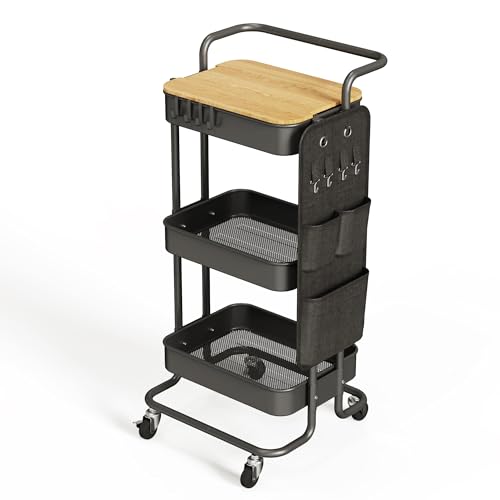
A tabletop changes a storage cart into a more flexible station. The TOOLF wooden-board cart provides an MDF top, while DTK documents a removable tabletop. These surfaces can hold items that should remain flat or within reach, but the supplied evidence does not establish that either surface is heatproof, waterproof, or intended for food preparation. Treat them as storage or work surfaces only within the manufacturer’s described use.
Measure the route and parking space
Compare both cart dimensions and the route to the destination. A cart that fits beside a washer still needs enough clearance to roll out and turn. Vivihomety is the narrow-gap specialist, with a listed 7.1-inch width for spaces between appliances, cabinets, and walls. Its narrow shelves are useful for bottles and supplies but may not suit broad boxes.
For larger loads, ThreeHio is 25.5 inches wide, while DTK stands 37.4 inches high. Those dimensions may be helpful for accessible storage, yet they can be awkward beneath counters or shelves. Before buying, measure doorways, cabinet openings, appliance gaps, and the final parking area. Include handle and accessory clearance where the listing provides those features.
Check wheel control and surface compatibility
Most selected carts use four swivel casters, and many specify two lockable wheels. Locks help keep the cart stationary, but they do not turn it into a fixed cabinet or guarantee stability on every surface.
If the cart will move between rooms, look for a handle or a design that provides a clear pushing point. Accessory-heavy designs can change the effective width, so measure with cups, hooks, bags, or pegboards attached. For a cart that will stay parked most of the time, prioritize accessible locks and a footprint that does not obstruct walkways.
Consider materials and assembly
Metal frames and baskets are common in this category and may suit heavier or humid-room storage when the listing documents a coated or rust-resistant finish. Vivihomety specifies powder-coated steel and a particleboard top, while EAGMAK describes anti-rust treatment. MaxWorks uses polypropylene described as resistant to rust, stains, scratches, and dents. Material alone does not establish a particular load rating or lifespan, so rely on the supplied capacity and care information.
Assembly varies from tool-free to screw-based setups. The TOOLF pegboard cart documents no-tool assembly, while several metal carts include tools and instructions. A quick setup claim is useful for planning, but it is not evidence of long-term durability. Follow the supplied instructions and tighten hardware as directed.
Final recommendation
Aokitsink 4-Drawer Metal Utility Cart ranks first overall in this specification-based comparison under the published weighted criteria.
Aokitsink 4-Drawer Metal Utility Cart is the first overall specification-based choice among these best rolling utility carts. Its combination of a documented 150-pound capacity, four mesh drawers, drawer stops, a wooden top, and locking casters makes it especially useful for craft and supply organization.
MaxWorks is the better fit for heavier workshop or service-cart duties because its listing documents a 500-pound capacity, deep trays, and 5-inch casters. ThreeHio offers a spacious wire layout with a documented 198-pound total capacity, while YASONIC provides a reinforced metal three-tier design with a stated 110-pound capacity and accessory storage.
Choose the TOOLF wooden-board model when a tabletop and drawer matter more than a compact footprint. EAGMAK fits heavier shelf-by-shelf storage, Goovilla offers the most adjustable tier arrangement, and DTK is the most workstation-like design. For a narrow gap, Vivihomety is the clearest match. These top rolling utility carts serve different use cases, so dimensions and documented load limits should determine the final choice.
Frequently Asked Questions
What are the best rolling utility carts for heavy items?
MaxWorks has the clearest heavy-load specification in this comparison, with a documented 500-pound capacity. ThreeHio lists a 198-pound total capacity, while EAGMAK documents the current price per shelf. Use the stated limit for the specific shelf or total arrangement, distribute weight evenly, and confirm that the cart fits the intended route.
Are rolling utility carts suitable for narrow spaces?
Yes, but width and turning clearance matter. Vivihomety is specifically documented as a 7.1-inch-wide cart for gaps beside appliances and cabinets. Measure the opening, the cart’s handle area, and the distance needed to pull the cart out before ordering.
Should I choose a cart with drawers or open baskets?
Choose drawers when small supplies need separation or a less exposed arrangement. Aokitsink has four mesh drawers, while Goovilla and the TOOLF wooden-board model combine drawer storage with open areas. Open baskets are easier for quickly grabbing bottles, books, or craft containers. The right choice depends on item size, visibility, and whether you need a flat top.
Do lockable wheels keep a cart completely stable?
Lockable wheels help prevent rolling when the cart is parked, but the supplied listings do not guarantee complete stability on every floor or under every load. Use level placement, keep heavy items low, and follow the product’s stated capacity. ThreeHio also documents adjustable feet, which may help with positioning on uneven floors.
How many tiers should a utility cart have?
Three tiers are a useful general format for baskets and supplies, while four tiers can provide more vertical organization in a similar footprint. Goovilla is more configurable because its listing describes two-, three-, four-, and combined five-layer arrangements. Extra tiers can reduce clearance between shelves, so compare the vertical space needed by the items you plan to store.