Buying Guide
Choosing among the best round cutting boards starts with the type of work you expect to do. A board for daily chopping needs a usable surface and stable material, while a board for pizza or charcuterie may prioritize presentation, handles, or special grooves. This comparison uses listed specifications and feature descriptions only; it does not represent hands-on testing or customer-opinion analysis.
Match the board to the food
For broad kitchen preparation, larger surfaces reduce the need to move ingredients repeatedly. The John Boos R-Board provides an 18-by-18-inch surface and 1.5-inch thickness, making it a substantial option in this group. The Ayiaren board also offers a large 21-by-16-inch footprint and is described for pizza, bread, meat, fruit, and cheese. These formats are better suited to large foods and generous serving layouts than the compact Kaizen Casa board.
A 12- to 16-inch format is more adaptable for ordinary counters. Vesta Homes documents a 15-inch round board, while Dynamic-top and SOFE use elongated dimensions around 15.7 inches by 11.8 inches. TUOCON’s 16-inch bamboo board is especially relevant to pizza because its front face includes slicing grooves. If pizza is the recurring task, that feature may be more useful than choosing solely by thickness.
Compare wood, bamboo, and polyethylene
Wood boards bring natural grain and serving appeal, but their care instructions matter. John Boos specifies hand washing and recommends board oil and cream for maintenance. SOFE calls for hand washing with mild soap and water plus occasional food-grade mineral oil. Dynamic-top likewise specifies hand washing, thorough drying, and occasional oiling. These requirements mean the boards are not documented as dishwasher options.
Acacia appears across several selected boards, including Vesta Homes, Ayiaren, Sliner, Patelai, and Kaizen Casa. The supplied listings describe acacia as suitable for food preparation and serving, with natural grain and, in some cases, pre-treatment or resistance to warping and cracking. Those are listing claims rather than independently verified test results, so buyers should follow the care guidance supplied with the product.
Bamboo is used by TUOCON, whose board has a pizza-oriented double-sided layout. Polyethylene takes a different approach: the Excellanté board is described as easy to clean, non-skid, and suitable for general slicing and dicing. That makes it a useful choice for shoppers who prefer a straightforward plastic prep surface over a wood board that needs oiling.
Consider thickness and usable features
Thickness helps describe a board’s physical profile, but it should not be treated as a guarantee of performance. The John Boos board is listed at 1.5 inches, Vesta Homes at approximately one inch, and SOFE at 0.8 inch. The thinner TUOCON board is 0.47 inch, while the Patelai set is listed at 0.6 inch. The supplied evidence does not establish comparative stability or durability through testing.
Reversible designs can add utility. John Boos, Vesta Homes, and TUOCON document two-sided use, although the specific layouts differ. TUOCON has pizza grooves on one side and a smooth reverse panel. Vesta Homes describes reversible sides, while John Boos combines reversibility with recessed finger grips. A juice groove is another specialized feature: Kaizen Casa documents one for liquids from foods such as tomatoes, mozzarella, and carved meats.
Decide whether you need a handle
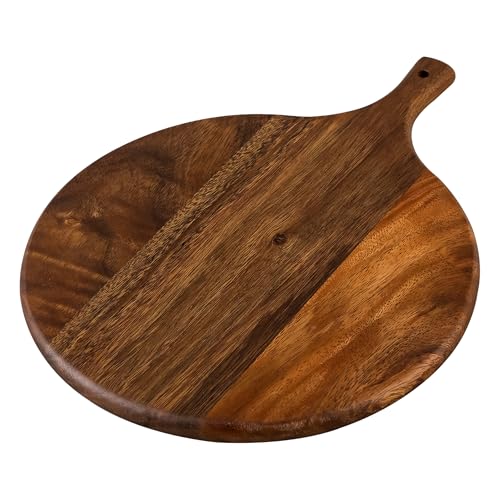
Handles help with carrying, hanging, or serving, but they also change the usable shape of a board. Ayiaren has a four-inch handle and hanging hole. A handle is useful when serving pizza, bread, or appetizers, but it may reduce the uninterrupted cutting area compared with a flat board.
The Patelai boards are flat and stackable, making them a better fit for batch use where storage matters. The Sliner set supplies six boards, which can help with events, replacement needs, or simultaneous serving. Sets trade individual-board simplicity for quantity, so check whether you have room to store all the pieces before choosing a multi-pack.
Plan for cleaning and storage
The supplied evidence most often points to hand washing for wooden boards. Let wood dry thoroughly and follow any supplied oiling instructions. Do not assume a wooden product is dishwasher safe unless its listing explicitly says so. The Excellanté polyethylene board is described as easy to clean, while the selected wood listings emphasize hand washing or maintenance instead.
Measure both the board and the available storage area. Large options such as John Boos and Ayiaren offer more workspace but need more room. Smaller boards such as Kaizen Casa are easier to place in compact kitchens but can require more frequent clearing during large prep jobs. Hanging holes and handles may help storage, while flat boards may stack more efficiently.
Final recommendation
Ayiaren 21-Inch Extra-Large Acacia Board ranks first overall in this specification-based comparison under the published weighted criteria.
Ayiaren 21-Inch Extra-Large Acacia Board is the first overall specification-based choice among the best round cutting boards. Its documented 21-by-16-inch size, handle, single-piece acacia construction, and stated reversible use give it a strong combination of workspace and serving utility.
John Boos R-Board 18-Inch Maple is another strong choice for shoppers who prioritize a thick, large wooden board. Its documented 18-by-18-inch size, 1.5-inch thickness, reversible sides, recessed grips, and edge-grain maple construction provide a detailed specification profile. Choose Vesta Homes if you want a more moderate acacia board with a handle and reversible design. Choose Excellanté when easy-clean polyethylene and a non-skid surface matter most.
For specialized uses, TUOCON is a strong pizza-oriented option because of its groove-lined slicing face, while Kaizen Casa is the compact juice-groove pick. Ayiaren offers a large handled presentation surface, and the Sliner or Patelai sets make more sense when several boards are useful. Among the top round cutting boards, the best fit depends on whether your priority is workspace, portability, serving, specialized features, or simpler care.
Frequently Asked Questions
Among the best round cutting boards, what size is practical for everyday prep?
The answer depends on counter and storage space, but the selected products range from Kaizen Casa’s 9-by-9-inch board to John Boos’s 18-by-18-inch board. Medium formats around 14 to 16 inches offer a compromise between workspace and handling. Larger options are better for pizza, bread, and generous serving arrangements, while smaller boards suit limited prep or compact kitchens.
Are wooden round cutting boards dishwasher safe?
The supplied listings for John Boos, SOFE, Dynamic-top, and other selected wooden boards specify hand washing or recommend hand washing and drying. The evidence does not establish dishwasher safety for those products. Follow the product’s care directions rather than assuming that wood, bamboo, or acacia boards can go in a dishwasher.
Which selected board is designed specifically for pizza?
TUOCON is the most specifically documented pizza option. Its 16-inch bamboo board has groove lines on the front for dividing pizza and a smooth reverse panel for kneading or serving. Ayiaren, Sliner, and SOFE are also described for pizza or serving, but their listings do not document the same pizza-slicing guide layout.
What is the advantage of a cutting board with a handle?
A handle can make a board easier to carry, serve from, or hang when not in use. Ayiaren, SOFE, Dynamic-top, and several set-based options document handles. The trade-off is that the handle changes the board’s shape and may leave less continuous cutting area than a flat design such as Patelai’s boards.
Are round cutting boards useful for serving as well as chopping?
Many selected products are explicitly described for both tasks. Vesta Homes, Ayiaren, SOFE, TUOCON, Patelai, and Kaizen Casa mention serving applications such as cheese, charcuterie, fruit, bread, appetizers, or desserts. Serving suitability depends on the documented surface and features, so check whether the board is reversible, grooved, handled, or flat before choosing it for table presentation.