Buying Guide
This specification-based guide compares the best western equestrian saddle pads by documented construction rather than hands-on testing. The most useful starting point is not color or brand, but the relationship among pad dimensions, saddle shape, horse conformation, material, and the type of riding planned. A pad that looks well cushioned may still be unsuitable if its footprint does not provide appropriate coverage or if its contour does not align with the saddle.
Start with dimensions and saddle compatibility
Measure the saddle and compare it with the pad’s listed length and width. Several selected pads are approximately 31 to 32 inches in length, including the Professional’s Choice 100% Steam-Pressed Wool Felt Pad, Weaver Equine 32 x 32 All Purpose Wool Blend Felt Pad, and Classic Equine Blended Felt Saddle Pad. These dimensions are common among full-size western pads in this pool, but they should not be treated as universal sizing guidance.
The pony options are materially smaller. The Weaver Equine 27 x 27 Contoured Pony Felt Pad and Weaver Equine 23 x 24 Contoured Pony Felt Pad are designed around pony-size dimensions, while the 30 x 30-inch Weaver Equine Wool Blend Felt Pad sits between compact and full-size formats. Confirm the saddle’s contact area, skirt clearance, and the horse’s back length before choosing. A larger pad is not automatically a better pad if it extends beyond the usable saddle area.
Choose wool, wool blend, or acrylic construction
Wool and wool-blend pads dominate this selection because the supplied listings repeatedly document moisture wicking, breathability, cushioning, and shock absorption. The Professional’s Choice pad uses 100% steam-pressed wool felt. The Weaver Equine 32 x 32 All Purpose Wool Blend Felt Pad, Weaver Equine 31 x 32 Contoured Wool Blend Pad, and Weaver Equine 30 x 30 Wool Blend Felt Pad use wool-blend felt. Wool-based designs may appeal to riders who want natural-fiber moisture management and a felt surface with a substantial listed profile.
Acrylic pads provide a different specification balance. The Weaver Equine 32 x 32 Contoured Acrylic Pad and Weaver Equine 30 x 32 Cut Back Acrylic Pad list quick-drying, colorfast acrylic tops with moisture-wicking action. Both also document felt filler and synthetic fleece bottoms. The acrylic route may be useful when a rider prefers a synthetic woven top, while the wool-blend route may be preferable when natural-fiber construction is the priority. The evidence does not establish that one material is universally superior.
Compare thickness and cushioning claims
Listed thickness ranges from 3/4 inch to 1 inch among the selected designs. The Professional’s Choice pad, Weaver Equine 32 x 32 All Purpose Wool Blend Felt Pad, Weaver Equine 32 x 32 Contoured Acrylic Pad, Weaver Equine 30 x 32 Cut Back Acrylic Pad, Classic Equine Blended Felt Saddle Pad, and Weaver Equine 27 x 27 Contoured Pony Felt Pad list 1-inch construction or filler. The Weaver Equine 30 x 30 Wool Blend Felt Pad and both selected smaller felt designs use 3/4-inch felt.
Thickness alone does not describe the entire cushioning system. Fiber type, contour, filler arrangement, and saddle fit also matter, but the supplied evidence does not provide independent pressure testing or comparative ride results. Treat thickness as a documented specification, not a guarantee of comfort. A properly matched 3/4-inch pad may be more appropriate than a thicker pad that does not fit the saddle or horse.
Look for contour, cutback, and mobility details
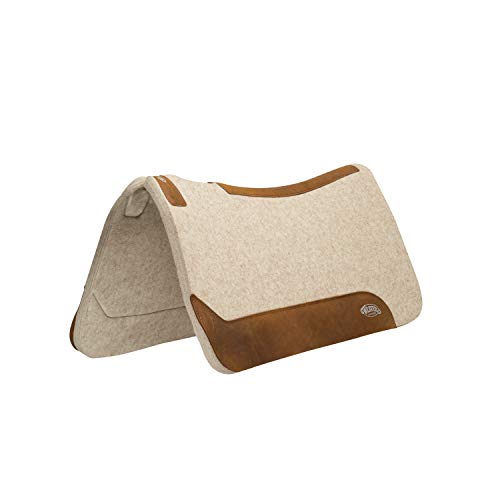
Contoured designs appear throughout the selected group. The listings describe contouring as helping shape the pad to the horse’s back and reduce saddle roll. The Professional’s Choice pad adds a contoured spine, built-in channel, and wither relief. Its cutback front is specifically described as allowing greater shoulder freedom and range of motion. The Weaver Equine 30 x 32 Cut Back Acrylic Pad also documents a cut-back design.
The Classic Equine Blended Felt Saddle Pad takes a different approach with a split design described as allowing the pad to move with the horse, plus a butterfly cut. These features make it a distinct choice for shoppers comparing mobility-oriented designs. However, the listings do not provide a universal fit formula, so riders should check the horse’s topline, wither shape, saddle placement, and desired clearance.
Evaluate wear protection and construction
Reinforced wear areas can matter because the saddle creates repeated contact at specific points. The Professional’s Choice pad uses oversized wear leathers. Multiple Weaver Equine models list reinforced pad spines and top-grain wear leathers, while the all-purpose Herculon model lists full-grain wear leathers. The compact pony felt model lists microfiber wear leathers.
These details support a durability comparison, but they do not establish a service life or resistance to every riding condition. Consider how the pad will be stored, cleaned, and used. A pad with clearly documented wear protection may be preferable for frequent work, while a simpler design can still be appropriate when the fit and material match the intended use.
Consider cleaning and daily handling
The Weaver Equine All Purpose Contoured Herculon Pad has the clearest maintenance-oriented feature in this group: its weather-repellent Herculon top is described as easy to clean and useful for removing burrs and brush. That makes it a practical choice for riders who frequently encounter debris. The other selected listings provide less specific care information, so avoid assuming that a wool, acrylic, or felt pad is machine washable unless the listing states it.
Weight can also affect handling. The supplied specifications list weights from the current price for the Weaver Equine 31 x 32 Contoured Wool Blend Pad to the current price for the Professional’s Choice pad, although listing measurements can vary by source or configuration. Use weight as a comparison point, not as a performance claim. Always follow the manufacturer’s care directions and allow a pad to dry appropriately after use.
Match the pad to the riding routine
For general western use, an all-purpose contoured wool-blend or acrylic pad offers a broad feature set. The Weaver Equine 32 x 32 All Purpose Wool Blend Felt Pad and Weaver Equine 32 x 32 Contoured Acrylic Pad document balanced combinations of cushioning, moisture management, contouring, and wear protection. For a mobility-focused design, the Professional’s Choice and Weaver Equine Cut Back models have the clearest cutback evidence.
Pony riders should narrow the decision to the 27 x 27 or 23 x 24-inch options rather than comparing them directly with full-size pads. The 27 x 27-inch Weaver Equine model offers a 1-inch felt profile, while the 23 x 24-inch model is more compact and uses 3/4-inch felt. The right selection depends on the actual saddle and pony dimensions.
Final recommendation
Professional’s Choice 100% Steam-Pressed Wool Felt Pad ranks first overall in this specification-based comparison under the published weighted criteria.
The Professional’s Choice 100% Steam-Pressed Wool Felt Pad is the first overall specification-based choice among these best western equestrian saddle pads. It has a particularly complete documented combination of 100% wool felt, moisture management, impact protection, contoured spine, wither relief, cutback mobility, and oversized wear leathers.
The Weaver Equine 32 x 32 All Purpose Wool Blend Felt Pad is a strong alternative for riders who want a 1-inch wool-blend design with a conventional all-purpose profile. Buyers preferring a synthetic top should consider the Weaver Equine 32 x 32 Contoured Acrylic Pad, while the Weaver Equine 30 x 32 Cut Back Acrylic Pad offers a more specific mobility-oriented shape. For pony equipment, choose between the two compact Weaver Equine models only after confirming saddle dimensions.
These top western equestrian saddle pads should be viewed as specification-based options, not tested winners. Check fit, thickness, contour, care requirements, and the manufacturer’s current product details before purchase.
Frequently Asked Questions
How do I choose among the best western equestrian saddle pads for a full-size western saddle?
Begin with the saddle’s contact footprint and the horse’s back length. Compare those measurements with the pad’s listed size, then review contour, thickness, and wither-clearance features. Full-size examples in this guide include 30 x 30, 30 x 32, 31 x 32, and 32 x 32 inches. The Professional’s Choice pad adds a contoured spine, channel, wither relief, and cutback front, while several Weaver Equine models document standard contoured construction. The evidence does not support choosing by size alone.
Is wool felt or acrylic better for a western saddle pad?
Neither material is established here as universally better. Wool and wool blends are documented with moisture wicking, breathability, and cushioning features. Acrylic models list quick-drying, colorfast, moisture-wicking tops and may include felt filler with synthetic fleece. Choose wool if natural-fiber felt is your priority; choose acrylic if the listed synthetic top and quick-drying features better match your handling preferences.
What does a contoured saddle pad do?
A contoured pad is shaped to follow the horse’s back and is described in the supplied listings as helping reduce saddle roll and improve contact. It does not guarantee a correct fit for every horse or saddle. Check the topline, withers, skirt clearance, and saddle placement. The Professional’s Choice model adds a contoured spine and built-in channel, while the Classic Equine model documents a split design and butterfly cut.
Are 3/4-inch pads suitable for everyday riding?
A 3/4-inch pad may be suitable when its dimensions, contour, and cushioning construction match the horse and saddle. The Weaver Equine 30 x 30 Wool Blend Felt Pad and the selected pony models use 3/4-inch felt and document shock absorption or cushioning features. Thickness is only one specification; the listing data does not provide independent testing or a universal riding recommendation.
How should I care for a felt or acrylic saddle pad?
Follow the product’s specific care instructions. The supplied evidence identifies the Herculon top on the Weaver Equine All Purpose Contoured Herculon Pad as weather repellent and easy to clean. It does not provide equivalent care directions for every other selected pad. Remove debris after use, allow moisture to dry appropriately, and avoid assuming a pad is machine washable unless the manufacturer states it.