Buying Guide
The best powersports scooter batteries are chosen by fitment first, not by a single headline specification. A battery can have impressive starting output and still be unsuitable if its case, terminal position, voltage, or charging requirements do not match the scooter. Treat the model code as a useful reference, then verify the original battery and the scooter manual.
Start with the battery code and physical space
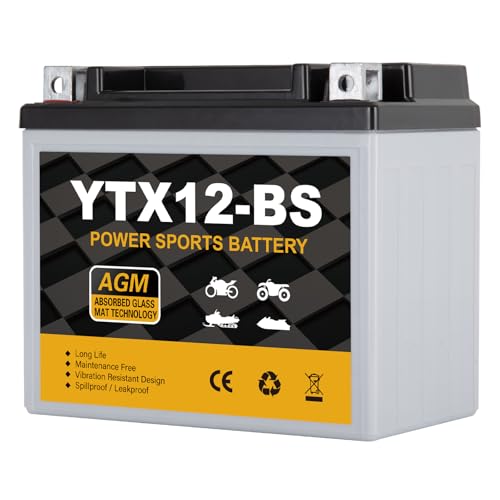
Battery families such as YTX4L-BS, YTX7A-BS, YTX9-BS, YTZ7S-BS, YTZ10S, and YTX12-BS describe particular size and connection patterns, but replacement listings can still vary in how dimensions are reported. Measure the old battery’s length, width, and height. Also compare positive and negative terminal positions, terminal hardware, and the available clearance around the case.
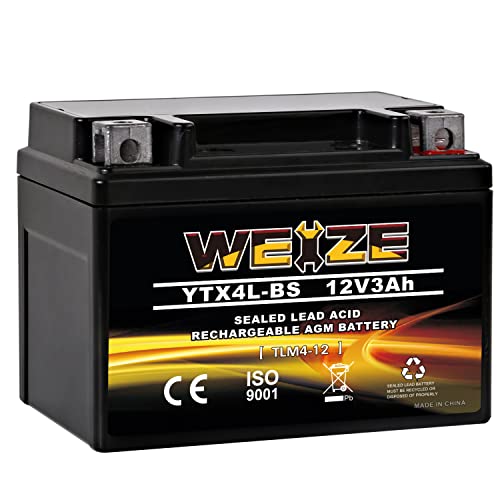
The Weize YTX4L-BS and ZIPPBATTERY YTX4L-BS are compact choices for scooters that use that small format. The ExpertPower YTX7A-BS GEL Battery and TYKOOL YTX7A-BS-Pro Lithium Battery are different chemistry options in the YTX7A-BS family, but they are not interchangeable solely because the model codes appear similar. The TPE YTZ7S-BS and ExpertPower YTZ10S AGM Battery belong to different formats and require their own fitment checks.
Match voltage and starting output
Most selected products list 12V operation, while the TYKOOL model lists 12.8V. That difference is important: the TYKOOL listing specifically requires a qualified regulator with output below 15.0V. Do not assume that a lithium replacement is suitable for every scooter that accepts a similar-looking lead-acid battery.
Cold-cranking amps, or CCA, indicate the listed starting-output rating. Higher CCA can be useful where the scooter’s requirements call for it, but it does not override size or terminal compatibility. The TPE model lists 380 CCA, TYKOOL lists 240 CCA, ExpertPower YTZ10S lists 220 CCA, and UPLUS lists 210 CCA. Smaller batteries such as Weize list 80 CCA. Compare the replacement with the original specification rather than selecting the largest number.
Capacity is another relevant specification. UPLUS lists 12Ah, Daakmax lists 10Ah, and ExpertPower YTX9-BS lists 9Ah. The small-format ZIPPBATTERY lists 4Ah. Capacity differences may reflect different battery sizes and intended applications, so they should be considered alongside the scooter manufacturer’s requirements.
Choose AGM, gel, or lithium deliberately
Sealed AGM batteries use absorbed glass mat construction and generally avoid routine water refilling or acid handling. In this group, the ExpertPower YTX9-BS, CB CHROMEBATTERY YTX9-BS, Daakmax YTX12-BS, UPLUS YTX14AH-BS, ExpertPower YTZ10S, Weize YTX4L-BS, and ZIPPBATTERY YTX4L-BS all document sealed AGM or sealed lead-acid designs. Their listed benefits include spill resistance, maintenance-free operation, and, in several descriptions, vibration resistance.
The ExpertPower YTX7A-BS GEL Battery uses gel construction rather than AGM. Its listing describes a factory-activated, maintenance-free design and identifies scooter applications including 150cc models. This can be a reasonable choice when the scooter is specified for that battery format and gel chemistry.
Lithium models can reduce weight, but their installation requirements deserve extra attention. TYKOOL lists a 1.8-pound design, a smart BMS, and a dedicated LiFePO4 charger requirement. TPE lists a 1.54-pound design and a built-in BMS, while also requiring a suitable lithium iron phosphate charger. A lead-acid charger with pulse or desulfation modes may be unsuitable for TYKOOL, according to its listing. Confirm the charging system before changing chemistry.
Consider protection and storage needs
For scooters exposed to vibration or outdoor conditions, review the construction details rather than relying on a general label. TYKOOL documents IP66 protection and a flame-retardant ABS housing. TPE documents BMS safeguards against overcharging, over-discharging, short circuits, and overheating. The selected AGM listings commonly describe sealed, spill-proof, or vibration-resistant construction.
Low self-discharge is mentioned for several models, including ExpertPower YTX9-BS, TYKOOL, Weize, and ExpertPower YTX7A-BS. That specification may be useful for vehicles stored between rides, but the listings do not establish a universal storage interval. Follow the battery maker’s charging and storage instructions.
Check installation and warranty details
Some products state that they arrive charged or factory activated. ZIPPBATTERY says its battery is fully charged and ready to connect, while ExpertPower YTX9-BS and ExpertPower YTX7A-BS GEL Battery describe factory-charged or factory-activated setup. Even so, inspect the battery, confirm polarity, and follow the manufacturer’s installation instructions.
Warranty terms vary. UPLUS lists 15 months, CB CHROMEBATTERY and ZIPPBATTERY list 18-month manufacturer coverage, and several ExpertPower models list one year. Warranty length is only one part of the decision; retain purchase documentation and check the applicable conditions before relying on it.
Final recommendation
ExpertPower YTZ10S AGM Battery ranks first overall in this specification-based comparison under the published weighted criteria.
The final choice among the best powersports scooter batteries depends on the documented features that match your intended use.
TYKOOL YTX7A-BS-Pro Lithium Battery is the highest-scoring returned product and the first overall specification-based choice. Its listed 240 CCA, low weight, LCD readout, smart BMS, and IP66 protection create the most specification-aligned feature profile, provided the scooter’s regulator and charger meet its requirements.
Among the top powersports scooter batteries using conventional AGM construction, UPLUS YTX14AH-BS is a strong high-capacity option, while ExpertPower YTX9-BS is a balanced choice for the YTX9-BS format. ExpertPower YTZ10S suits compatible YTZ10S applications with 220 CCA. For compact scooters, Weize YTX4L-BS and ZIPPBATTERY YTX4L-BS offer small cases with sealed AGM designs. The right selection remains the model that matches the scooter’s documented size, polarity, voltage, and chemistry requirements.
Frequently Asked Questions
What should I verify before buying the best powersports scooter batteries?
Verify the battery model or equivalent, case length, width and height, terminal position, terminal type, voltage, and the scooter manufacturer’s required capacity or CCA. If switching from lead-acid to lithium, also verify regulator compatibility and charger requirements.
Are AGM and gel batteries interchangeable?
Not automatically. AGM and gel are different battery constructions, even when their cases appear similar. The ExpertPower YTX9-BS and ExpertPower YTX7A-BS GEL Battery illustrate why chemistry and model format should both be checked against the scooter’s requirements.
Is a lithium scooter battery always a better choice?
No. Lithium can offer lower listed weight and high starting-output specifications, as shown by TYKOOL and TPE, but those models require suitable charging equipment and electrical-system compatibility. A sealed AGM battery may be the more straightforward replacement when the original system is designed for it.
Which selected battery is suited to a small scooter?
The Weize YTX4L-BS and ZIPPBATTERY YTX4L-BS are compact options with scooter application references. They should be considered only when the scooter uses the YTX4L-BS format and the listed dimensions and polarity match the original battery.
Does higher CCA guarantee a better replacement?
No. CCA is only one specification. Fitment, terminal layout, voltage, chemistry, capacity, charging compatibility, and installation requirements all matter. A battery with higher listed CCA is not suitable if it cannot be installed correctly or supported by the scooter’s electrical system.