Buying Guide
The best slr camera batteries are not universal accessories. They are keyed to a battery family, voltage range, and camera design, so the first step is to remove the existing battery and read its model code. A camera body name alone is not enough when manufacturers offer several nearby battery formats.
Match the battery code first
Compatibility is the most important screening point.
Nikon users should pay close attention to the distinction between EN-EL3e, EN-EL9, and EN-EL14A. The ANCBD EN-EL3e kit lists cameras such as the D50, D70, D80, D90, D200, D300, and D700. EN-EL9 kits instead list the D40, D40x, D60, D3000, and D5000 families. The ecoEfficiency EN-EL14A pack lists Nikon D3100 through D5600 models and DF. These battery codes should be treated as separate systems even when the products have similar lithium-ion descriptions.
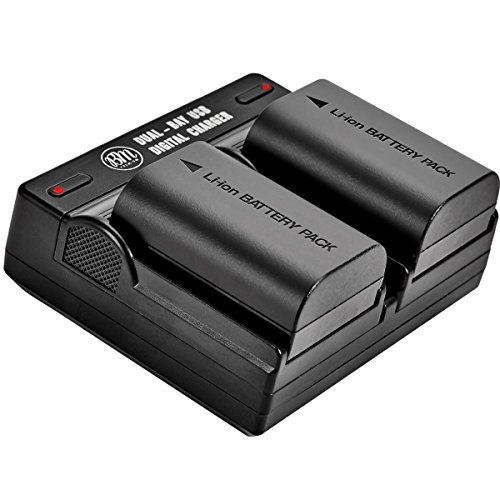
Sony owners in this selection are served by the BM Premium NP-FM500H two-pack. Check the battery label in your camera kit before ordering, particularly if your body is an older or regional model.
Compare capacity and electrical details
Capacity is normally expressed in milliamp-hours, or mAh. A higher stated number indicates more stored charge on paper, but it is not a guarantee of a particular number of photographs or recording time. Camera settings, flash use, image review, temperature, lens choice, and battery age all affect actual use.
The selected products provide useful comparisons. The Powerextra Pro EN-EL9 and ANCBD EN-EL9 products also state 2000mAh. The ecoEfficiency EN-EL14A batteries list 1030mAh. Voltage and watt-hour data are also useful when supplied, especially for checking whether a replacement follows the intended battery specification.
Do not compare mAh across unrelated battery families as if the figures were directly interchangeable. A 2000mAh EN-EL9 is not a substitute for a 2000mAh NP-FM500H. The connector, physical shape, electronics, and camera communication all matter.
Decide whether you need batteries, a charger, or both
A battery-only pack can be sensible when you already own a working charger. The BM Premium NP-FM500H product is an example: it supplies two batteries but does not list a charger in the package. The ecoEfficiency EN-EL14A listing also focuses on a two-battery replacement pack rather than identifying a charger. These products keep the purchase focused, but they are less convenient for someone replacing an entire charging setup.
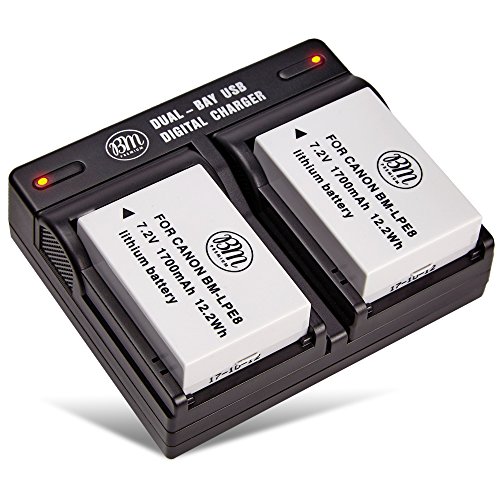
Complete kits add a charger and may be better for a first replacement purchase. Dual-slot designs can charge two batteries at once, while conventional AC chargers may be simpler for indoor use.
Input type is another practical distinction. The ANCBD EN-EL3e and EN-EL9 chargers accept both USB-C and Micro-USB input. Other products use Micro-USB or a foldable AC plug. USB charging can work with a suitable wall adapter, car adapter, laptop, or power bank, but the listing does not mean those power sources are included.
Consider protection and warranty wording
Replacement battery listings commonly describe protection against overcharging, short circuits, excessive temperature, over-voltage, over-current, or surges. These are useful design specifications to compare, but they are not a substitute for correct compatibility or proper charging equipment. Use the charger intended for the battery family and stop using a pack if it becomes damaged or unusually hot.
Warranty terms vary. A warranty can be useful when evaluating replacement products, but the supplied listing information does not establish how a claim is handled.
Choose the right pack size
They also provide a straightforward backup for travel or longer sessions. A single replacement may be enough for occasional use, especially if you already have an original battery and charger. The best slr camera batteries for one photographer may therefore be a complete two-pack, while another photographer may prefer a battery-only option.
Also check what is actually in the box. Some kits include a cable, cleaning cloth, or charger, while battery-only packs do not. The charger and cable can add convenience, but neither changes the camera compatibility of the battery itself.
Final recommendation
ANCBD EN-EL3e 2-Pack with USB-C Dual Charger ranks first overall in this specification-based comparison under the published weighted criteria.
The final choice among the best slr camera batteries depends on the documented features that match your intended use.
For Nikon EN-EL3e users, the ANCBD two-pack with USB-C dual charger is a strong alternative, particularly for travel and flexible charging. Nikon EN-EL14A owners may prefer the ecoEfficiency two-pack when their camera matches the supplied compatibility list.
These are specification-based recommendations, not hands-on test results or summaries of customer opinions. Before choosing among the top slr camera batteries, verify the code printed on your current battery, confirm the exact camera model in the compatibility list, and check whether you need a charger included.
Frequently Asked Questions
How do I identify the best slr camera batteries for my camera?
Remove the current battery and read its model code. Match that code to the replacement listing and then confirm your exact camera model. For example, EN-EL9 products in this guide list Nikon D40, D40x, D60, D3000, and D5000 cameras, while EN-EL3e products list a different Nikon camera group. Do not rely only on brand or similar-looking battery shapes.
Is a two-pack better than one replacement battery?
A two-pack provides a spare while the other battery is installed or charging. It is particularly useful for travel and longer photo sessions. However, a single battery may be sufficient if you already own a reliable original pack and charger. The decision depends on your shooting routine, existing equipment, and whether the replacement is sold with a charger.
Do all camera battery chargers support USB-C?
No. Other kits use Micro-USB or an AC wall plug. Check the charger specification and remember that a compatible wall adapter, car adapter, or power bank may be required separately.
Does a higher mAh rating guarantee longer camera use?
No. A higher stated capacity can indicate more stored charge within the same battery family, but actual camera runtime also depends on camera settings, flash use, image review, temperature, and battery condition.
Are protection circuits and warranty details important?
They are useful specifications when comparing replacement batteries. The products here describe protections such as overcharge, short-circuit, over-temperature, over-voltage, or surge protection, and many list one-year coverage. These details do not remove the need to use the correct battery code and compatible charger.