Buying Guide
When shopping for the best business mailing envelopes, the right choice depends on how your office actually sends documents. Focus on size, paper weight, closure type, and privacy features before you look at pack quantity. Together, those four specifications determine whether an envelope will handle your daily workflow or create friction at the mailroom bench.
Match the Envelope Size to the Documents You Send
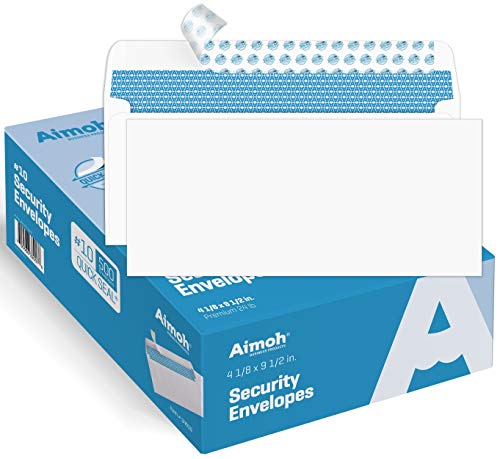
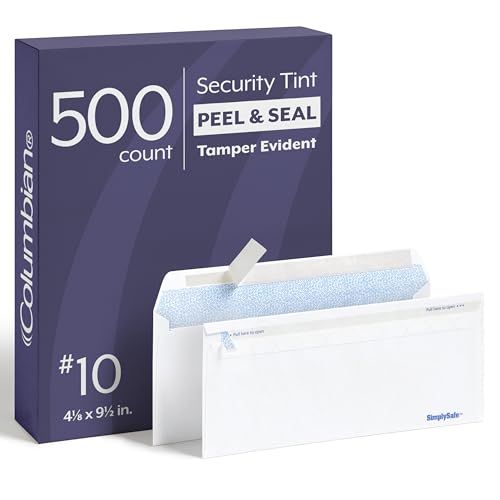
Most office correspondence is built around the #10 business envelope, which measures 4-1/8" x 9-1/2" and is designed to hold an 8-1/2" x 11" sheet folded into thirds. If you send invoices, statements, checks, or letter-size contracts, a #10 envelope is almost always the right starting point. Within this guide, every product except the Quality Park #6 3/4 uses the #10 format, which keeps comparisons consistent.
If your workflow includes remittance slips, payment cards, or small return envelopes, a smaller #6 3/4 envelope (3-5/8" x 6-1/2") is a useful complement. The Quality Park #6 3/4 is the small-format option here and pairs well with #10 envelopes for two-way billing systems. Choosing between the two sizes comes down to the paper you actually mail rather than a single universal standard.
Decide Between Windowless and Window Designs
Every product in this comparison is windowless, which gives you maximum flexibility for printed or handwritten addresses, logos, and barcodes. Windowless envelopes also keep the full front surface available for branding. If you print addresses through accounting or mailing software, windowless designs avoid alignment problems and let you reposition labels without reprinting the whole envelope.
Evaluate Paper Weight and Durability
Paper weight is one of the clearest specification signals of build quality. A 24-pound sheet is thicker than standard copy paper and holds up better through postage machines and stacking.
Choose the Right Closure Type
Closures fall into two practical categories: peel-and-seal and moisture-activated gummed seals. Peel-and-seal designs, including Redi-Strip, Release & Seal, and Press-It Seal-It styles, are documented across most picks here, including the Amazon Basics self-seal, Quality Park #10, Columbian #10, Aimoh, SUNEE, HERKKA, Splendoress, and Quality Park #6 3/4. They are faster for high-volume mailings because no sponge or moisture is needed.
Gummed seals, like the one on the Amazon Basics gummed envelopes, rely on moisture to create a traditionally secure closure. They are documented as slower per envelope but remain common in billing departments that value a permanent seal. If your team sends dozens of envelopes a day, peel-and-seal is generally more efficient; if sealing speed is less important than a classic feel, gummed seals remain a valid specification choice.
Look at Privacy and Security Features
For checks, legal notices, and medical or financial statements, security features matter. Most products in this comparison document an interior security tint that obscures contents when held to light. Some, like the Columbian #10 and HERKKA #10, document a stronger pattern or heavier tint coverage. If privacy is your primary concern, compare the tint descriptions directly and favor windowless designs that keep every printed line inside the envelope.
Confirm Printer and Label Compatibility
If you address envelopes through a laser or inkjet printer, check whether the product documentation mentions printer compatibility. Several picks here, including Aimoh #10 100-count, Splendoress, SUNEE, and HERKKA, explicitly state compatibility with both laser and inkjet printers. Side-seam construction, documented on the Quality Park #10 and Columbian #10, helps create a smooth printing area. If you primarily use labels, plain windowless envelopes work equally well, but printer-tested surfaces reduce paper jams.
Plan Around Pack Quantity
Pack quantity affects how often you reorder and how much storage you need. Bulk 500-pack options, such as Amazon Basics self-seal, Amazon Basics gummed, Columbian, Aimoh 500-count, SUNEE, HERKKA, and Splendoress 500, suit busy mailrooms. Smaller 100-pack options, including Quality Park #10, Aimoh 100-count, and Quality Park #6 3/4, are easier to store and a better specification match for smaller teams that mail less frequently. There is no single right answer, but matching pack size to monthly mail volume prevents both shortages and overstock.
Build a Specification Checklist
Before you finalize a pick, write down the size, closure type, paper weight, security features, and pack quantity you need. Cross-reference that list with the documented specifications in this guide, and you will land on one of the best business mailing envelopes for your specific workflow.
Final Recommendation
HERKKA #10 Security Self-Seal Envelopes, 500-Pack ranks first overall in this specification-based comparison under the published weighted criteria.
The Amazon Basics #10 Security Tinted Gummed Envelopes stand out as the first overall specification-based choice among the best business mailing envelopes, pairing a standard #10 format with 24-pound paper and a security tint in a 500-pack format. For offices that prefer peel-and-seal convenience, the Amazon Basics #10 Security-Tinted Self-Seal Envelopes and the SUNEE #10 Security-Tinted Self-Seal Envelopes are closely matched alternatives. Teams that prioritize stronger privacy documentation should look closely at the HERKKA #10 and Columbian #10 options, while small-format workflows benefit from adding the Quality Park #6 3/4 to a #10-centric setup. Together, these picks cover the most common specification profiles for the top business mailing envelopes used in offices across the United States.
Frequently Asked Questions
Among the best business mailing envelopes, what size envelope do I need for standard business mail?
For most office correspondence, a #10 business envelope measuring 4-1/8" x 9-1/2" is the correct specification. It holds a letter-size sheet folded into thirds and is the format used by nearly every product in this guide except the Quality Park #6 3/4. If you send smaller documents such as payment slips or cards, a #6 3/4 envelope (3-5/8" x 6-1/2") is the documented alternative.
Are peel-and-seal envelopes better than gummed envelopes?
Both are documented as functional, but they serve different workflows. Peel-and-seal closures are documented as faster because they do not require moisture, which is helpful in high-volume mailrooms. Gummed closures are documented as slower per envelope but are valued in billing departments that prefer a traditional, permanent seal. The best business mailing envelopes for your office depend on how many envelopes your team seals per day.
Does paper weight really matter for business mailing envelopes?
Yes, paper weight is one of the clearest specification indicators of durability. Most of the top business mailing envelopes listed here use 24-pound white wove paper, which is thicker than standard copy paper and holds up better through postal handling.
How do I choose between self-seal and security-tinted envelopes?
Self-seal refers to the closure style, while security tint refers to the interior privacy design. Many of the best business mailing envelopes combine both features, such as the Columbian #10, Aimoh #10, SUNEE #10, and HERKKA #10. If you send checks or sensitive statements, choose a self-seal envelope with a documented security tint and a windowless format. If you only need sealing speed, a self-seal envelope without a strong tint pattern may be sufficient.
Are windowless envelopes better for printing addresses?
Windowless envelopes are documented as more flexible for printed or handwritten addresses because the entire front surface is available. Several picks in this guide, including the SUNEE #10 and HERKKA #10, explicitly document compatibility with laser and inkjet printers. If your office prints addresses directly on envelopes or applies labels, a windowless design removes alignment issues and supports cleaner output.