Buying Guide
The best self-centering lathe chucks are not interchangeable simply because they share a 3-jaw or 4-jaw layout. The spindle connection, chuck diameter, jaw travel, through-hole, and intended material all affect whether a model is a sensible match. This comparison uses supplied listing specifications only. Scores reflect documented utility, not hands-on testing, independent measurements, customer opinions, or marketplace signals.
Match the chuck to the machine
Start with the spindle thread or mounting pattern. Several selected woodturning models use a 1 x 8 TPI thread, including the WEN LA4444, VINWOX SCR4-4, and WEN LA4374. The VINWOX model also lists a 3/4 x 16 TPI adapter. That does not mean it fits every wood lathe: the listing specifically directs buyers to verify the spindle thread before ordering.
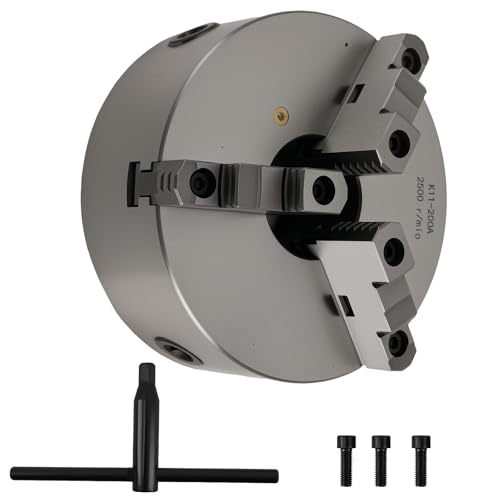
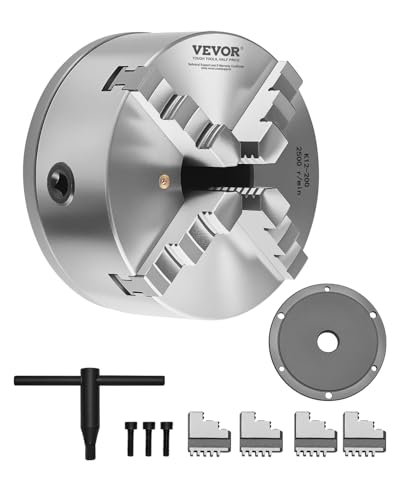
The larger machining-oriented models use different arrangements. The maXpeedingrods K11-200A lists a 180 mm bolt circle, three M10 mounting threads, and a 65 mm center through-hole. The VEVOR K11 200 uses a 2-1/4 in-8 threaded backing plate, while the VEVOR K12 200 uses a 1-1/2 in-8 threaded backing plate. These are materially different mounting systems. Confirm the spindle interface, backing plate, bolt circle, registration dimensions, and clearance before choosing by diameter alone.
The CME Tools 10-inch chuck has a plain back and requires a fitted backing plate. It may be a useful route for a prepared machine, but it is not the same ready-to-connect proposition as a model supplied with a threaded backing plate. The RATTMMOTOR K12-125 likewise requires careful review of its listed mounting details because its compact size does not establish universal compatibility.
Choose the right jaw layout
A 3-jaw self-centering chuck is often the straightforward choice when the workpiece is round or hexagonal and quick centering is important. The maXpeedingrods and VEVOR 3-jaw models document internal and external jaw use, with the larger options reaching up to 200 mm. The findmall K11-160 also lists internal and external jaw sets and several separate gripping ranges.
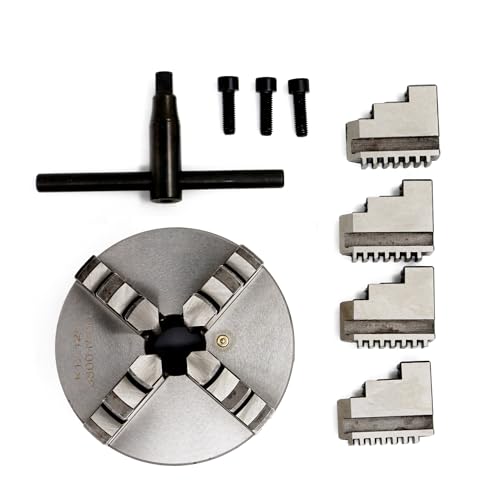
A 4-jaw self-centering chuck can provide a different gripping format and may be preferable when the listing documents reversible or two-direction jaw use. The CME chuck has two-piece reversible jaws, while the VEVOR K12 200 and RATTMMOTOR K12-125 are larger and compact 4-jaw examples respectively. For woodturning, the WEN and VINWOX sets use 4-jaw designs and list bowl, spindle, pilot-hole, or dovetail-jaw applications.
Do not confuse self-centering with independent jaw adjustment. The supplied products describe scroll or self-centering operation, but the evidence does not establish that every model provides independently adjustable jaws. If independent adjustment is essential for a particular setup, the listing should explicitly document it before purchase.
Compare capacity and through-hole size
Capacity should be checked against the actual workpieces, not just the chuck’s outside diameter. The VEVOR K11 200 and VEVOR K12 200 list 4-200 mm ranges, while the maXpeedingrods K11-200A lists 4-85 mm internal and 65-200 mm external handling. The CME 10-inch model documents a 0.24-9.84-inch workpiece outside range and a 3-1/8-inch through-hole, which gives it a different scale from the compact wood-lathe sets.
For smaller projects, the WEN LA4444 lists 1.6-2.8-inch internal clamping and 2-3.2-inch external support. The WEN LA4374 covers 1.25-2.5-inch internal workpieces and 1.75-3.125-inch pilot holes. The VINWOX SCR4-4 lists 1.5-3-inch internal jaws and external support from 2 to 3 5/8 inches. These ranges are useful for comparing project size, but jaw position, workpiece shape, and safe setup still matter.
A through-hole is especially relevant for bar work and long stock. The maXpeedingrods model lists a 65 mm center hole, the VEVOR 8-inch 4-jaw model lists a 65 mm inner diameter, and the RATTMMOTOR model lists a 30 mm through-hole. Where no through-hole specification is supplied, do not infer one from the chuck’s outside diameter.
Consider construction details
The industrial-size VEVOR models identify HT300 cast iron bodies, hardened jaws, and hardened scroll plates. The maXpeedingrods model describes precision-hardened steel construction, while findmall lists a cast iron body with ground and hardened jaw teeth and guides. CME describes quench-hardened steel inner mechanisms. These details help distinguish documented material and treatment choices, but they are not proof of real-world service life.
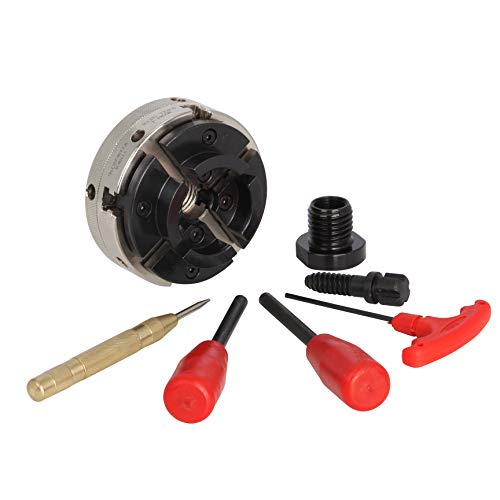
Wood-lathe models emphasize different features. VINWOX lists a K1045 steel body, nickel plating, ground teeth, and machined guideways. The VEVOR 4-inch wood chuck lists high-hardness steel and a nickel-plated finish. The WEN models focus more on compact project capacity and thread compatibility than on detailed hardness specifications. Choose the level of construction documentation that fits the work, while remembering that compatibility and correct workholding remain priorities.
Check operation and included components
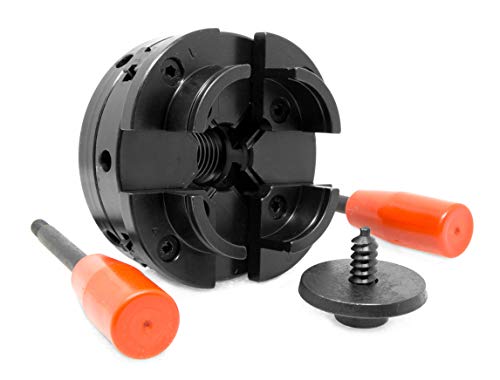
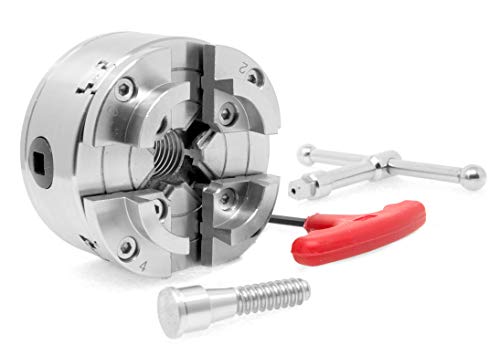
Included tools can affect setup convenience, but they should not substitute for fit verification. The VEVOR machining chucks list T-shaped tools, the WEN LA4444 includes a screw chuck, and the VINWOX set includes a screw chuck, adapter, levers, and T Allen wrench. The RATTMMOTOR listing includes a locking wrench and identifies forward and reverse jaw arrangements.
The stated maximum speed on the RATTMMOTOR model is 3000 r/min. Treat that as a product-listing specification and compare it with the machine, workpiece, jaw position, and operating instructions. It is not an independent safety or performance endorsement. Larger chucks may also demand more machine capacity; the VEVOR K12 200 is listed at the current price, so weight and clearance deserve attention.
Final recommendation
maXpeedingrods K11-200A 8-Inch 3-Jaw Chuck ranks first overall in this specification-based comparison under the published weighted criteria.
The final choice among the best self-centering lathe chucks depends on the documented features that match your intended use.
maXpeedingrods K11-200A 8-Inch 3-Jaw Chuck is the highest-scoring returned product and the first overall specification-based choice. Its combination of stated ≤0.05 mm accuracy, 4-200 mm overall capacity, reversible hardened jaws, 65 mm through-hole, and explicit mounting dimensions gives it the most specification-aligned evidence profile in this comparison.
The top self-centering lathe chucks still divide into clear use cases. Choose the VEVOR K11 200 or VEVOR K12 200 when the listed backing-plate thread and 8-inch format match your machine. Choose CME Tools 10-inch when you need the largest documented range and already have a suitable backing plate. For compact precision specifications, RATTMMOTOR K12-125 is notable for its stated ≤0.03 mm repeatable positioning accuracy.
Woodturners should begin with spindle-thread compatibility. WEN LA4444 and WEN LA4374 are compact 1 x 8 TPI choices, while VINWOX SCR4-4 adds a documented adapter and screw chuck. The findmall K11-160 offers a useful 6-inch machining format with multiple jaw ranges, and the VEVOR K11-200 provides broad 200 mm capacity. In every case, verify the interface and workpiece range before ordering.
Frequently Asked Questions
What should I verify before buying the best self-centering lathe chucks?
Verify the spindle thread or backing-plate arrangement first, then compare chuck diameter, through-hole, jaw ranges, and machine clearance. A 1 x 8 TPI wood-lathe chuck is not automatically compatible with a 1-1/2 in-8 or 2-1/4 in-8 machining setup. Also check whether the selected model includes the required backing plate or requires one separately, as with the CME Tools 10-inch plain-back chuck.
Are 3-jaw or 4-jaw self-centering chucks better?
Neither layout is universally better. A 3-jaw model such as the maXpeedingrods K11-200A or VEVOR K11 200 offers a familiar self-centering arrangement and broad listed capacity. A 4-jaw model such as the VEVOR K12 200, CME Tools 10-inch, or WEN LA4444 may be preferable when its jaw arrangement, reversible sections, or woodturning format matches the work. Compare the documented jaw functions and ranges with your projects.
Do all selected chucks include a backing plate?
No. The VEVOR K11 200 and VEVOR K12 200 list threaded backing plates, while the CME Tools 10-inch chuck has a plain back and requires a fitted backing plate. Wood-lathe models such as WEN LA4444, VINWOX SCR4-4, and WEN LA4374 list spindle threads rather than the same style of industrial backing plate. Read the mounting specification closely instead of assuming that a plate is included.
How important is the stated clamping range?
It is important, but it is only one part of fit. Internal and external jaw ranges describe different ways to hold a workpiece, and the usable range can depend on the shape, pilot hole, jaw position, and safe operating setup. For example, the WEN LA4374 lists separate internal and external ranges, while the VEVOR 8-inch models give broad overall ranges. Use the relevant range for your workholding method and leave appropriate clearance.